
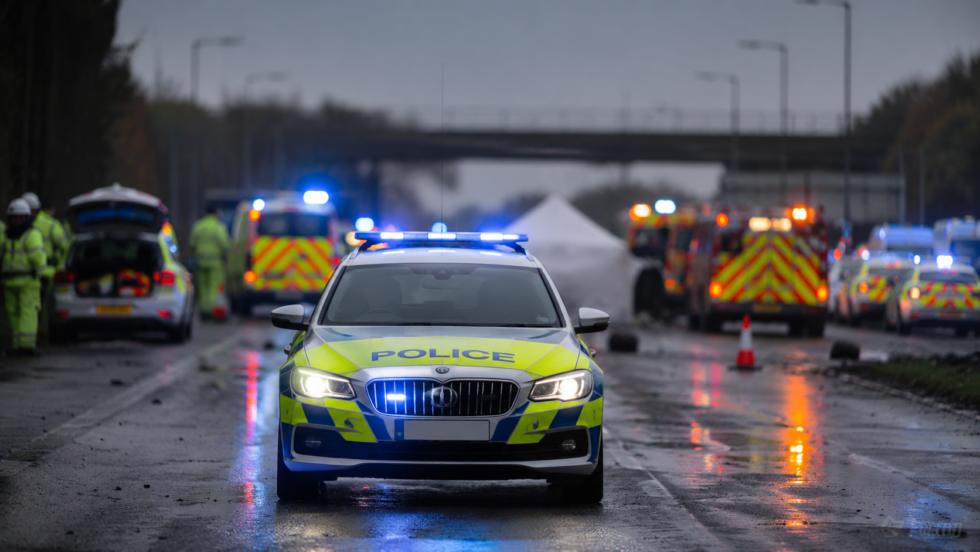
A66 South Bank became the scene of a fatal collision at 3.39am on Saturday, 22 August 2026, when a Volkswagen Passat travelling the wrong way along the A66 near Middlesbrough collided with a marked Cleveland Police vehicle travelling in the correct direction. Seven people died at the scene: two serving police officers and five members of the public in the Volkswagen. Cleveland Police later named the officers as PC Matthew Blades, 37, and PC Tom Clough, 38. The Independent Office for Police Conduct has opened an independent investigation because the crash followed earlier police contact with a vehicle described as suspicious. Those are the central confirmed facts in a case that left no survivors in either vehicle and prompted one of the largest emergency responses seen on Teesside that morning, The WP Times reports.
Police and the watchdog have established an initial sequence but have not yet provided a complete reconstruction of the minutes before the impact. The IOPC says Cleveland Police officers sighted a suspicious vehicle and a pursuit began before the car travelled on to the A66 in South Bank. Cleveland Police says the Passat was travelling in the wrong direction when it collided with a police vehicle travelling correctly along the same road. The force made a mandatory referral to the IOPC, which declared an independent investigation at 6.03am, less than two and a half hours after the collision. Investigators must now establish how the pursuit developed, how the Passat came to be travelling against traffic and exactly what happened immediately before the vehicles collided.
What happened in the A66 South Bank crash near Middlesbrough
The A66 crash happened in South Bank, on Teesside, at 3.39am. According to an official Cleveland Police statement, the Volkswagen Passat was travelling the wrong way along the A66 when it collided with a marked police vehicle heading in the correct direction. Two Cleveland Police officers were inside the police car and five members of the public were travelling in the Volkswagen. Every person in the two vehicles was pronounced dead at the scene.
The incident did not begin at the moment of impact. The Independent Office for Police Conduct says that, at an early stage of its inquiry, it understands Cleveland Police had sighted a suspicious vehicle and that a pursuit began. The vehicle then travelled on to the A66 in South Bank before the fatal collision. The watchdog has not yet published a full route, the reason the vehicle was considered suspicious or a definitive account of every police vehicle involved in the preceding operation.
The confirmed collision time is 3.39am on Saturday, 22 August 2026.
Reporting during Saturday added further detail, but not every element carries the same evidential weight. Sky News reported that the marked police vehicle involved in the fatal collision was a separate car from the vehicle involved in the initial pursuit. That distinction is significant because it affects how the final moments are understood, but it had not been set out in the IOPC’s initial public statement by Saturday evening. For that reason, it remains a reported detail rather than a formal investigative finding.
The sequence publicly established so far is:
- Cleveland Police officers sighted a vehicle regarded as suspicious.
- The IOPC says a pursuit began.
- The Volkswagen Passat travelled on to the A66 at South Bank.
- Police say the Passat was travelling against the correct flow of traffic.
- At 3.39am it collided with a marked Cleveland Police vehicle travelling in the right direction.
- Two police officers and all five occupants of the Passat died at the scene.
- Cleveland Police referred the incident to the IOPC, which opened an independent investigation at 6.03am.
There is therefore a clear distinction between what is known and what remains under examination. The wrong-way driving is confirmed by Cleveland Police. The earlier pursuit is confirmed by the watchdog. What has not yet been formally established is the precise relationship between the pursuing officers, the police vehicle struck by the Passat and the decisions made during the minutes before the crash.
Who were PC Matthew Blades and PC Tom Clough?
Cleveland Police named the two officers killed in the collision as PC Matthew Blades, 37, and PC Tom Clough, 38. Both were on duty when they died. Chief Constable Victoria Fuller said the deaths represented an “incredibly sad day for Cleveland” and described the two men as officers who had been serving and protecting local communities.
“These were brave officers protecting our communities and serving our residents who didn’t return home to their families at the end of their shift.” (Chief Constable Victoria Fuller, Cleveland Police, 22 August 2026)
Fuller said senior officers had visited the families of both men and that specialist support was being provided. Cleveland Police was also supporting colleagues and staff affected by the deaths. The force’s headquarters lowered flags to half-mast as tributes came from police organisations, emergency services and politicians across Britain.
The five people travelling in the Volkswagen Passat had also been formally identified by Saturday evening, according to later police reporting, although their names had not been publicly released in the material available at the time of publication. Family liaison officers were being deployed to support their relatives. Earlier media reports described the occupants as young males, but publication of names and further personal details remained a matter for the authorities and the bereaved families.
Seven people died in total: two serving Cleveland Police officers and five people travelling in the Volkswagen Passat.
The force has kept the first public accounts of Blades and Clough focused on their service and their families rather than releasing extensive career biographies. That is standard in the immediate aftermath of a fatal incident, when formal identification, family notification and investigative requirements take priority.
What is the IOPC investigating after the A66 police crash
The police crash automatically required independent scrutiny because deaths occurred following police contact. Cleveland Police made the mandatory referral, and the IOPC says it declared an independent investigation at 6.03am. Investigators were sent to post-incident procedures and began reviewing evidence on Saturday morning.
“Our role is to establish and examine the circumstances of what happened.” (Nicola Marfleet, IOPC Director of Investigations, 22 August 2026)
That wording is important. An IOPC investigation does not in itself mean misconduct has been established. Its purpose at this stage is to reconstruct the events surrounding police contact and determine what happened before the collision. Nicola Marfleet said the investigation was in its “very early stages” and that Cleveland Police was cooperating with inquiries.
Investigators are likely to focus on several connected questions:
- why the Volkswagen Passat first attracted police attention;
- where and when officers began following or pursuing it;
- what information was passed between officers and the control room;
- how the Passat reached the A66 carriageway in the wrong direction;
- which police vehicles were involved at each stage;
- the movements of the Passat and police car immediately before impact;
- whether police pursuit procedures and risk assessments were followed.
The watchdog has not yet published conclusions on any of those issues. Claims about the Passat’s speed, the exact number of police vehicles involved in the pursuit or individual decisions by officers should therefore be treated separately from established findings unless and until they are confirmed by investigators.
What evidence could establish the final sequence?
A serious Cleveland Police pursuit investigation can draw on several forms of evidence. These may include police radio traffic, command and control logs, vehicle tracking records, dashcam footage, body-worn video, CCTV, witness statements and forensic examination of the road and vehicles. The IOPC has confirmed only that investigators have begun reviewing evidence; it has not published an inventory of everything recovered in this case.
Electronic timestamps will be particularly important because the known sequence unfolded over a short period. They could establish when officers first saw the Passat, when a pursuit was authorised or recorded, when the Volkswagen entered the A66 and where individual police vehicles were positioned.
The physical collision scene can answer a different set of questions. Tyre marks, debris, vehicle deformation and final resting positions may help investigators calculate movement and points of impact. Those findings will need to be considered alongside digital and witness evidence before a complete chronology can be established.
What do the confirmed A66 crash facts show so far
The public record on Saturday evening contains enough information to describe the core event without filling the remaining gaps.
| Detail | Confirmed position |
|---|---|
| Location | A66, South Bank, near Middlesbrough |
| Date | Saturday, 22 August 2026 |
| Collision time | 3.39am |
| Vehicles | Volkswagen Passat and marked Cleveland Police vehicle |
| Passat direction | Travelling the wrong way |
| Police vehicle direction | Travelling in the correct direction |
| People killed | Seven |
| Police officers killed | Two |
| People killed in Passat | Five |
| Named officers | PC Matthew Blades, 37; PC Tom Clough, 38 |
| Earlier police contact | IOPC says a suspicious vehicle was sighted and a pursuit began |
| Independent investigation | Opened by IOPC at 6.03am |
The table also shows what cannot yet be stated as fact. There is no published IOPC conclusion explaining why the Passat was being driven on the wrong side of the A66. There is no final official account of the pursuit. There has been no determination of responsibility for the collision, and no investigative conclusion about the conduct of individual officers.
This distinction matters because searches for a66 crash today, “crash on A66” and “Middlesbrough crash” rapidly produced a mixture of official statements, eyewitness claims and breaking-news reports on Saturday. The authoritative baseline remains the Cleveland Police account of the collision and the IOPC account of the preceding police contact.
How large was the emergency response on the A66?
The scale of the collision produced a substantial emergency response in South Bank. North East Ambulance Service said it deployed 14 ambulance resources, including emergency ambulance crews, a specialist paramedic, the Hazardous Area Response Team and a doctor from the Great North Air Ambulance Service. Despite that deployment, all seven people in the two vehicles were pronounced dead at the scene.
The A66 was closed around the collision site while emergency services worked and investigators began examining the road. Local traffic was diverted away from the area, with the closure affecting the route through South Bank and Eston. Police urged drivers to avoid the scene while the investigation continued.
Emergency personnel were dealing not only with a fatal road collision but with the deaths of two serving officers. Cleveland Fire Brigade and police organisations later issued messages of support to Cleveland Police and the families of all seven people who died.
“No one should leave their home and not return safely, including police officers serving their communities and protecting the people of Cleveland.” (Chief Constable Victoria Fuller, Cleveland Police, 22 August 2026)
The chief constable also urged the public not to speculate. Similar calls came from political and policing figures throughout Saturday as investigators began gathering evidence.
Why does the A66 South Bank investigation matter beyond the collision itself
The A66 Middlesbrough case involves two distinct but connected investigations of fact. One concerns the fatal road collision itself: the position, direction and movement of the Volkswagen and the police car. The second concerns the police contact that preceded it, including the pursuit identified by the IOPC.
That does not make police actions responsible for the deaths. It means the independent watchdog must examine whether the contact was handled according to policy and whether any operational decision is relevant to the sequence that followed. The IOPC exists precisely so that this assessment is carried out independently of the police force involved.
The wrong-way movement of the Passat is another critical strand. Cleveland Police has stated clearly that the Volkswagen was travelling against the correct direction of traffic while the police vehicle was travelling correctly. What remains unknown is why the Passat entered or continued along the carriageway in that direction and at what stage during the earlier police contact this happened.
The investigation is therefore about the minutes before 3.39am as much as the moment of impact itself.
Some Saturday reports described the collision as occurring “during a pursuit”. That is broadly consistent with the initial IOPC account, which says a pursuit began before the car travelled on to the A66. However, whether the police vehicle struck by the Passat was actively participating in that pursuit at the moment of impact is a more specific question. Sky News reported that it was not the vehicle involved in the initial pursuit, a detail that should remain attributed until confirmed through the official investigation.
What remains unknown after the Middlesbrough A66 crash
Several of the most important questions were unanswered by Saturday evening. The authorities had not publicly explained what initially made the Passat suspicious. The IOPC had not released a detailed pursuit chronology. The five Passat occupants had been identified but had not all been publicly named in the available official material.
Investigators also had not announced findings on speed, pursuit tactics, road entry points or the actions of individual officers. None of those gaps changes the confirmed core account: a Passat travelling the wrong way on the A66 collided with a marked Cleveland Police vehicle travelling in the correct direction, killing all seven people in the two vehicles.
The next substantive update is most likely to concern the investigative chronology, further information released with the agreement of bereaved families, or evidence explaining how the Volkswagen came to be travelling against traffic. Until then, the official accounts from Cleveland Police and the IOPC remain the primary sources for the A66 South Bankcollision.
Materials used: Cleveland Police, Independent Office for Police Conduct, BBC News, Sky News, Channel 4 News.Read about the life of Westminster and Pimlico district, London and the world. 24/7 news with fresh and useful updates on culture, business, technology and city life: What is known about the August England bus pass change and who will have to wait longer to qualify