
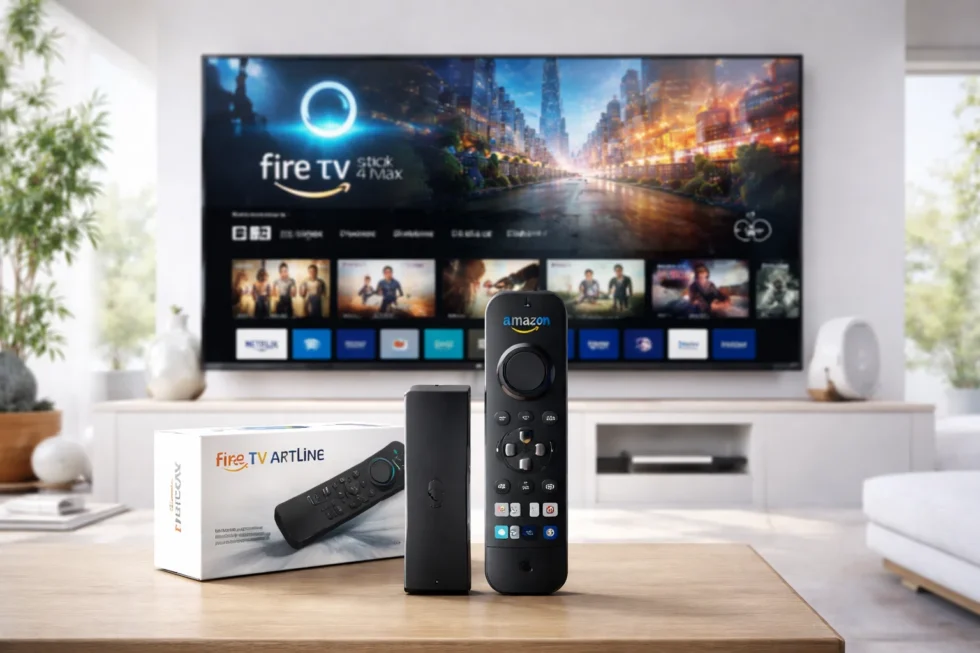
LONDON — Wednesday, 7 January 2026. Amazon’s newly announced Fire TV overhaul is now entering its first rollout phase, following the company’s 5 January launch of a rebuilt interface, a redesigned mobile app and the generative-AI powered Alexa+ system. The WP Times reports, citing Amazon product roadmaps, that the upgrade is being led by the Amazon Fire TV Stick 4K Max, which will be the first consumer device to receive the new software update in February, ahead of Amazon’s own smart TVs and partner brands including Panasonic, TCL and Hisense later this spring.
The Fire TV Stick 4K Max has been chosen as the first device to receive the upgrade because it combines Amazon’s fastest consumer hardware with Wi-Fi 6E and a more powerful processor, allowing it to run the new software architecture without compromising performance. From February, users of the device will be the first to experience what Amazon describes as a “ground-up rebuild” of how people find, watch and interact with television.
A platform redesigned around a single problem
Amazon’s decision to overhaul Fire TV was driven by one core statistic: modern viewers spend too long deciding what to watch. Data from Gracenote, referenced by Amazon, shows that households now spend an average of 12 minutes browsing for content before pressing play — up from 10.5 minutes in 2023. With more than 300 million Fire TV devices in circulation globally, Amazon concluded that the problem was not a lack of content but the difficulty of navigating it.
The new Fire TV interface is designed to eliminate the need to jump between apps. Instead of opening Netflix, Prime Video or BBC iPlayer separately, users will now see films, series, live television, sport and news grouped into dedicated content “homes” that pull results from all installed services at once. A film search, for example, will display titles from every subscription and free streaming service in a single feed.
Underneath the visual redesign, Amazon engineers have rewritten large parts of Fire TV’s codebase. The company says this has delivered speed improvements of between 20 and 30 per cent in many areas of the interface, reducing tile loading times, search delays and scrolling lag. These gains are particularly visible on the Fire TV Stick 4K Max, which uses a higher-performance chipset and faster networking than previous models.
Alexa+ brings artificial intelligence to TV discovery
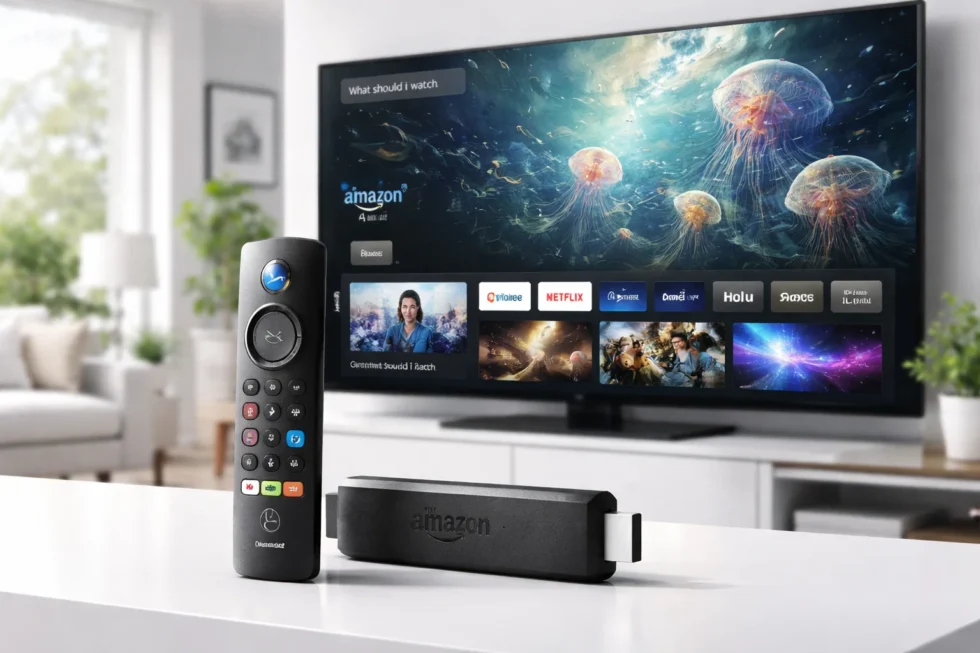
At the heart of the new system is Alexa+, Amazon’s generative-AI powered assistant for entertainment. Unlike the original Alexa, which relied largely on fixed commands, Alexa+ is designed to interpret natural language and contextual requests.
Viewers can now say, for example, “Find a thriller we can all watch,” or “Show me films with Cate Blanchett,” and Fire TV will produce curated results across all available services. More significantly, Alexa+ introduces scene-level navigation. If a user asks for “the courtroom scene” or “the final battle”, Fire TV can skip directly to that moment in a supported film on Prime Video.
Amazon says Alexa+ is already being used more than twice as often as the previous version of Alexa on Fire TV, which was one of the reasons it decided to expand the system into every part of the interface.
Turning Fire TV into a control centre
Fire TV is also being positioned as a hub for the connected home. A new shortcut panel, accessed by long-pressing the Home button, gives instant access to sound and picture controls, smart lighting, thermostats and Ring security cameras.
This means the Fire TV Stick 4K Max is no longer simply a streaming player, but a central controller for household technology, allowing users to adjust lighting, check door cameras or change audio settings without leaving what they are watching.
A rebuilt mobile app
Alongside the TV software, Amazon has relaunched the Fire TV mobile app. The new version allows users to browse content, manage watchlists and start playback remotely. Amazon says this reflects how people increasingly discover programmes via recommendations from friends, social media or messaging apps, rather than by sitting in front of the television.
The Ember Artline: Amazon’s lifestyle television
The most visually striking part of the launch is the Amazon Ember Artline, the company’s first so-called lifestyle TV. It is a 4K QLED television with Dolby Vision, HDR10+, Wi-Fi 6 and a matte anti-glare screen designed to resemble framed artwork when not displaying video.
The Artline includes motion sensors that automatically activate the display when someone enters the room and turn it off when the room is empty. In Ambient mode, it can show more than 2,000 free artworks or personal photos via Amazon Photos.
Amazon has also added an AI tool that allows customers to photograph their room and receive personalised art recommendations to match their interior design. Ten magnetic frames in colours such as walnut, pale gold and midnight blue allow the TV to blend into different living spaces.
Rollout and pricing
The new Fire TV interface will launch in February on the Fire TV Stick 4K Plus, the Fire TV Stick 4K Max (2nd generation) and the Fire TV Omni Mini-LED televisions. It will then expand to Amazon’s wider TV range and partner brands including Panasonic, TCL and Hisense later in the spring.
The Ember Artline will go on sale in the United States, the United Kingdom, Germany and Canada later this spring, starting at $899 for 55-inch and 65-inch models.
Amazon is shifting Fire TV from a collection of apps into a single operating layer that sits between viewers and every streaming service in the home. By centring this system on the Amazon Fire TV Stick 4K Max, the company is consolidating search, recommendations, live television, voice control and smart-home functions into one interface.
For users, this changes how content is accessed. Instead of moving between platforms, programmes, films and live broadcasts are surfaced through a unified discovery system that draws from multiple subscriptions at once. Scene-level voice navigation and AI-driven recommendations reduce the time spent searching and increase the precision of what is delivered to the screen.
For content providers, the redesign means that visibility is increasingly determined by the Fire TV interface rather than by individual apps. What appears first in search results, home screens and voice queries becomes the primary gateway to audiences.
With this update, Fire TV becomes the control layer of the modern living room, and the Amazon Fire TV Stick 4K Maxis the device through which that layer is deployed.
Read about the life of Westminster and Pimlico district, London and the world. 24/7 news with fresh and useful updates on culture, business, technology and city life: LEGO smart bricks: how the new connected Lego system is changing children’s play in Britain