
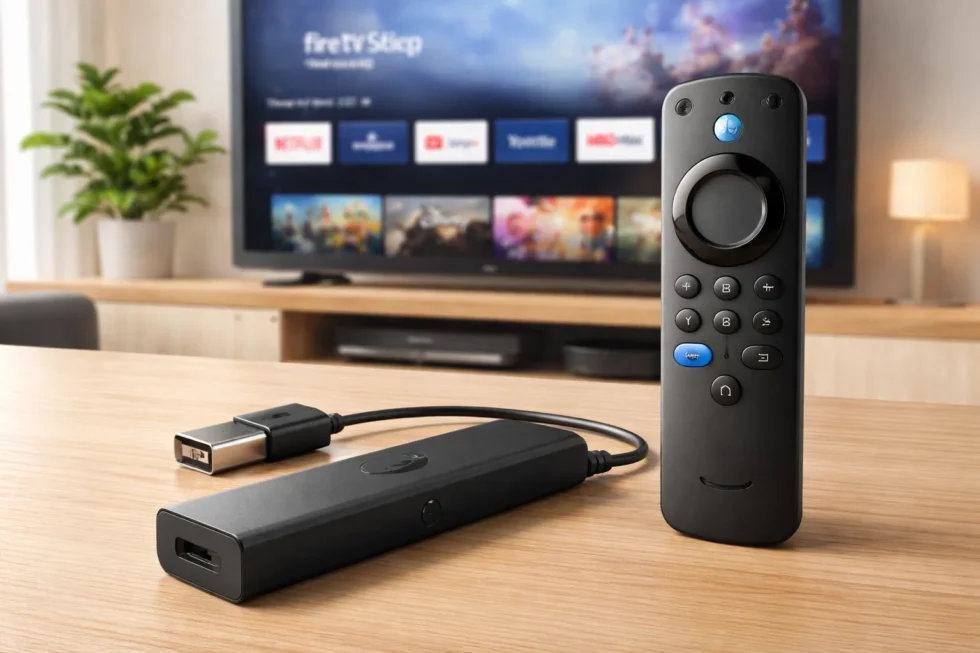
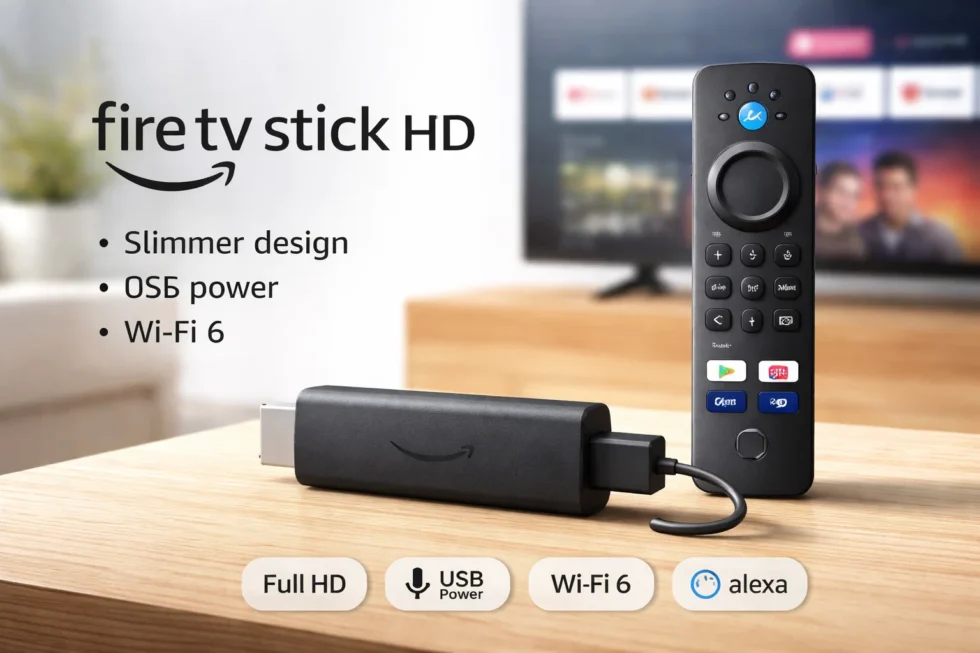
Amazon vega os fire tv has entered a new phase as Amazon unveiled its slimmest streaming device to date, the Fire TV Stick HD, with shipments scheduled from 29 April 2026 across the US, UK and multiple global markets. The device is around 30% slimmer than previous HD models, supports direct USB power from a television without a wall adapter, and integrates Alexa+ alongside a redesigned Fire TV interface aimed at faster access to films, series and live content, The WP Times reports.
The launch matters for two reasons. First, it is a clear hardware refresh aimed at people who want to upgrade an older HD television without buying a new smart TV. Second, it lands amid wider industry reporting that Amazon is moving Fire TV towards Vega OS, a Linux-based platform intended to reduce reliance on Android-based Fire OS, although Amazon’s own launch post for the Fire TV Stick HD focuses on the product, design, interface and Alexa+ rather than formally positioning the device as a Vega OS milestone.
Fire TV Stick HD launch details show Amazon is targeting price, portability and TV upgrades
The immediate consumer case for the new stick is straightforward: Amazon is trying to make entry-level streaming simpler, neater and easier to carry. The Fire TV Stick HD is pitched not as a flagship 4K box but as a lower-cost upgrade for people who still own HD televisions, use second screens in bedrooms or kitchens, or want a streaming stick they can throw into a bag for travel. Amazon says the device is narrow enough to fit more easily beside other cables and plugs behind a television, which addresses one of the most common practical annoyances with small streaming hardware.
The Direct Power feature is one of the most practical changes. Instead of relying on a wall plug in every setup, the Fire TV Stick HD can draw power directly from a TV’s USB port using the supplied cable. That reduces clutter, frees a socket and makes hotel-room or travel setup easier. Amazon also says the device can still be powered with a USB-C cable and wall adapter where needed, which matters for older televisions or cases where the included cable is not available. For ordinary buyers, the strongest selling points are not abstract software claims but immediate utility:
- lower entry price than more premium 4K models
- easier installation behind wall-mounted TVs
- fewer cables in everyday use
- more practical portability for travel or second homes
- a way to modernise an existing HD television instead of replacing it
That is where this launch has real consumer value. It is less about headline-grabbing innovation than removing friction from cheap streaming hardware.
Performance, Wi-Fi 6 and Bluetooth 5.3 add practical speed gains, not just marketing claims
Amazon says the Fire TV Stick HD is more than 30% faster on average than the previous-generation HD stick. In practical terms, that should affect the areas users notice first: boot-up time, loading apps, switching between services and browsing content-heavy menus. That claim also lines up with Amazon’s broader 2026 Fire TV refresh, which the company says was designed to make the interface cleaner, faster and better organised, while outside reporting has described the wider Fire TV software overhaul as a response to complaints about sluggishness and clutter.
The connectivity upgrades are also important because they change how stable the device should feel in busy households. Support for Wi-Fi 6 improves performance in environments where multiple devices are using the network at the same time, while Bluetooth 5.3 should help with more reliable pairing for accessories such as wireless headphones, speakers and some remotes. Amazon does not frame the stick as a high-end gaming or premium-cinema product, but these standards still matter because entry-level devices often feel outdated fastest when wireless performance is weak.
Here is the core specification picture from Amazon’s launch material:
| Feature | What Amazon says |
|---|---|
| Launch date | Preorder from 15 April 2026 |
| Shipping | From 29 April 2026 |
| US price | $34.99 |
| Size | About 30% slimmer than previous HD stick |
| Speed | More than 30% faster on average than last-gen HD stick |
| Wireless | Wi-Fi 6 |
| Bluetooth | Bluetooth 5.3 |
| Power | TV USB port, or USB-C plus wall adapter |
| Alexa+ | Included in US, Canada and UK |
The user benefit here is clear: if someone’s current HD streaming setup feels slow, basic navigation takes too long or a television still lacks a decent smart interface, this is the exact pain point Amazon is trying to solve.
Alexa+ and the redesigned Fire TV interface are central to Amazon’s pitch
Amazon is not selling this stick on hardware alone. The company is pairing the device with a broader software and AI push around Alexa+ and the redesigned Fire TV experience. In the US, Canada and the UK, Amazon says Alexa+ on Fire TV can offer more personalised recommendations through natural conversation, help users find a title based on a scene description, identify actors on screen and control connected smart-home devices from the television interface.
That matters because streaming platforms now compete not just on app support but on how quickly users can decide what to watch. Amazon’s own description of the new interface stresses clearer organisation into categories such as movies, TV shows, live content, sports and news. The aim is to reduce the “scroll forever” problem that defines much of modern streaming. The broader Fire TV redesign announced earlier in 2026 also added more structured top navigation and faster responsiveness across the platform.
Amazon has also been expanding Alexa+ internationally. The company said the UK became the first country in Europeto get Alexa+, and Italy has since followed through an Early Access launch, where Amazon said the assistant would later be included for Prime members and cost €22.99 per month for non-Prime users after the programme ends. That wider rollout is relevant because it shows Amazon is not treating AI on Fire TV as a one-market experiment. A practical user-facing reading of this is:
- the stick itself is cheaper hardware
- the interface refresh is meant to cut search time
- Alexa+ is Amazon’s answer to content overload
- Fire TV is being repositioned as an entertainment hub plus smart-home control point
That is strategically more important than the physical size reduction alone.
Where Amazon vega os fire tv fits in — and what is confirmed versus reported
This is the part where the article needs precision. Amazon’s official product post does not explicitly market the Fire TV Stick HD as a “Vega OS device”. It focuses on design, performance, markets, the new Fire TV interface and Alexa+ features.
However, the phrase Amazon vega os fire tv is in the conversation because several well-followed technology outlets have reported that Amazon is shifting future Fire TV hardware towards Vega OS, a Linux-based operating system developed in-house. The Verge reported in late 2025 that Amazon was preparing to roll out Vega on Fire TV devices and had already used the platform in some Echo products, while Lowpass and Android Authority reported in April 2026 that the new Fire TV Stick HD is Amazon’s second streaming stick associated with Vega OS. That distinction matters for journalism and for readers. What can be safely said is this:
- Amazon officially launched the Fire TV Stick HD and disclosed its specifications.
- Amazon officially confirmed the redesigned Fire TV experience and Alexa+ expansion.
- Industry outlets report that Amazon is using this period to move Fire TV hardware towards Vega OS.
For users, the practical question is not just “what OS is underneath?” but “what changes for apps, compatibility and sideloading?” Android Authority reported that some customers were warned they would not be able to sideload apps on the new Fire TV Stick HD, which, if broadly applicable, could matter for more advanced users who rely on unofficial installs. That is not a mainstream feature for every buyer, but it is relevant context for people who use Fire TV devices more flexibly than Amazon intends.
(“The new Fire TV Stick HD is the second Amazon streaming stick to launch with Vega OS,” Android Authority, 19 April 2026)
(“Amazon releases second Fire TV stick with Vega OS, plans to bring it to all future models,” Lowpass, 16 April 2026)
Accessibility, travel use and regional rollout add more value than the headline alone suggests
One useful part of Amazon’s announcement is that it does not frame the device only around entertainment speed. The company also says the Fire TV Stick HD will receive an Adaptive Display accessibility setting in the coming months. Amazon says this feature will enlarge smaller on-screen items such as text and menus while scaling artwork proportionally to create a more balanced browsing experience. The stick also continues existing Fire TV accessibility features such as Dialogue Boost, Audio Descriptions and High Contrast Text. That makes the device more relevant for:
- older users who struggle with small menu text
- households using smaller secondary televisions
- users watching from further away in kitchens or bedrooms
- travellers who want a familiar interface on different screens
Amazon is also clearly building a wider international Fire TV push. The Fire TV Stick HD will ship first in the US, UK, Canada, Mexico, Japan, Australia and New Zealand, while users in Germany, France, Italy, Spain, the Netherlands, Belgium, Poland and Sweden are being directed to local Amazon sites to register interest and be notified when sales open. In Japan, Amazon says the Fire TV experience is also getting a dedicated anime hub, which shows how the company is using regional content habits to localise the interface.
What buyers should actually take from this launch now
For most readers, the key question is whether the Fire TV Stick HD is worth attention. Based on the facts Amazon has released, the answer is yes for a specific group of users: people with an older HD television, people who want a cheap second streaming device, and people who need something more portable than a box or full television replacement. It is not being marketed as the most powerful Fire TV product. It is being marketed as the neatest and easiest. That means the real strengths are:
- entry price
- smaller size
- easier power setup
- faster operation than the old HD model
- access to the new Fire TV software experience
- Alexa+ support in selected markets
The bigger story around Amazon vega os fire tv is strategic rather than cosmetic. Amazon is simultaneously refreshing Fire TV hardware, cleaning up the interface, expanding Alexa+ internationally and, according to industry reporting, continuing its move towards a more Amazon-controlled operating system stack. That combination suggests the company wants tighter control over the Fire TV ecosystem at the same time as it tries to make the everyday user experience more seamless.
Read about the life of Westminster and Pimlico district, London and the world. 24/7 news with fresh and useful updates on culture, business, technology and city life: When will fire tv blaster discontinue take effect and why are UK devices being disabled now