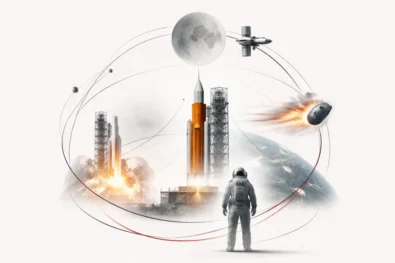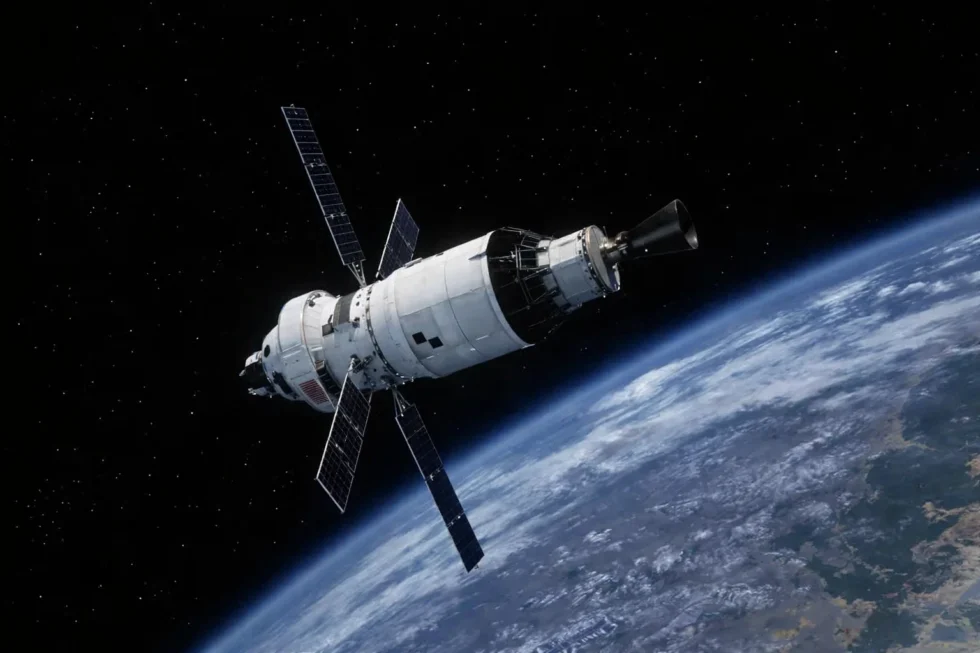
The crew of Artemis II has officially established a new milestone for humankind by becoming the farthest humans have ever traveled from Earth, reaching a peak distance of 252,752 miles (406,763 kilometers). This historic achievement, occurring in the lunar vicinity during the mission's high-altitude eccentric orbit, surpasses the long-standing record of 248,655 miles set by the Apollo 13 crew in April 1970 by approximately 4,102 miles. Commander Reid Wiseman, Pilot Victor Glover, and Mission Specialists Christina Koch and Jeremy Hansen are now operating the Orion spacecraft in a deep-space environment that provides critical data on radiation shielding and life-support stability for future Mars-bound missions.
For the global scientific community, this mission validates the Space Launch System (SLS) Block 1 capabilities and marks the definitive return of human presence to the lunar neighborhood after more than five decades, reports The WP Times, via NASA.
Technical Precision of the Lunar Free-Return Trajectory
The achievement of this record is a direct result of the Artemis II mission’s specific "hybrid" free-return trajectory, designed to test the Orion spacecraft's manual handling and deep-space navigation without a lunar orbit insertion. According to official NASA telemetry data, the spacecraft utilized the Moon’s gravitational pull to slingshot the crew into a Wide Earth Orbit (WEO), pushing the apogee significantly further than the Apollo-era missions.
Unlike Apollo 13, which reached its record distance out of a survival necessity following an oxygen tank explosion, Artemis II achieved its 252,752-mile mark as a planned stress test of the onboard communication systems with the Deep Space Network (DSN). This maneuver confirms that the ESM can maintain thermal regulation and cabin pressure even at the extreme edge of the Earth-Moon system.
"We are not just retracing footsteps; we are pushing the boundaries of where the human spirit and our technology can reside," stated NASA Administrator Bill Nelson during a live briefing from the Johnson Space Center.
A new milestone for humankind: The crew of Artemis II are now the farthest any human has ever travelled, reaching a maximum distance of 252,752 miles from Earth.
— NASA (@NASA) April 6, 2026
This surpasses the previous record set by Apollo 13 in 1970 by about 4,102 miles. pic.twitter.com/DbLFvvdEfT
Comparative Distance Records in Human Spaceflight
| Mission | Year | Max Distance from Earth (Miles) | Crew Size | Status |
| Artemis II | 2026 | 252,752 | 4 | Active/Record Holder |
| Apollo 13 | 1970 | 248,655 | 3 | Previous Record |
| Apollo 17 | 1972 | ~243,000 | 3 | Last Lunar Landing |
| ISS (Average) | 2026 | ~250 | 7 | Low Earth Orbit |
Radiation and Life Support: Practical Implications of Deep Space Travel
Operating at a distance of over 250,000 miles subjects the crew and the Orion spacecraft to significantly higher levels of galactic cosmic rays (GCRs) and solar energetic particles compared to the International Space Station. The Artemis II mission serves as a live laboratory for the "Hermes" radiation instrument suite, which monitors how deep-space environments affect biological tissues and electronic hardware over extended periods.
For future mission planners, the data gathered at this record-breaking distance is essential for designing the shielding requirements for the Artemis IV Lunar Gateway habitation modules. Engineering teams are currently analyzing the Orion’s ability to dissipate heat while exposed to direct solar radiation without the protective "umbrella" of Earth’s magnetosphere.
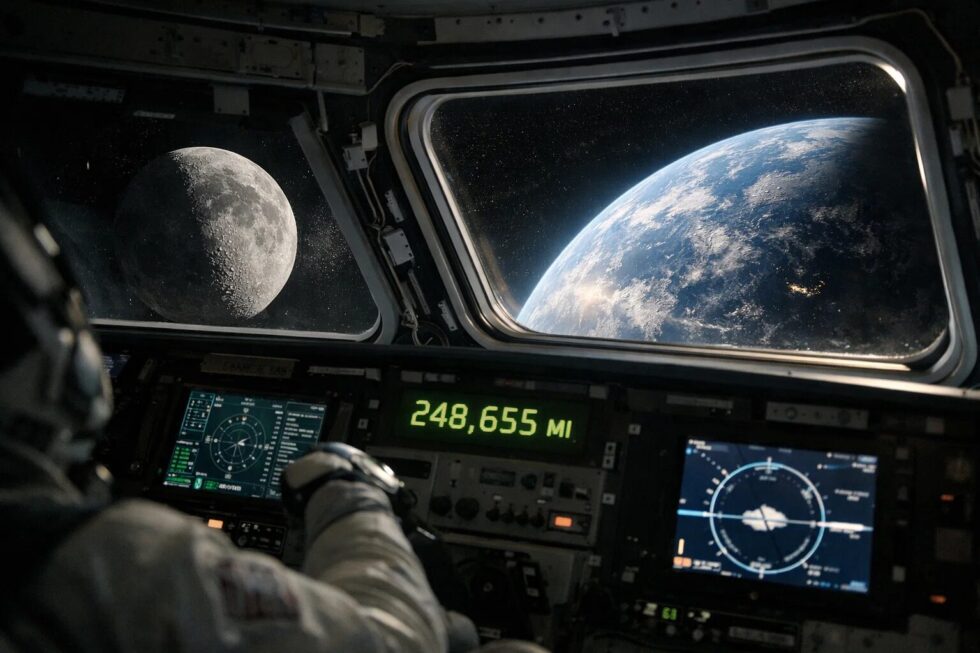
- Redundant Communication Protocols: Ensure high-gain antenna alignment is maintained via autonomous star-tracking to avoid signal loss at distances exceeding 250,000 miles.
- Radiation Shielding Verification: Utilize the water-storage shielding method implemented in Orion to protect crew quarters during solar flare events.
- Biological Monitoring: Track real-time heart rate variability and cognitive load of the crew to assess the psychological impact of the "overview effect" in total isolation.
- Hardware Stress Testing: Monitor the integrity of the ESM’s solar array drive mechanisms under extreme thermal cycling.
Economic and Geopolitical Significance of the Artemis Accords in 2026
The success of Artemis II in reaching 252,752 miles is not merely a scientific triumph but a validation of the Artemis Accords—a framework for international cooperation in space led by the United States and now signed by over 40 nations. This mission includes the first international astronaut, Jeremy Hansen of the Canadian Space Agency (CSA), signaling a shift from the solo-nation "Space Race" of the 20th century to a multi-national lunar economy.
According to the Bureau of Economic Analysis (BEA), the commercial space sector’s contribution to global GDP has grown by 7% in 2026, largely driven by lunar-adjacent contracts and infrastructure development. The ability of the Orion spacecraft to safely transport humans to this distance creates a "flight-proven" market for upcoming commercial lunar deliveries and private space station modules.
- International Collaboration: Integration of the CSA-provided robotic systems and European propulsion tech.
- Commercial Growth: Expansion of contracts for SpaceX, Blue Origin, and Lockheed Martin for the HLS (Human Landing System).
- Strategic Positioning: Establishment of norms for "safety zones" and resource utilization on the lunar surface.
- Resource Assessment: Preparation for the Artemis III mission, which will target the lunar South Pole for ice-water extraction.
Future Trajectory: From Artemis II to Mars Readiness
The distance record achieved today is the final "green light" required for Artemis III, the mission slated to land the first woman and person of color on the Moon. By successfully navigating 252,752 miles from Earth, NASA has proven that the current life support systems can sustain a crew for the 10-to-14-day duration required for a surface sortie. Furthermore, the telemetry gathered at this distance provides the baseline for the "Mars Forward" initiative, as it represents the first step in breaking free from the Earth-Moon gravity well.
The psychological resilience of the Artemis II crew, operating as a self-contained unit with a multi-second communication delay, offers a vital case study for the multi-month transit times required for a journey to the Red Planet.
- Risk of Micrometeoroid Impact: Use of reinforced Bumper Shields on Orion's exterior to protect against high-velocity debris.
- Communication Latency: Development of AI-driven onboard diagnostic tools to allow the crew to fix system errors without Houston’s immediate input.
- Psychological Isolation: Implementation of VR (Virtual Reality) environments to maintain crew morale during the deepest phases of the flight.
- Propulsion Failure: Utilizing the "free-return" geometry to ensure gravity brings the capsule back to Earth even if the main engine fails.
Frequently Asked Questions
Why did Artemis II go further than Apollo 13?
Artemis II used a specific Wide Earth Orbit trajectory that intentionally pushed the spacecraft beyond the lunar far side to test deep-space communication and radiation levels.
Is the crew in danger at this record distance?
While risks are higher due to radiation and distance from immediate rescue, the Orion spacecraft is equipped with advanced shielding and redundant life support systems far superior to those of the 1970s.
What is the significance of the 252,752-mile mark?
It represents the farthest distance any human-rated spacecraft has safely operated, providing a new "ceiling" for human exploration and testing the limits of the Deep Space Network.
Read about the life of Westminster and Pimlico district, London and the world. 24/7 news with fresh and useful updates on culture, business, technology and city life: Fuel Crisis 2026: UK Petrol Prices Hit Historic £3 Milestone Amid Middle East Tensions