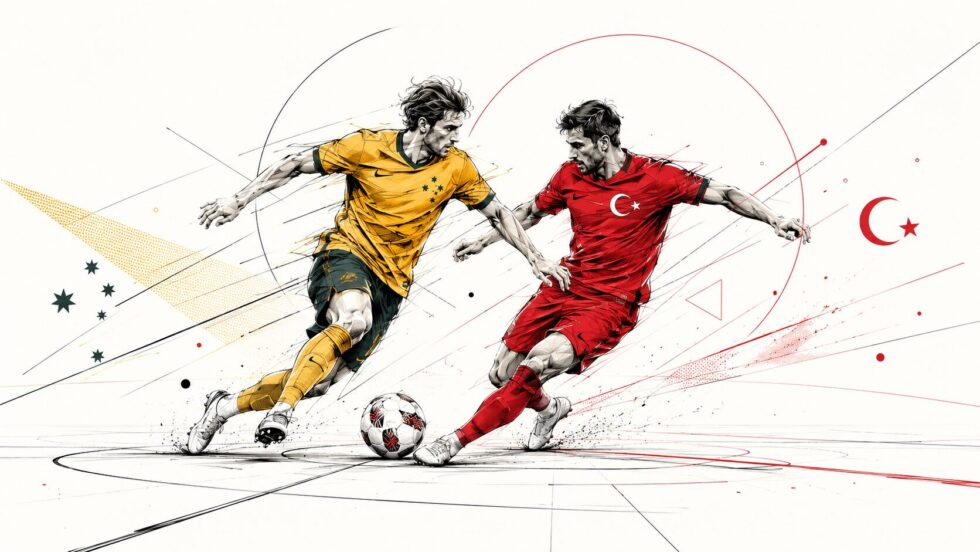
Australia vs Türkiye became one of the first major tactical shocks of the 2026 World Cup group stage as Nestory Irankunda fired Australia in front against Turkey at BC Place in Vancouver, finishing a sharp counterattack in the 27th minute after Paul Okon-Engstler released him into space. The Group D match was still live with Australia leading 1-0 in the second half, and the story was already bigger than the score: Tony Popovic had left out captain Mathew Ryan and vice-captain Jackson Irvine, trusted a young goalkeeper in Patrick Beach, and watched one of his youngest attacking players deliver the moment that changed the game, The WP Times reports.
For Turkey, this was supposed to be a confident return to the World Cup stage, built around Arda Güler, Hakan Çalhanoğlu and the possibility of Kenan Yıldız influencing the second half after injury concerns. Instead, Turkey controlled long spells of possession without finding the clean final pass, while Australia defended deep, stayed compact and attacked the spaces behind the Turkish line with Irankunda and Mohamed Touré. It was not a beautiful domination from the Socceroos, but it was disciplined, brave and tactically clear. In tournament football, especially in an expanded World Cup where early points can reshape a group, that can matter more than style.
Australia vs Türkiye live: what happened in the first half and why Irankunda’s goal changed the match
Australia vs Türkiye opened as a contest between Turkish possession and Australian structure. Turkey had more of the ball, moved it patiently through Çalhanoğlu and Güler, and tried to pull Australia’s block from side to side. Australia, however, were not interested in matching Turkey pass for pass. Popovic’s side defended with numbers, protected the middle of the pitch and waited for the one transition that could expose Turkey’s high positioning.
That moment arrived in the 27th minute. Beach made an important intervention, Australia moved the ball quickly, Okon-Engstler spotted Irankunda’s run, and the forward cut inside before finishing at the near post. It was the kind of goal that turns a tactical plan into a headline: direct, fast, clean and completely against the possession rhythm of the match. Irankunda then came close again before half-time, showing that Australia’s threat was not accidental but built around his pace and timing.
The key first-half pattern was clear:
| Match detail | What it meant |
|---|---|
| Australia 1-0 Turkey at half-time | The Socceroos had the result their defensive plan demanded |
| Irankunda goal, 27th minute | Australia punished Turkey’s slow possession with one rapid break |
| Okon-Engstler assist | Popovic’s midfield gamble immediately gained value |
| Beach save before the goal | The young goalkeeper justified his surprise selection early |
| Turkey possession advantage | Control of the ball did not become control of the penalty area |
| Yıldız introduced after half-time | Turkey needed more direct threat and individual quality |
The goal also changed the emotional tone of the game. Turkey had entered the match with the aura of a technically superior side, a team with European club pedigree and a midfield capable of controlling tempo. Australia, by contrast, looked like a side built on courage, athleticism and discipline. After Irankunda scored, Turkey were forced to chase, and Australia could retreat even deeper into a game state that suited them.
Why Nestory Irankunda became the key Australia player against Turkey
Nestory Irankunda was not just the scorer; he was the reason Turkey could not fully commit their back line forward. Every time Australia cleared or recovered possession, Turkey had to account for his speed in the left channel and his ability to turn one pass into a shot. That matters because Turkey’s attacking structure depends on territorial pressure. If their defenders and midfielders cannot squeeze the pitch, their possession becomes slower and less dangerous.
Irankunda’s finish also carried symbolic weight for the Australia national football team. The Socceroos have often been associated with physicality, set pieces and endurance, but this goal was about explosive attacking talent. It gave Australia a different image: young, fearless, fast and capable of hurting a major opponent without needing long spells of the ball. In a World Cup group featuring the United States and Paraguay as well, that profile could become crucial.
Tony Popovic’s Australia selection: why Ryan and Irvine being dropped became the biggest pre-match story
Tony Popovic’s team sheet was the first shock of Australia vs Turkey. Mathew Ryan, Australia’s long-serving captain and a 100-cap veteran, was left out of the starting XI. Jackson Irvine, another senior figure and vice-captain, was also not in the line-up. In their place came Patrick Beach in goal and Paul Okon-Engstler in midfield, two decisions that would have looked risky even in a friendly, never mind a World Cup opener.
The logic became visible once the game started. Beach was asked to be calm under pressure, command his box and make the save that keeps an underdog in the game. He did that. Okon-Engstler was asked to help Australia survive midfield pressure but also find forward passes when the rare chance arrived. He did that too, producing the assist for Irankunda’s goal. Popovic did not simply make changes for energy; he changed the identity of the team.
For a coach, these decisions are dangerous because they only look brave if they work. If Australia had conceded early, the absence of Ryan and Irvine would have been the story for the wrong reason. Instead, by half-time, the selections looked like a deliberate generational shift. Australia were not sentimental, not cautious and not built around past World Cup memories. They were younger, sharper and willing to live with risk.
The selection decisions created three immediate consequences:
- Australia played with more athletic urgency in transition.
- The team became less dependent on veteran rhythm and more dependent on structure.
- Turkey had to solve a younger, quicker opponent than expected.
- Irankunda and Touré gave Australia vertical threat from the start.
- Beach’s early save gave confidence to a defence sitting under pressure.
- Okon-Engstler’s assist made the midfield call central to the match narrative.
How Patrick Beach and Paul Okon-Engstler changed the match narrative
Patrick Beach’s selection ahead of Ryan was the type of call that dominates analysis before kick-off. Goalkeepers carry symbolic weight at World Cups because one error can define a national campaign. Beach did not need to be spectacular for 90 minutes to justify Popovic’s decision; he needed to make the first difficult moment look manageable. His first major save did exactly that and gave Australia the platform for the counterattack that followed.
Okon-Engstler’s role was just as important. Australia were not going to dominate midfield against Turkey, so his value was not measured by possession volume. It was measured by clarity when Australia finally had the chance to break. His pass for Irankunda was not merely an assist; it was the proof that Australia’s plan had a technical edge, not only defensive organisation.
Turkey vs Australia: why Güler, Çalhanoğlu and Yıldız still had work to do
Turkey vs Australia was also a test of Turkish patience. Arda Güler started as the creative reference point, Çalhanoğlu tried to dictate from midfield, and Turkey had enough technical quality to pin Australia back for long spells. Yet possession alone did not bring clear chances. Australia protected the central spaces, forced Turkey wide and challenged them to produce high-quality crosses or combinations in crowded areas.
The second-half introduction of Kenan Yıldız made sense because Turkey needed a different rhythm. Yıldız offers close control, acceleration and the ability to attack defenders directly from the left. His presence made Turkey more dangerous immediately, but it also confirmed the problem: Turkey needed individual disruption because their starting attacking structure had not done enough to break Australia down.
Turkey’s main issues were practical rather than dramatic:
| Turkey problem | Why it mattered against Australia |
|---|---|
| Slow circulation around the box | Australia had time to reset their defensive line |
| Limited runs behind the defence | Souttar and Burgess could defend facing the ball |
| Crosses without clear targets | Australia’s aerial defenders were comfortable |
| Güler forced into difficult shots | Creative possession became low-value shooting |
| Yıldız not starting | Turkey’s most direct attacking option arrived only after the break |
Turkey still had enough quality to rescue the game, but the match had moved away from their preferred script. When a technically superior side goes behind early, it must increase tempo without losing shape. That is difficult against a team like Australia, who are comfortable defending deep and waiting for the next break.
What the result would mean for Group D and Australia’s World Cup campaign
If Australia hold this lead, the result would be one of the most significant early statements of Group D. The Socceroos entered the match knowing that points against Turkey could transform their route through the group before facing the United States and Paraguay. In the expanded World Cup format, a win in the opening fixture can put a team in a strong position not only for the top two places but also for the best third-place calculations.
For Turkey, dropping points in the opener would create immediate pressure. Their return to the World Cup has been framed around talent, expectation and a generation led by players such as Güler and Yıldız. A defeat to Australia would not end their tournament, but it would make the next match far more tense. In World Cup football, the first game does not decide everything, but it often decides the emotional direction of the campaign.
Australia’s deeper message is about identity. This was not a veteran side trying to repeat an old formula. It was a younger Socceroos team, with one previous World Cup starter in Harry Souttar, leaning into pace, discipline and brave selection. That makes the match important even beyond the score. Popovic has shown that he is willing to make hard decisions before the tournament forces them on him.
Australia vs Turkey: key facts for UK readers following the match on ITV and live stats
Australia vs Turkey drew attention from UK football fans because it combined a World Cup live window, a Premier League-style tactical story and several recognisable names from European football. Turkey brought the star appeal through Güler, Çalhanoğlu and Yıldız. Australia brought the shock through Popovic’s selection and Irankunda’s finish. For neutral viewers, that is the ideal group-stage formula: a favourite with the ball, an underdog with a plan, and a goal that changes everything.
The match also showed why live statistics can mislead if read without context. Possession favoured Turkey, but the more dangerous attacking moments belonged to Australia in transition. Turkey’s territory did not automatically become clear chances, while Australia’s limited possession produced a decisive shot. That is the tactical lesson of the game: the team with less of the ball can still control the most important spaces.
Quick match file:
| Category | Detail |
|---|---|
| Match | Australia vs Türkiye |
| Competition | FIFA World Cup 2026 |
| Stage | Group D |
| Venue | BC Place, Vancouver |
| Score at time of writing | Australia 1-0 Turkey |
| Goal | Nestory Irankunda, 27th minute |
| Assist | Paul Okon-Engstler |
| Major Australia call | Mathew Ryan and Jackson Irvine left out of the starting XI |
| Major Turkey call | Kenan Yıldız started on the bench and entered after half-time |
| Tactical theme | Turkey possession against Australia counterattack |
What to watch next in the final phase of Australia v Turkey
The final part of Australia v Turkey depends on whether Turkey can turn possession into penalty-box pressure. Güler needs runners beyond him, Çalhanoğlu needs quicker passing options, and Yıldız needs to receive the ball early enough to isolate defenders. If Turkey keep circulating slowly, Australia will welcome crosses, clearances and stoppages. If Turkey raise the tempo, the match can still turn quickly.
Australia’s task is different. The Socceroos must avoid defending too passively, because a 1-0 lead at the World Cup is never comfortable. They need Irankunda and Touré to remain outlets, not just passengers waiting near the halfway line. They also need Beach to stay composed as Turkey push more bodies forward. The danger for Australia is that a brilliant tactical first hour can become survival if the team stops counterattacking altogether. That is why Irankunda remains central even after scoring. His pace is Australia’s pressure valve, his confidence is Turkey’s warning sign, and his goal is the moment that turned a bold selection plan into a possible World Cup statement. Whether Australia finish the job or Turkey respond late, Australia vs Türkiye has already delivered one of the clearest early lessons of this tournament: bravery in selection only matters when the players chosen are brave enough to justify it.
Read about the life of Westminster and Pimlico district, London and the world. 24/7 news with fresh and useful updates on culture, business, technology and city life: Why Is Louis Partridge Back in Enola Holmes 3 and What Does the New Netflix Trailer Reveal