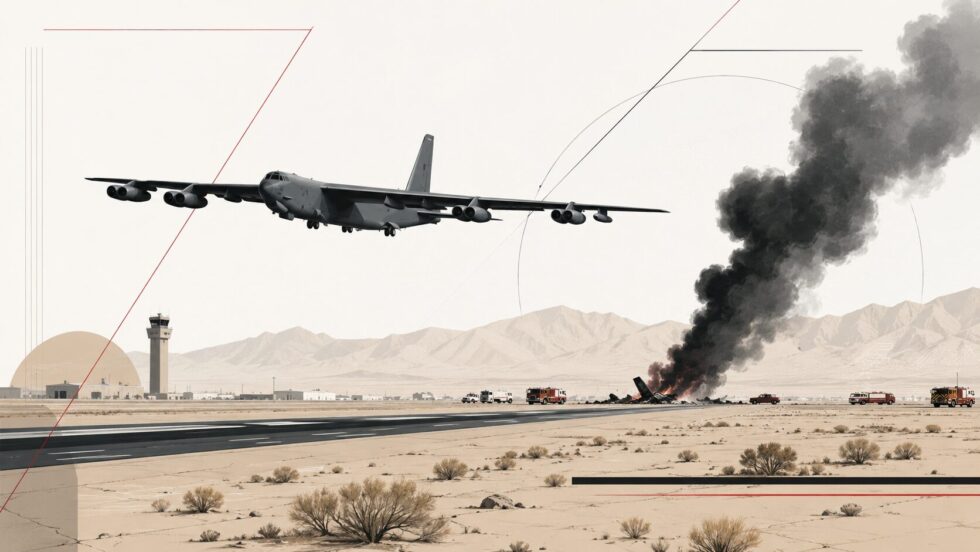
A B-52 bomber crashed shortly after takeoff from Edwards Air Force Base in southern California on Monday, 15 June 2026, triggering an emergency response at one of America’s most important military aviation sites and sending a dark plume of smoke over the Mojave Desert. The incident happened at about 11:20 a.m. local time on the Edwards airfield, around 100 miles north of Los Angeles, and involved a US Air Force B-52 Stratofortress, The WP Times reports, citing official base updates and US media reports.
The most important point for readers is that the crash remains a developing military incident, not a completed accident report. Officials confirmed the aircraft crashed shortly after takeoff, emergency crews responded immediately, the airfield was closed, inbound aircraft were diverted, and non-commercial visitor passes were suspended. At the time of the first official statements, the base had not publicly confirmed how many people were on board, whether there were injuries, whether the aircraft was carrying weapons, or what caused the crash.
B-52 crash at Edwards Air Force Base: the confirmed timeline
The crash happened on Monday morning in California, at 11:20 a.m. local time. Edwards Air Force Base said a United States Air Force B-52 Stratofortress crashed shortly after takeoff on the Edwards airfield. That wording matters because it places the incident in the most dangerous phase of flight: the first minutes after leaving the runway, when the aircraft is heavy, close to the ground and still building altitude.
Emergency crews were sent to the scene immediately. Aerial images from local coverage showed a scorched area near the runway and smoke rising from the crash site, but early footage did not clearly show large recognisable sections of wreckage. The base later said the airfield had been closed and inbound aircraft were being diverted, a standard but serious step when emergency response, crash-site control and possible investigation work take priority over normal flight operations.
The base also suspended non-commercial visitor passes until further notice. That indicates commanders wanted to reduce movement on the installation and keep the focus on emergency operations, security and access control. For a major military airfield, such restrictions are not unusual after a crash, but they show that the response was still active and sensitive.
What is confirmed so far:
| Detail | Confirmed information |
|---|---|
| Aircraft | US Air Force B-52 Stratofortress |
| Location | Edwards Air Force Base, California |
| Region | Mojave Desert, around 100 miles north of Los Angeles |
| Date | Monday, 15 June 2026 |
| Time | About 11:20 a.m. local time |
| Phase of flight | Shortly after takeoff |
| Emergency response | Crews responded immediately |
| Airfield status | Closed, with inbound aircraft diverted |
| Crew status | Not officially confirmed in first reports |
| Cause | Not yet released |
What remains unknown after the B-52 bomber crash
The most sensitive unknown is the condition of the crew. A B-52 typically operates with a crew of five, but officials had not initially confirmed how many people were on board this specific aircraft. Military test, training or operational flights can involve different crew arrangements depending on mission, instrumentation, evaluation work and safety requirements.
The cause is also unknown. Early images of smoke, scorched ground or runway damage cannot explain why a heavy bomber went down. Investigators will need flight data, cockpit communications, maintenance records, engine performance, weather conditions, runway information, aircraft configuration and witness accounts before they can determine what happened. At this stage, any claim about engine failure, pilot error, bird strike, fuel, munitions or mechanical failure would be speculation unless confirmed by officials.
There has also been no official early confirmation on whether the bomber carried weapons. That is an important question because the B-52 is capable of carrying conventional and nuclear-capable weapons systems, but capability is not the same as loadout. A crash at a US base does not automatically mean the aircraft was armed, and responsible reporting must avoid assuming that without confirmation.
The aircraft’s unit and exact mission were also not immediately clear in the first reports. Edwards is a major flight test centre, and B-52 aircraft have long been connected with test, evaluation and weapons-development work. But until the Air Force identifies the aircraft, the mission and the operating unit, the safest wording is simple: a B-52 Stratofortress crashed shortly after takeoff at Edwards Air Force Base.
Why Edwards Air Force Base matters in this B-52 crash
Edwards Air Force Base is not an ordinary military airfield. It is one of the central locations in American aerospace testing, with a long history in experimental flight, aircraft evaluation and advanced weapons programmes. The base sits in the Mojave Desert, where wide airspace, long runways and remote terrain have made it a key site for military aviation development.
That context matters because a crash at Edwards can affect more than routine base traffic. It may interrupt testing schedules, close operating areas, restrict access to the installation and trigger specialised accident-investigation procedures. The base’s decision to close the airfield and divert inbound aircraft showed that the immediate priority was emergency response rather than maintaining normal operations.
Edwards also has an important connection with the B-52’s future. Although the bomber first entered US Air Force service in the 1950s, it remains part of America’s strategic aviation force and has been kept operational through repeated upgrades. The aircraft is old in design, but not obsolete in military planning; it has been modernised repeatedly and is still expected to serve for years.
For that reason, a B-52 crash is not only a local accident story. It is also a question about a long-serving strategic aircraft, the pressure of keeping legacy platforms flying, and the complexity of testing or operating a bomber designed in another era but still central to US military power.
What the B-52 Stratofortress is used for
The B-52 Stratofortress is a long-range heavy bomber built by Boeing and used by the US Air Force for strategic and conventional missions. The aircraft can fly long distances, carry a very large weapons payload and refuel in the air, giving it global reach. It became one of the symbols of Cold War deterrence and later remained important in conventional conflicts.
The B-52H, the version still in service, can carry conventional weapons and nuclear-capable systems. It is widely associated with long-range strike missions, show-of-force deployments and strategic deterrence. In practical terms, that means it can operate far from US territory and remain useful even in modern air campaigns, especially when paired with stand-off weapons and support aircraft.
The bomber is also known for its unusual longevity. Production ended in the early 1960s, yet the US Air Force continues to operate the aircraft because its basic airframe, range and payload remain valuable. Modernisation programmes have focused on engines, avionics, radar and weapons integration rather than replacing the aircraft outright.
Why a B-52 crash attracts global attention
A B-52 crash receives global attention because the aircraft is not just another military plane. It is a strategic bomber with nuclear-capable history, a Cold War legacy and a continuing role in US power projection. When such an aircraft crashes, readers immediately ask three questions: were the crew safe, was the aircraft armed, and what does it say about the ageing bomber fleet?
The first question is human. Crew safety is always the central issue, and in this case officials had not immediately released the crew’s condition. Until the Air Force gives a formal update, that must remain the main unresolved fact.
The second question is security-related. The B-52 can carry major weapons loads, but no public information in the initial reports confirmed any weapons on this aircraft. Serious reporting should therefore say the aircraft is capable of carrying such weapons, not that this aircraft did.
The third question is strategic. The B-52 has survived for decades because it remains useful, but every accident involving such an old platform will raise scrutiny over maintenance, upgrades, testing and operational risk. That does not mean age caused this crash. It means the investigation will be watched closely by military planners, aviation specialists and lawmakers.
Key questions investigators are likely to examine:
- What was the aircraft’s mission when it took off?
- How many crew members were on board?
- What was the aircraft’s configuration and weight?
- Were there any engine, control, fuel or systems warnings?
- What did tower communications show in the seconds before the crash?
- What were weather and runway conditions at the time?
- Was the aircraft part of a test, training or routine movement?
- Did any previous maintenance issue appear in records?
- Was there any external factor such as bird activity or debris?
- What emergency procedures were attempted?
Previous B-52 accidents and why this case will be investigated carefully
The B-52 has a long operating history, and over decades it has been involved in serious accidents, including fatal crashes. One of the most frequently cited recent fatal incidents was in 2008, when a B-52 crashed off Guam during preparation for a flyover, killing six personnel. There was also a non-fatal 2016 accident at Andersen Air Force Base in Guam, where crew members safely evacuated after a B-52H was destroyed.
These past incidents matter only as context, not as an explanation for the California crash. Each accident has its own chain of events. Aviation investigations normally avoid assuming a cause from previous cases because the same aircraft type can crash for very different reasons: maintenance, configuration, weather, human factors, engine performance, systems failure, bird strike, runway issue or mission-specific variables.
A military aircraft accident investigation will normally move through several stages. First comes emergency response and site security. Then investigators preserve evidence, document debris, recover recorders or data sources where available, interview witnesses and crew if possible, and review maintenance and flight records. Only after that can an official cause or contributing factors be identified.
That process can take months. Early official statements are therefore usually limited and cautious. For readers, the most reliable approach is to separate confirmed facts from open questions and avoid turning video footage into conclusions.
What the B-52 crash means for flights, base access and the local area
The immediate operational consequence was the closure of the Edwards airfield. Inbound aircraft were diverted, and non-commercial visitor passes were suspended. That means the base was prioritising emergency vehicles, military responders, security teams and investigators over normal traffic.
For the local area, the crash site is inside a military installation, not a public airport. That limits civilian access and means local residents are unlikely to receive the same type of passenger-airport disruption notices seen after a commercial aviation accident. However, smoke, emergency traffic and airfield restrictions can still affect the surrounding community and base personnel.
For military aviation, the disruption may be wider. Edwards is a major test and evaluation hub, so closing or limiting airfield operations can affect scheduled flights, testing activity and aircraft movements. The duration of disruption depends on wreckage recovery, safety checks, runway condition and the needs of investigators.
The public should expect updates in stages rather than all at once. The first update normally confirms the incident and emergency response. Later updates may clarify crew status, aircraft identity, unit, mission type and whether there are environmental or safety concerns. A full explanation of cause usually comes much later.
The next official updates will be critical. The most important will be a statement on the crew, because that is still the central human question. After that, the Air Force may identify the aircraft’s unit and mission, confirm whether the aircraft was on a test or training flight, and explain whether the airfield has reopened. A later investigation will determine cause, but that is unlikely to be immediate. If the crash involved a mechanical failure, investigators will examine the affected systems and maintenance records. If it involved flight configuration, investigators will look at takeoff data and cockpit procedures. If it involved external factors, they will examine runway conditions, weather and possible hazards.
Until then, the accurate headline is narrow but serious: a US Air Force B-52 Stratofortress crashed shortly after takeoff at Edwards Air Force Base in California, emergency crews responded, the airfield was closed, inbound aircraft were diverted, and the crew’s condition was not immediately released.
What is a B-52 bomber and why does the Stratofortress still matter
The B-52 Stratofortress is a long-range heavy bomber used by the United States Air Force for strategic deterrence, conventional strike missions and global power projection. Built by Boeing, it entered service in 1955, but the current B-52H version remains active because it can fly long distances, carry a weapons payload of up to about 70,000 lb, operate at altitudes of up to about 50,000 ft and refuel in mid-air. The aircraft normally carries a crew of five and is capable of carrying conventional weapons as well as nuclear-capable systems, although that does not mean every B-52 flight is armed or connected to nuclear missions.
The Stratofortress still matters because it combines range, payload and endurance in a way few modern aircraft can match. Its eight-engine layout, large wingspan and Cold War-era design make it one of the most recognisable military aircraft in the world, while repeated upgrades to avionics, communications, weapons systems and planned new Rolls-Royce F130 engines are intended to keep it in service for decades. For Britain and Europe, the B-52 is also relevant because US bomber deployments to RAF Fairford and other NATO-linked operations are closely watched as signals of American strategic commitment, deterrence and long-range military readiness.
Read about the life of Westminster and Pimlico district, London and the world. 24/7 news with fresh and useful updates on culture, business, technology and city life: London Traffic, 15–20 June 2026: The Week's Closures, Hour by Hour and Day by Day
In preparing this article, reports from BBC News, The Telegraph, CNN, CBS News, Reuters and official updates from Edwards Air Force Base were used.