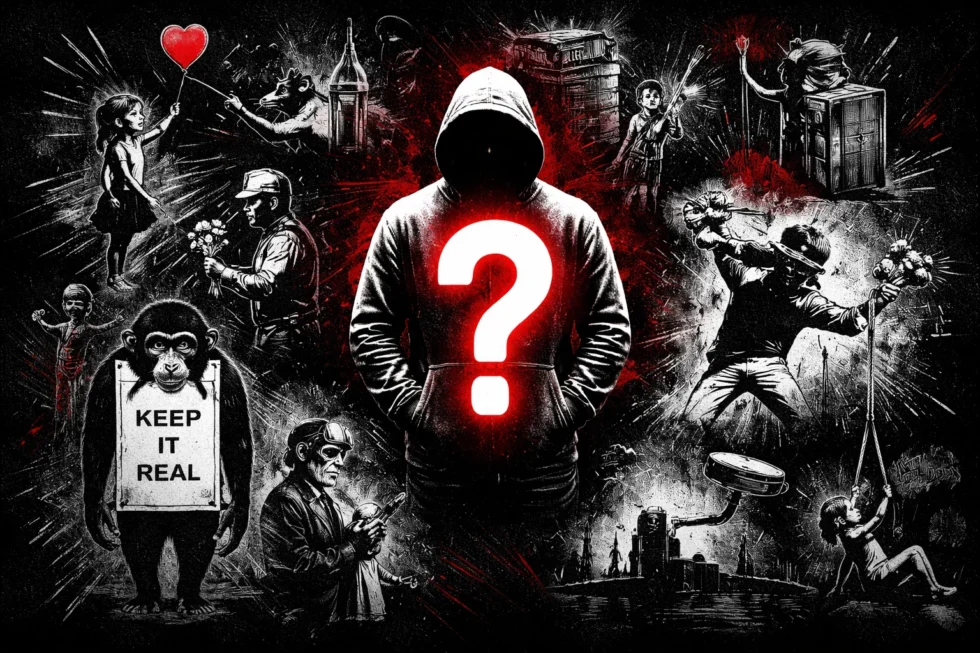
The long-running mystery surrounding the Banksy artist has resurfaced after a new international investigation suggested that the anonymous figure behind some of the world’s most recognisable street artworks may be Robin Gunningham, a man born in Bristol in 1973. As The WP Times reports, citing an extensive investigation by Reuters published on 13 March 2026, journalists analysed court records, travel data, photographs and testimony from witnesses in several countries in an attempt to trace the identity behind the pseudonym Banksy.
For more than twenty years, reporters, art historians and fans have attempted to uncover who created the politically charged stencil images that suddenly appear on walls in cities from London and Bristol to New York, Bethlehem and Kyiv. The new reporting again places the name Robin Gunningham at the centre of that debate, reviving a theory first widely discussed in the British press in 2008. According to the investigation, previously unpublished documents from a New York vandalism case in 2000 allegedly contained a handwritten confession signed with that name, providing one of the strongest documentary links yet between the real person and the global street-art phenomenon.
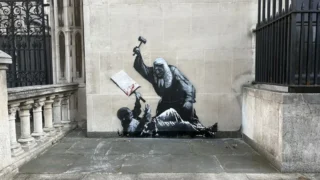
For over two decades, the Banksy artist has built a worldwide reputation while remaining almost completely anonymous. Unlike traditional painters whose careers develop through galleries and exhibitions, Banksy’s rise happened largely in the public space of city streets. His works — often created using stencils that allow an image to be sprayed within minutes — typically appear overnight and combine dark humour with commentary on politics, war, consumerism and social inequality.
That unusual strategy transformed a relatively unknown graffiti figure from Bristol into one of the most influential contemporary artists of the 21st century. Today Banksy’s artworks regularly command millions at auction. In 2018, for example, his iconic “Girl with Balloon” sold for about £1.04 million at Sotheby’s in London before partially shredding itself inside the frame moments after the hammer fell. Three years later, the altered piece — renamed “Love Is in the Bin” — resold for nearly £18.6 million, illustrating how the mystery surrounding the Banksy artist has become inseparable from the value and global fascination surrounding his work.
Why Robin Gunningham is linked to Banksy
The name Robin Gunningham first entered the public debate about the identity of the Banksy artist in the mid-2000s, when journalists began examining the early street-art scene in Bristol, the English city widely considered the birthplace of Banksy’s work. As Renewz reports, citing investigations by Reuters and earlier British media research, several clues over the years have pointed toward Gunningham, a Bristol-born man who grew up in the same cultural environment that produced some of the UK’s most influential graffiti and music movements of the 1990s.
Robin Gunningham was reportedly born in 1973 and educated at Bristol Cathedral School, where archived student publications mention his interest in drawing, acting and school art projects. Former classmates have said that he was known for artistic talent during his teenage years, a period when Bristol’s graffiti culture was expanding rapidly. The city was also home to a vibrant underground creative scene that included musicians, visual artists and experimental designers. It was within this environment that stencil graffiti — the technique later closely associated with the Banksy artist — began to spread across walls and abandoned buildings.
Journalistic investigations began linking Robin Gunningham to the identity of the Banksy artist in 2008, when reporters examined photographs, school records and locations connected to early Banksy murals. Analysts comparing timelines noted that Gunningham’s movements during the late 1990s appeared to coincide with the emergence of the first stencil works attributed to Banksy in Bristol and later London. Researchers also identified connections between people in Gunningham’s circle and the underground art networks that helped popularise stencil graffiti across Britain at the time.
Further details strengthening the theory emerged from archival records connected to an incident in New York in September 2000, when a man was arrested for altering a fashion billboard in Manhattan’s Meatpacking District. Documents linked to the case reportedly included a handwritten statement signed with the name Robin Gunningham, which investigators later examined as part of broader attempts to trace the early activities of the artist who would eventually become known worldwide as Banksy.
Scholars studying the origins of Banksy’s style also point to the cultural environment of Bristol in the 1990s, a city that played a central role in Britain’s alternative art and music movements. The local scene brought together graffiti writers, photographers, designers and musicians connected to the trip-hop movement, including figures associated with the band Massive Attack. Art historians often argue that Banksy’s use of stencils, political satire and dark humour reflects the same experimental culture that shaped Bristol’s underground creative community during that period.
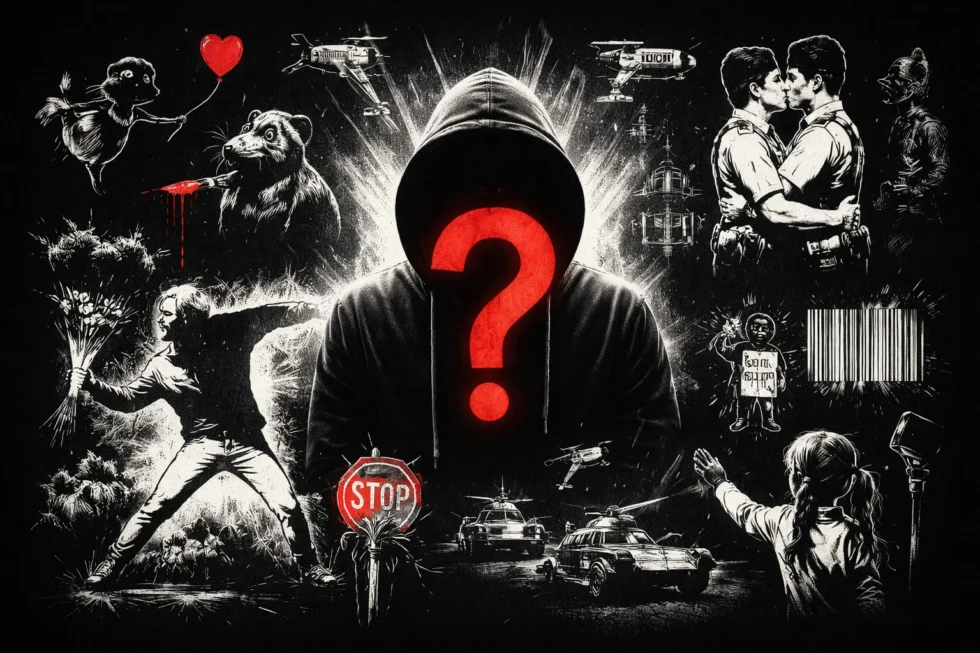
Despite the accumulation of clues, none of these elements alone definitively proves that Robin Gunningham is the Banksy artist. Banksy himself has never publicly confirmed his real name, and people close to the artist have repeatedly refused to discuss his identity. His lawyer has also argued that anonymity protects both the artist’s safety and the freedom to address sensitive political themes. Nevertheless, the combination of school records, photographic evidence, court documents, travel timelines and long-standing connections to Bristol’s underground art scene has kept the name Robin Gunningham at the centre of the debate for nearly two decades. For many investigators and art historians, those overlapping details make him the most frequently cited candidate behind the identity of the world’s most famous anonymous street artist.
The David Jones name and the disappearance from records
Another detail that has attracted attention is the claim that Robin Gunningham may have later used the name David Jones. Reports examining travel records and public documentation suggest that the name change may have helped maintain anonymity as Banksy’s fame grew internationally. The name David Jones is extremely common in Britain, which could make it easier for someone seeking to disappear from public databases. According to investigations cited in recent reporting, a person with that name and the same birth date as Gunningham appeared in certain travel records connected with Banksy’s activities. Whether that identity is still used today remains unclear, and neither Banksy nor his representatives have publicly confirmed the claim.
The role of anonymity in Banksy’s work
Many art historians argue that anonymity is not simply a practical strategy for the Banksy artist but a core part of the artistic concept. Graffiti historically existed outside the institutional art world, often created quickly in public spaces without permission. Remaining unidentified allowed artists to challenge authority and social norms without becoming part of the traditional gallery system.
In Banksy’s case, anonymity has also become part of the mythology surrounding his work. The absence of a visible author often shifts the focus entirely onto the message of the artwork itself. Murals addressing war, surveillance, migration or political power have appeared in cities across the world, frequently generating global media attention within hours. Some critics even argue that revealing the identity of the Banksy artist could weaken the mystique that helped elevate his work beyond street culture into international contemporary art.
From street graffiti to a global art market
Although Banksy’s work often criticises capitalism and consumer culture, his pieces have become some of the most valuable artworks in the contemporary market. Auction houses such as Sotheby’s and Christie’s have sold Banksy works for millions of pounds, and collectors around the world compete to acquire authenticated prints and paintings.
One of the most famous moments in modern art occurred in 2018 when a Banksy piece titled Girl with Balloon was partially shredded immediately after being sold at auction. The artwork, later renamed Love is in the Bin, became even more valuable after the stunt, highlighting how Banksy combines performance, protest and market awareness. Despite these high-profile sales, Banksy continues to produce works in public spaces that are not intended for commercial sale. These pieces often appear in locations connected to political events or humanitarian crises.
Banksy’s influence on modern culture
Whether or not Robin Gunningham is truly the Banksy artist, the impact of the name Banksy on contemporary culture is undeniable. His visual language – simple stencils combined with powerful symbolism – has influenced a generation of street artists and designers around the world.
Museums, galleries and universities now study Banksy’s work as an example of how street art moved from the margins of urban culture into mainstream artistic discourse. At the same time, the mystery surrounding the creator continues to fascinate the public. For many observers, the identity question may never be fully resolved. Banksy himself once suggested that invisibility could be a form of power. As long as the artist remains unseen, the focus remains where he appears to want it – on the walls, the messages and the reactions they provoke.
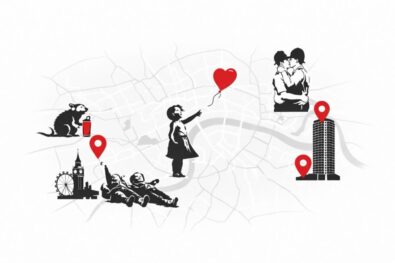
Read about the life of Westminster and Pimlico district, London and the world. 24/7 news with fresh and useful updates on culture, business, technology and city life: Banksy in London: from iconic early murals to the new December 2025 works in Bayswater and Centre Point