British Gas customers across England, Scotland and Wales are entering 2026 under a higher Ofgem energy price cap, as a modest January increase collides with peak winter demand and rising standing charges. For millions of households on variable tariffs, this means higher costs precisely as heating use peaks during the coldest weeks of the year. This is reported by The WP Times editorial team.
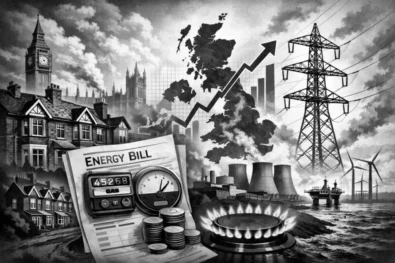
The January rise may appear small, but it sits at the end of a dramatic four-year energy cycle in Britain: average household bills stood near £1,200 in early 2022, exploded above £4,000 during the Ukraine-driven gas crisis in 2023, fell back through 2024 as emergency subsidies were removed, then crept higher again in 2025 as climate levies and grid charges were restored. The £1,758 cap for 2026 reflects not just fuel prices but the cost of rebuilding Britain’s energy system for net zero — making this winter the last under the old crisis-era structure before tax-funded reforms and lower caps are expected to take effect from April.
What exactly has changed from 1 January 2026
From the first day of 2026, Ofgem’s energy price cap increased by 0.2%, taking the annual benchmark for a “typical” dual-fuel household from £1,755 to £1,758. This figure is not what households actually pay — it is a benchmark based on standardised consumption of 11,500 kWh of gas and 2,700 kWh of electricity paid by direct debit. Real bills depend entirely on how much energy a household uses.
What matters for British Gas and other suppliers is not the headline bill, but the unit price per kilowatt-hour and the standing charges. From January:
- Electricity standing charges rise by 2%
- Gas standing charges rise by 3%
- Electricity unit rates increase slightly
- Gas unit rates fall marginally
This means homes that rely more on electricity than gas will feel the biggest impact, even though the overall cap change looks small on paper.
Why winter households are being hit now
The timing of the January increase is critical. The UK enters its coldest period in January and February, when heating demand peaks and daily energy use rises sharply. For British Gas customers on standard variable tariffs, even a small unit-price increase compounds quickly once radiators are running all day. Cold weather alerts across parts of the UK mean:
- Longer heating hours
- Higher electricity use for lighting and appliances
- Increased standing charge exposure
Campaign groups warn this creates what they call “a stacked winter effect” — when higher fixed charges collide with maximum consumption.
Who is protected — and who is not
The Ofgem price cap applies only to:
- England
- Scotland
- Wales
Northern Ireland operates under a separate regulatory system.
Anyone on a fixed-rate energy deal is protected from the January increase because their unit prices are locked in. However, when those deals expire, customers are typically moved back onto the price-capped variable tariff unless they actively switch. Energy watchdog Which? says many fixed deals currently sit below the price cap, meaning British Gas customers could reduce bills by switching — if exit fees are not punitive.
The general rule they recommend:
- Fixed deals cheaper than the cap
- No longer than 12 months
- Minimal or zero exit fees
Support schemes available this winter
As energy bills rise and temperatures fall, the UK government has activated a package of targeted winter support designed to protect the most vulnerable households during the coldest months of the year.
Cold Weather Payments — automatic winter cash
Households in eligible areas receive £25 per week for each seven-day period when the average local temperature is recorded as 0°C or below.
This support applies in:
- England
- Wales
- Northern Ireland
Payments are triggered automatically based on Met Office data — households do not need to apply. In areas affected by prolonged snow or ice, multiple payments can be made across January and February if cold spells continue. Scotland operates a separate Winter Heating Payment system, designed to provide more predictable support rather than temperature-triggered payouts.
Warm Home Discount — £150 off electricity bills
The £150 Warm Home Discount has been expanded for winter 2025–26 to include more low-income households and pensioners.
For eligible customers:
- The discount is applied automatically
- It appears directly on electricity bills
- No repayment is required
This scheme is designed to reduce upfront winter costs when heating use is at its highest, particularly for homes that rely on electricity for warmth or hot water.
Winter Fuel Payments — pensioner support restored
After a policy reversal by the government, Winter Fuel Payments have been reinstated for pensioners for winter 2025–26.
This payment helps older households:
- Keep heating on for longer
- Avoid dangerous cold indoor temperatures
- Manage rising standing charges
For many pensioners on fixed incomes, this payment now acts as a core part of winter energy budgeting, arriving at exactly the point when bills peak.
Why April could change everything
The real financial shift comes not in January, but from April 2026, after Chancellor Rachel Reeves rewrote how energy bills are funded.
Two major levies have been removed or slashed:
| Change | Impact |
|---|---|
| End of the Energy Company Obligation | Removes costs used to fund home efficiency schemes |
| 75% cut to the Renewables Obligation | Reduces household contributions to clean power subsidies |
Together, these changes are expected to reduce household bills by around £154 a year on average. However, part of that saving is offset by network investment costs — about £30 per year will still go toward maintaining gas pipes and strengthening electricity grids.
Net effect for most homes:
Around £120–£150 per year in lower bills from April.
Ofgem price cap forecast: what Cornwall Insight predicts
Energy consultancy Cornwall Insight now forecasts that Ofgem will cut the price cap by 8% in April 2026, taking the typical bill down to around:
£1,620 per year — the lowest level since September 2024.
That drop reflects:
- Lower wholesale gas prices
- Increased global supply from the US
- Milder European winter demand
- Reduced policy levies
- Grid cost revisions
This is the first structural reduction driven by government tax and levy reform rather than emergency subsidies.
What British Gas customers should monitor between January and April 2026
Between January and April, household energy costs in Great Britain are governed by two different regulatory and pricing regimes.
January to March 2026 — winter price exposure
During the first quarter of 2026, energy bills reflect:
- Higher standing charges introduced in January
- Seasonally elevated consumption due to heating demand
- Marginally higher electricity unit rates under the updated Ofgem cap
For British Gas customers on variable tariffs, this period produces the highest cash outflow of the year, even though the official price cap increase is numerically small.
From April 2026 — revised bill structure
From April, the composition of energy bills changes as government budget measures take effect. These include:
- Removal or reduction of policy levies from household tariffs
- Lower contribution to renewables and energy efficiency schemes
- Partial transfer of climate and infrastructure costs to general taxation
At the same time, wholesale market conditions and regulatory adjustments are expected to produce a lower Ofgem price cap, based on current forecasts.
Operational implications for British Gas customers
Households’ financial exposure depends primarily on their tariff type.
Customers should verify:
- Whether they are on a standard variable tariff governed by the Ofgem cap
- Or a fixed-rate contract with predetermined unit prices
Unit rates, not headline cap figures, determine actual spending. Comparing a household’s current pence-per-kWh rateswith the capped maximum provides a more accurate measure of cost than annualised benchmarks.
Fixed contracts should be evaluated based on:
- Unit price relative to the cap
- Contract duration
- Exit fees
How the billing system is changing
The current energy transition involves a structural shift in how costs are collected. Until now, much of the UK’s decarbonisation and energy-efficiency policy has been funded through levies added directly to household bills. Under the post-Budget framework, a growing share of those costs will be met through general taxation, reducing the portion charged per unit of energy.
As a result, future reductions in the Ofgem price cap will reflect not only fuel markets but also changes in how policy and infrastructure costs are distributed across the economy. For British Gas customers, 2026 represents the transition from crisis-era pricing to a tax-adjusted energy billing model.
That is why, in 2025, British patients still live between prescriptions and prosecutions. Read about the life of Westminster and Pimlico district, London and the world. 24/7 news with fresh and useful updates on culture, business, technology and city life: Pimlico private doctors: same-day GP, blood tests and private medical clinics near Westminster