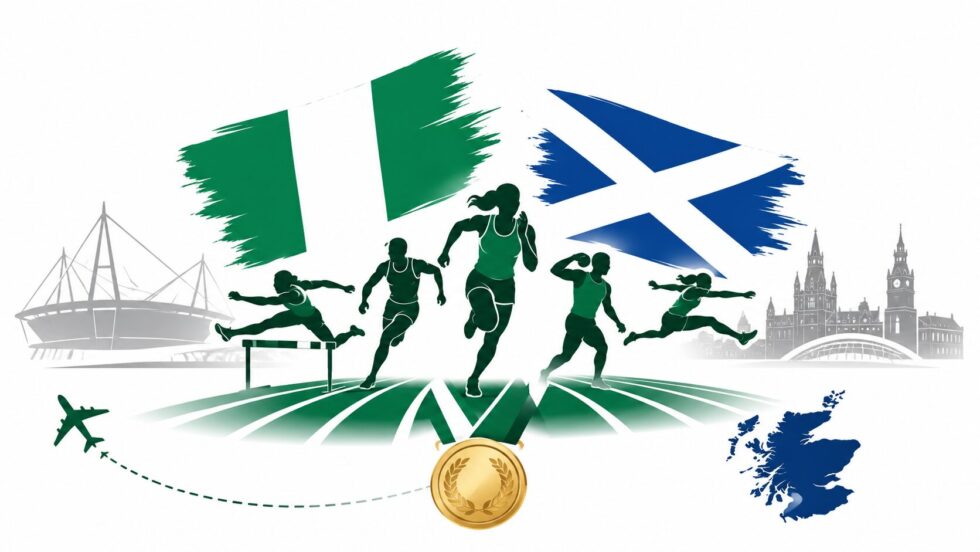
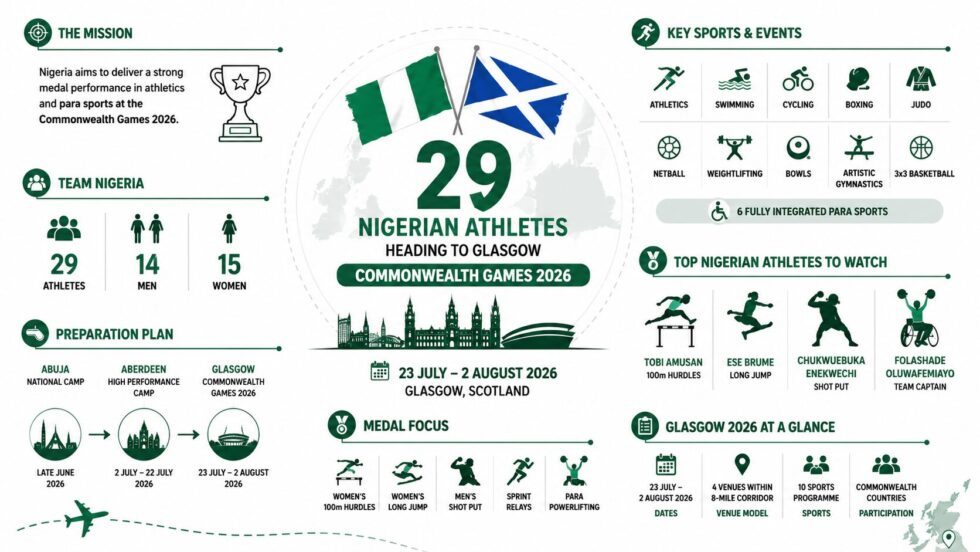
Commonwealth Games 2026 preparations have entered a decisive phase for Nigeria after the Athletics Federation of Nigeria invited 29 track and field athletes to camp before the Games in Glasgow, Scotland, which run from 23 July to 2 August 2026. The squad will continue work in Abuja before moving to a three-week high-performance camp in Aberdeen from 2 July, with sprint hurdler Tobi Amusan, long jumper Ese Brume and shot putter Chukwuebuka Enekwechi among the headline names, , The WP Times reports.
The Glasgow Games will be smaller than recent editions, with a 10-sport programme, six fully integrated Para sports, and events staged across four venues within an eight-mile corridor. For Nigeria, the reduced format makes selection sharper and the margin for medals narrower, especially in athletics, para powerlifting, relays and field events.
Why Nigeria chose Aberdeen before the Commonwealth Games 2026
Nigeria’s final camp in Aberdeen is not a symbolic stop before Glasgow. It is the last controlled phase of preparation before athletes enter the pressure of the Commonwealth Games 2026, and officials see it as a practical way to close the gap between training form and competition performance. The camp is scheduled to begin on 2 July, almost three weeks before the Games open in Glasgow on 23 July. That timing gives coaches a narrow but important window to adjust athletes to Scottish weather, reduce the strain of long-distance travel, and test final race plans before medals are decided.
For sprinters and hurdlers, Aberdeen will be about precision rather than volume: sharper starts, cleaner acceleration, hurdle rhythm, bend running and the ability to reproduce race pace under controlled pressure. For the relay squads, the camp could be decisive. Baton changes, exchange-zone timing, lane discipline and final running order often separate medal teams from those eliminated by small technical errors.
For jumpers and throwers, the priority will be consistency. Coaches are unlikely to overload athletes at this stage; the focus is expected to be on approach runs, release angles, take-off rhythm, recovery and maintaining power without risking late injury. The National Sports Commission says the preparation plan is built around technical, medical and logistical support. In practical terms, that means physiotherapy, recovery sessions, strength maintenance, nutrition planning, video analysis, travel management and close monitoring of training loads before the team moves into Games mode.
What the Aberdeen camp is expected to cover
| Area | Main focus before Glasgow |
|---|---|
| Sprints | Starts, acceleration, race execution |
| Hurdles | Rhythm, stride pattern, technical control |
| Relays | Baton exchanges, running order, lane discipline |
| Jumps | Approach rhythm, take-off timing, consistency |
| Throws | Release technique, power maintenance |
| Recovery | Physiotherapy, sleep, injury prevention |
| Sports science | Load monitoring, video review, performance checks |
| Area | Why it matters before Glasgow |
|---|---|
| Sprint starts | Crucial for 100m, 200m and hurdles |
| Relay exchanges | Nigeria has medal hopes in 4x100m and mixed relays |
| Weather adaptation | Scotland conditions differ from Abuja |
| Recovery | Prevents late injuries before competition |
| Medical support | Manages workload and existing niggles |
| Technical events | Jumps, throws and hurdles need final rhythm |
Tobi Amusan headlines Nigeria’s athletics squad
The strongest name in the athletics list is Tobi Amusan, a two-time Commonwealth Games champion in the women’s 100m hurdles. Her role is not only competitive but also symbolic: Nigeria enters Glasgow with a proven championship performer capable of setting the tone for the wider team.
Also listed are Kayinsola Ajayi, Favour Ashe, Ese Brume, Chukwuebuka Enekwechi, Ezekiel Nathaniel, Rosemary Chukwuma, Patience Okon-George, Ella Onojuvwevwo and Temitope Adeshina.
Director General of the National Sports Commission Bukola Olopade described the group as a reflection of Nigeria’s ambition to compete strongly for medals. He said the athletes had shown the “quality and competitiveness” needed to perform internationally.
Key Nigerian medal routes in Glasgow
Nigeria’s clearest medal opportunities are likely to come from:
- Women’s 100m hurdles
- Women’s long jump
- Men’s shot put
- Sprint relays
- Mixed 4x400m relay
- Para powerlifting
- Selected women’s sprint events
Favour Ofili missing from Nigeria’s 29-athlete list
One of the most significant omissions from Nigeria’s Commonwealth Games 2026 athletics list is Favour Ofili, the high-profile sprinter whose name had been closely watched before the final Scotland camp was confirmed. Ofili was not included among the 29 athletes invited by the Athletics Federation of Nigeria for the three-week preparation camp in Aberdeen. Her absence is notable because she remains one of Nigeria’s best-known sprint talents, especially across the 100m, 200m and relay pool, where depth and experience can be decisive at championship level.
The omission comes after a period of uncertainty around her international future. Reports in Nigeria had linked her situation to earlier discussions over a possible switch of allegiance and to questions around her participation in national selection events. While she had been a major talking point before the Games build-up, her name is missing from the official preparation group heading to Scotland. For Nigeria, the sporting impact is clear. Ofili’s absence removes a proven sprint option from the women’s short sprints and relay calculations at a time when coaches are trying to settle final combinations before Glasgow. In relays, one missing athlete can affect not only speed but also baton order, exchange zones and tactical balance across the team.
However, Nigeria still has several strong names in the women’s sprint group, including Rosemary Chukwuma, Tima Godbless, Blessing Ogundiran, Miracle Ezechukwu, Olayinka Olajide and Obi Chukwuka. That gives selectors options in the 100m, 200m and 4x100m relay, even if Ofili’s absence reduces the margin for error.
Why Ofili’s absence matters
| Area | Impact on Nigeria |
|---|---|
| Women’s 100m | Removes one experienced sprint option |
| Women’s 200m | Reduces depth in one of her strongest events |
| 4x100m relay | Affects possible baton order and combinations |
| Team planning | Forces coaches to rely on the selected camp group |
| Media attention | Keeps focus on selection and athlete availability |
Ofili’s omission does not end Nigeria’s sprint hopes, but it changes the shape of the team. The Aberdeen camp will now be the key test for the athletes selected to prove that Nigeria can still arrive in Glasgow with a competitive women’s sprint and relay unit.
Women’s sprints, jumps, throws and relays
| Event area | Athletes |
|---|---|
| 100m hurdles | Tobi Amusan |
| Long jump | Ese Brume |
| 100m / 200m / 4x100m | Blessing Ogundiran, Rosemary Chukwuma, Tima Godbless, Miracle Ezechukwu, Olayinka Olajide, Obi Chukwuka |
| 400m / mixed relay | Patience Okon-George, Ella Onojuvwevwo, Favour Onyah, Esther Joseph |
| High jump | Temitope Adeshina |
| Shot put | Jessica Oji |
| Hammer throw | Oyesade Olatoye |
Why Glasgow 2026 is different from previous Commonwealth Games
The Commonwealth Games 2026 will not look like Birmingham 2022.
Glasgow is staging a leaner event after Victoria, Australia withdrew as host. The 2026 model is built around fewer sports, existing venues and a smaller operating footprint.
The official programme includes athletics and para athletics, swimming and para swimming, track cycling and para cycling, boxing, judo, netball, weightlifting and para powerlifting, bowls and para bowls, artistic gymnastics, and 3x3 basketball including wheelchair basketball. That structure means athletics becomes even more important for countries such as Nigeria because fewer sports can reduce alternative medal routes.
What happens next for Team Nigeria
Nigeria’s immediate schedule is now clear.
| Date | Stage |
|---|---|
| Late June 2026 | National camp continues in Abuja |
| 2 July 2026 | Aberdeen high-performance camp begins |
| July 2026 | Final training, recovery and team coordination |
| 23 July 2026 | Commonwealth Games 2026 opens in Glasgow |
| 2 August 2026 | Games close |
The next major checkpoint will be athlete fitness after the first phase of the Aberdeen camp. Coaches will also need to finalise relay teams, manage travel loads and protect key medal contenders from late injury.
Commonwealth Games 2026 FAQ
When are the Commonwealth Games 2026?
The Commonwealth Games 2026 take place in Glasgow from 23 July to 2 August 2026.
How many Nigerian athletics athletes were invited?
The Athletics Federation of Nigeria invited 29 athletes for the Commonwealth Games preparation camp.
Where is Nigeria training before Glasgow?
Nigeria’s athletics squad is scheduled for a three-week camp in Aberdeen, Scotland, beginning 2 July 2026.
Who is Team Nigeria captain?
Folashade Oluwafemiayo, a two-time Paralympic champion and multiple world medallist, has been named captain.
Is Tobi Amusan in the squad?
Yes. Tobi Amusan headlines the athletics squad and remains one of Nigeria’s strongest medal contenders.
Is Favour Ofili included?
No. Favour Ofili was not listed among the 29 athletes invited for the Scotland camp.
Nigeria enters the final month before the Commonwealth Games 2026 with a defined squad, a Scotland-based training plan and medal hopes centred on athletics and para sport. The Glasgow campaign will test not only individual stars such as Amusan, Brume, Enekwechi and Oluwafemiayo, but also the strength of Nigeria’s preparation system under pressure.
Read about the life of Westminster and Pimlico district, London and the world. 24/7 news with fresh and useful updates on culture, business, technology and city life: What are tonight’s Lotto results and National Lottery numbers for Saturday 27 June 2026