
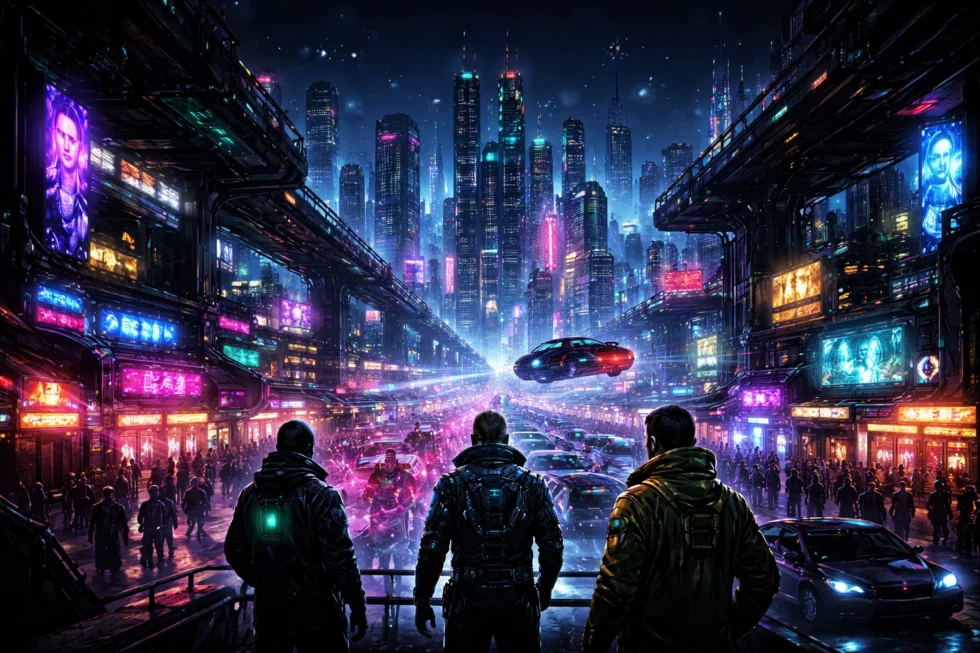
Today, 21 April 2026, a major expansion of the Cyberpunk franchise has been formally confirmed with Night City 2045, a 312-page prequel sourcebook that reconstructs the universe decades before Cyberpunk 2077 and delivers the most comprehensive structural model of Night City to date, integrating governance systems, infrastructure networks and factional power dynamics into a single operational framework; The WP Times reports. Developed by R. Talsorian Games in collaboration with CD Projekt Red, the release is positioned as a canonical bridge between established lore and the next phase of the franchise, including the forthcoming sequel Project Orion, with pre-orders now open globally and a confirmed physical rollout scheduled for June 2026.
Pre-orders are available internationally, with the digital PDF accessible immediately while physical editions are set to ship from late June. Set in 2045 — within the period known as the Time of the Red following the Fourth Corporate War — the sourcebook provides a system-level analysis of Night City’s governance, economy and power structures roughly three decades before the events of Cyberpunk 2077. The material marks a clear shift from narrative-led expansion towards structured world simulation, detailing how districts operate, how authority is distributed and how infrastructure, organised crime and corporate influence interact within a fragmented post-war metropolis.
how Night City 2045 fundamentally reshapes the Cyberpunk universe
The new sourcebook represents a structural upgrade rather than a simple lore expansion, redefining how Night City is understood across the franchise. Instead of presenting isolated stories or districts, the book models the city as a functioning system where infrastructure, власть and survival are interconnected. This approach reflects a broader industry shift towards deeper, systems-driven worldbuilding that supports long-term engagement.
“Night City 2045 is designed as a comprehensive guide to the setting, focusing on people, places and power structures that define life in the Dark Future,” the publisher notes in its official release materials (R. Talsorian Games, 17 April 2026). That framing is critical, as it positions the book closer to a simulation framework than a traditional RPG supplement.
The scale underlines that ambition. The entire city is mapped across 24 districts, each with distinct control dynamics, populations and conflicts. More than 600 locations are catalogued, while legal systems, citizenship rules and transport networks are integrated into a single operational model. This transforms Night City into a navigable system rather than a narrative backdrop.
what the book contains: data, systems and playable structure
At a practical level, Night City 2045 functions as both a reference work and a gameplay engine, combining narrative depth with structured mechanics. The content is designed to support both storytelling and simulation, allowing players to operate within a consistent and predictable system.
“You’ll know who is in charge, who lives there, and what events have happened recently,” the official synopsis states, highlighting the focus on real-time dynamics within districts (CD Projekt Red collaboration brief, 2026). This level of granularity enables users to understand not just what exists in Night City, but how it functions moment to moment.
key structural elements included
- 24 fully mapped districts with governance and conflict profiles
- 600+ locations (corporate zones, clinics, megabuildings, gang HQs)
- 44 gangs and 6 criminal organisations with defined roles
- 23 private security providers operating across districts
- 99 stat blocks for character deployment and simulation
- Integrated systems: law, economy, media, infrastructure
operational scope of the sourcebook
| Category | Coverage | Practical use |
|---|---|---|
| Districts | 24 zones | Campaign structure, territorial dynamics |
| Locations | 600+ | Mission design, navigation |
| Factions | 70+ groups | Conflict modelling |
| Systems | Law, economy, media | Realistic gameplay logic |
| Characters | 99 stat profiles | Population building |
This level of systemisation places the book closer to an urban simulation model than a traditional tabletop expansion.
the Time of the Red: why 2045 is a critical turning point
The timeline of 2045 is not incidental; it represents one of the most unstable and formative periods in Cyberpunk history. The Fourth Corporate War has just ended, culminating in a nuclear event that devastates Night City and reshapes global power dynamics. The environment itself becomes hostile, with radioactive fallout producing the phenomenon known as “blood rain”.
“The 4th Corporate War’s over… that leaves everyone else to fend for themselves in a shattered world,” the official narrative synopsis explains, emphasising the collapse of centralised authority and the rise of decentralised survival systems (Cyberpunk RED materials, 2026). This context is essential to understanding how Night City evolves into its later form.
In this phase, corporations retreat or weaken, allowing gangs, local властные структуры and private security forces to fill the vacuum. Infrastructure becomes unreliable, economies fragment into local systems, and social order is redefined through power rather than law. The book captures this transition in detail, making it one of the most important periods in the franchise timeline.
how Night City 2045 differs from earlier Cyberpunk sourcebooks
The differences between Night City 2045 and earlier materials are both quantitative and conceptual. Previous sourcebooks focused on atmosphere and narrative support, often limiting their scope to specific districts or themes. The new release expands both the scale and the purpose of the material.
comparison overview
| Feature | Earlier sourcebooks | Night City 2045 |
|---|---|---|
| Scope | Partial districts | Entire city |
| Approach | Narrative-focused | System-driven |
| Locations | Limited | 600+ mapped |
| Factions | Selective | Full ecosystem |
| Use | Story support | Simulation + gameplay |
This shift reflects the maturation of the Cyberpunk franchise, aligning it with modern expectations of depth and interactivity.
release timeline, pricing and access strategy
The rollout strategy for Night City 2045 combines physical and digital distribution to maximise accessibility and engagement. The physical edition will debut at the Origins Game Fair, running from 17 to 21 June 2026, with wider shipping beginning on 24 June.
The digital version is already available, providing immediate access to players and creators. Pricing is structured to encourage cross-format adoption, with discounts offered for combined purchases.
release and pricing breakdown
| Edition | Price | Availability | Notes |
|---|---|---|---|
| Physical | $60 | Ships 24 June 2026 | Early access at event |
| Digital PDF | $30 | Available now | Immediate use |
| Bundle | Discounted | Pre-order offer | Cross-platform value |
Additional incentives include integration with digital tools such as Roll20, allowing users to interact with the city in real-time campaign environments.
why this release matters for the UK and global gaming market
From a UK perspective, the significance of Night City 2045 extends beyond tabletop gaming into broader franchise strategy. The Cyberpunk brand is currently between major releases, with Cyberpunk 2077 stabilised and Project Orionstill in development. This creates a gap in high-impact content, which the new sourcebook is designed to fill. The release supports three strategic objectives:
- maintaining audience engagement between AAA titles
- expanding the franchise into hybrid formats
- testing narrative frameworks for future development
For UK audiences, where tabletop RPG participation and hybrid gaming formats are growing, this approach aligns with shifting consumption patterns. It also demonstrates how major franchises can sustain relevance without relying solely on high-cost game releases.
system-level worldbuilding: how the city actually functions
One of the defining characteristics of Night City 2045 is its focus on systemic realism. Governance is fragmented across competing entities, including corporations, gangs and private security firms, creating a layered authority structure. This reflects a deliberate attempt to model instability rather than impose artificial order. Economic systems are equally complex, with black markets and decentralised trade networks dominating the landscape. Scarcity and infrastructure failure force populations to operate within multiple overlapping economies. This creates a dynamic environment where access to resources is determined by location, alliances and power.
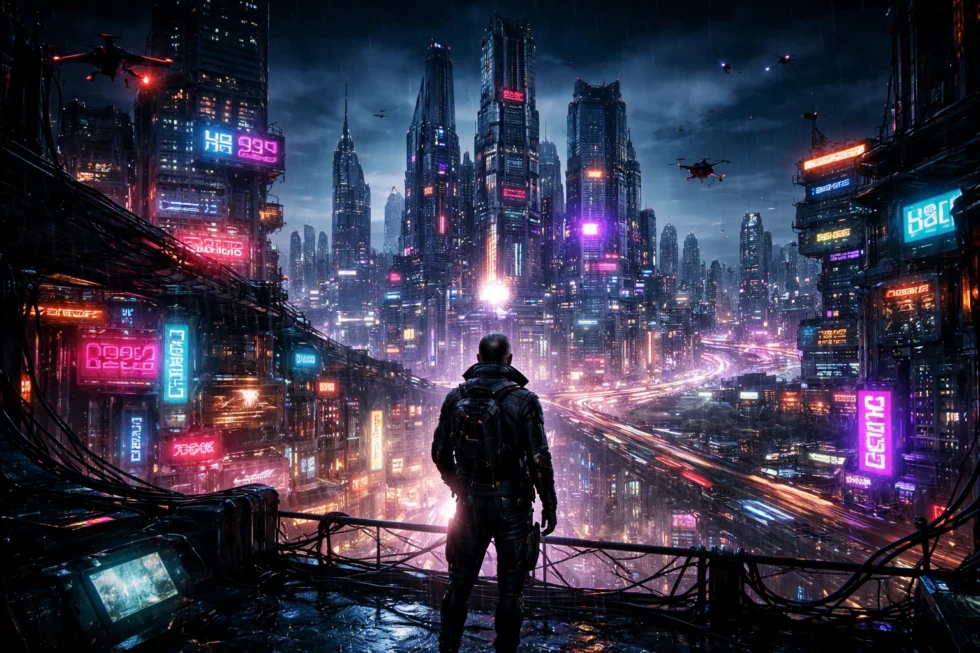
Social structures are shaped by inequality and survival pressures. Corporations retain influence but no longer dominate completely, while gangs and local groups act as de facto authorities. Media systems play a critical role in shaping perception, reinforcing one of the core themes of the Cyberpunk genre.
connections to Cyberpunk 2077 and future narrative development
The sourcebook establishes direct continuity with Cyberpunk 2077, providing context for events and structures that define the later timeline. Incidents such as the Arasaka Tower attack are presented as recent history, offering a more immediate connection to the game’s narrative.
This continuity allows players to understand how Night City evolves, including the consolidation of corporate power and the transformation of districts. It also creates a foundation for future storytelling, particularly in relation to Project Orion. From a development perspective, this material functions as a narrative testing ground. By expanding the historical framework, the creators can explore themes and systems that may later be integrated into future games, ensuring consistency across the franchise.
what players and creators gain from Night City 2045
For players, the primary benefit is depth. The detailed systems allow for more realistic and engaging campaigns, where actions have measurable consequences within a structured environment. This enhances both immersion and replayability. For creators, the sourcebook provides a comprehensive toolkit, including pre-defined locations, factions and mechanics. This reduces preparation time while enabling more complex storytelling. The balance between structure and flexibility is a key advantage, particularly for long-form campaigns.
From an industry standpoint, the release highlights the growing importance of worldbuilding as a strategic asset. By investing in detailed, adaptable environments, franchises can extend their lifespan and support multiple forms of engagement. Night City has always been central to the Cyberpunk identity, but Night City 2045 formalises its role as more than a setting. By modelling the city as a system — complete with governance, economy and social dynamics — the sourcebook transforms it into an active driver of narrative.
This shift aligns with broader trends in gaming and media, where audiences increasingly seek depth, coherence and realism. As the Cyberpunk franchise moves towards its next phase, the emphasis on systemic worldbuilding established here is likely to shape future developments.
Read about the life of Westminster and Pimlico district, London and the world. 24/7 news with fresh and useful updates on culture, business, technology and city life: When will fire tv blaster discontinue take effect and why are UK devices being disabled now