Digital ID UK is rapidly emerging as one of the most strategically significant pillars within the King’s Speech 2026, delivered during the State Opening of Parliament, where the government sets out its legislative programme for the year ahead. The speech, read by the monarch in the House of Lords alongside Queen Camilla, is expected to outline more than 30 bills, with digital identity elevated from a technical concept to a core state infrastructure reform linking public services, economic efficiency and national security, The WP Times reports, citing The Guardian.
Digital ID UK is being positioned not as a standalone tool but as a structural transformation of how identity is verified and reused across the UK economy. The policy direction points to a unified, interoperable system spanning government departments, financial institutions and regulated services, replacing fragmented checks with a standardised framework. This reflects growing pressure to modernise public systems, reduce fraud exposure and enable scalable digital services, placing the design and rollout of Digital ID UK under close scrutiny across Westminster.
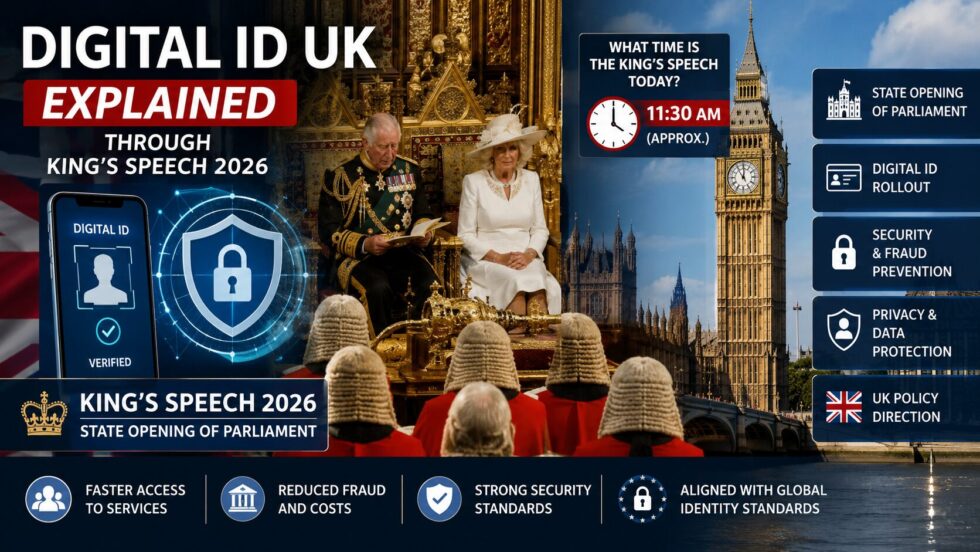
What is Digital ID UK: definition, structure and policy scope
Digital ID UK refers to a government-backed framework that allows individuals to prove their identity digitally, replacing fragmented verification methods currently used across departments and industries. Unlike previous pilot schemes, the current model is expected to integrate public databases, certified private providers and secure authentication technologies.
Core components include:
- Verified digital identity credentials for citizens
- Integration with HMRC, NHS and local government systems
- Certified private-sector identity providers
- Strong authentication standards (multi-factor, biometrics where applicable)
| Component | Function |
|---|---|
| Digital identity wallet | Stores verified identity credentials |
| Government data links | Enables secure verification with official records |
| Private provider layer | Allows banks and services to use the same identity framework |
| Security protocols | Protect against fraud, misuse and data breaches |
The system is intended to reduce duplication, accelerate access to services and create a unified identity layer across the UK economy.
How Digital ID UK appears in the King’s Speech 2026 agenda
Within the King’s Speech 2026, Digital ID UK is positioned as core national infrastructure rather than a standalone reform — embedded across welfare delivery, taxation, healthcare access and financial compliance. The legislative framing suggests a transition from fragmented identity checks toward a unified verification layer that can be reused across departments and regulated industries. In practical terms, this means a citizen could verify identity once and reuse that credential across HMRC filings, NHS access, banking onboarding and local authority services, reducing duplication, delays and administrative friction.
The government links Digital ID UK directly to productivity and cost efficiency: identity verification is one of the largest hidden cost drivers in both public administration and private finance. By standardising it, ministers aim to cut processing times, reduce fraud exposure and enable faster service delivery. Crucially, the King’s Speech signals intent to formalise legal recognition of digital credentials — moving beyond pilots into enforceable standards, certification of identity providers and interoperability rules.
Policy priorities linked to Digital ID UK include:
- Faster access to public services and benefits through pre-verified identity
- Reduction of identity fraud in banking, lending and online transactions
- Simplification of onboarding and KYC processes for businesses
- Alignment with European and global digital identity frameworks
| Priority area | Practical impact |
|---|---|
| Public services | Reduced waiting times, fewer in-person checks |
| Financial systems | Lower fraud risk, faster account opening |
| Business compliance | Streamlined onboarding and verification |
| International alignment | Cross-border recognition and interoperability |
The inclusion of Digital ID UK reflects a decisive policy shift: identity becomes a regulated digital asset, not an administrative process.
Kings speech time and delivery: when is the king’s speech 2026
Search demand around “what time is the king’s speech today” and “kings speech live” reflects the event’s national visibility. The King’s Speech is delivered in the House of Lords during the State Opening of Parliament, typically in the late morning, following the full ceremonial procession.Expected schedule:
- 10:30 — Royal procession reaches Westminster
- ~11:30 — Speech delivered from the throne
- Afternoon — Commons debates begin immediately after
This year’s timetable carries added weight: the speech is framed as a policy reset following electoral setbacks, and Digital ID UK is one of the few reforms with both immediate administrative impact and long-term structural significance.
Political context: leadership pressure and legislative urgency
The King’s Speech 2026 is delivered under clear political strain. Chris Mason notes that internal positioning within government is intensifying, with senior ministers weighing leadership scenarios while legislative priorities are being set publicly. This creates a compressed environment where policy must demonstrate impact quickly. Government messaging around Digital ID UK reflects this urgency:
- Rebuilding public trust through visible efficiency gains
- Demonstrating delivery after electoral losses
- Accelerating reforms across health, taxation and digital systems
- Using Digital ID UK as proof of modern, functional governance
Digital ID UK therefore operates on two levels: operational reform and political signalling. It is intended to show that the government can deliver measurable change, not just announce policy.
Policy debate: competing visions on economic and social priorities
The King’s Speech has triggered immediate response across the political spectrum. David Blunkett argues that cost-of-living protection should remain the central priority, warning that structural reforms must not outpace immediate economic needs. Theresa May continues to shape debate on governance and institutional balance, particularly around how large-scale reforms are implemented and regulated.
“A government must demonstrate it is on the side of those working to make ends meet,” (David Blunkett)
This highlights a core tension: whether Digital ID UK delivers short-term relief through efficiency, or primarily serves long-term system transformation.
Digital ID UK: benefits, risks and implementation challenges
Digital ID UK introduces measurable efficiency gains but also concentrates risk within a single system. Its success depends on architecture, governance and public trust.
Potential benefits:
- Instant identity verification across services
- Significant reduction in fraud and duplicate processes
- Faster onboarding in banking, telecoms and public services
- Foundation for a scalable digital economy infrastructure
Key risks:
- Centralisation of sensitive personal data
- Cybersecurity exposure at national scale
- Public resistance if privacy safeguards are unclear
- Exclusion of users without digital access or literacy
| Area | Opportunity | Risk |
|---|---|---|
| Public services | Faster access, fewer delays | Over-reliance on digital systems |
| Financial sector | Lower fraud, faster onboarding | Data security vulnerabilities |
| Citizens | Convenience, single identity layer | Privacy and surveillance concerns |
| Government | Cost reduction, efficiency gains | Complex implementation and oversight |
The central policy challenge is not technical capability, but trust: citizens must accept how their identity is stored, shared and protected.
What happens after the king’s speech: legislative pathway
Following the King’s Speech, Digital ID UK moves into formal parliamentary scrutiny. This stage determines whether policy intent becomes enforceable law. Next steps include:
- Multi-day debates in the Commons and Lords
- Detailed committee scrutiny of digital identity provisions
- Amendments addressing privacy, governance and scope
- Negotiations across parties and stakeholders
Implementation timelines will depend on legislative approval, regulatory frameworks and technical deployment capacity.
Digital ID UK is a structural reform that underpins multiple sectors simultaneously. Within the King’s Speech 2026, it signals a shift toward a state where identity is digital, reusable and integrated across services — a foundational change rather than a sector-specific policy. Its success will depend on three factors: legislative clarity, technical execution and public trust. The State Opening sets the direction — but Digital ID UK will be judged on delivery, not intent.
Read about the life of Westminster and Pimlico district, London and the world. 24/7 news with fresh and useful updates on culture, business, technology and city life: What are the key measures in the King’s Speech 2026 and how will they reshape the UK economy, housing and security agenda