
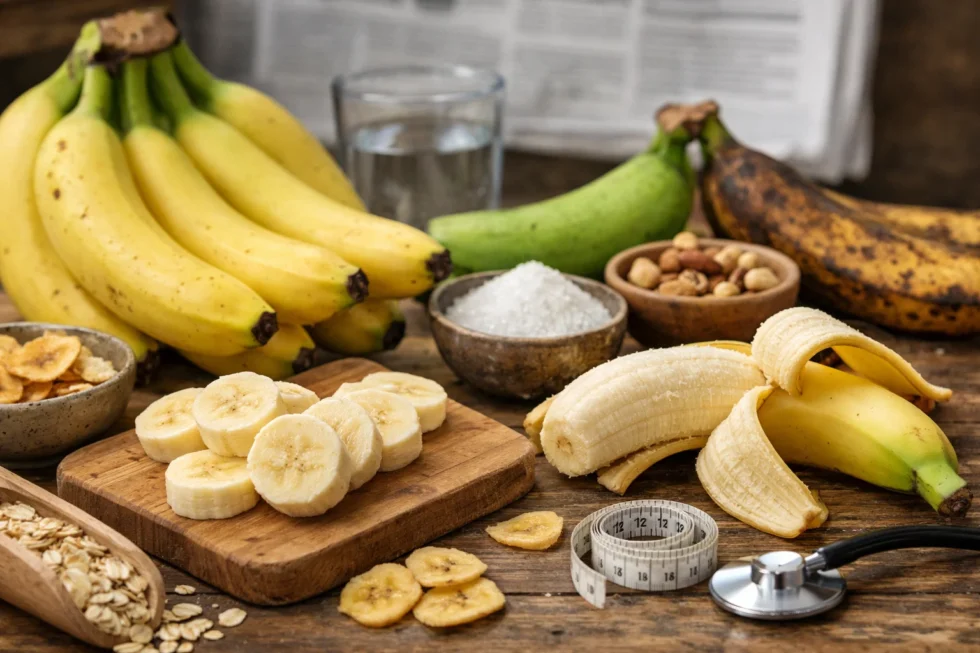
Bananas are among the most commonly consumed fruits in the UK, yet they rarely become the subject of serious nutritional discussion unless online debate pushes them to one extreme or another. They are inexpensive, portable and naturally sweet, and feature widely in everyday diets, from school lunchboxes to endurance sports nutrition. At the same time, bananas are increasingly criticised in public discourse for their sugar content, their starch profile and their suitability for people monitoring blood glucose levels.
The evidence is more nuanced and more practical. A medium banana contains around 105 calories, approximately 14 grams of naturally occurring sugars, about 3 grams of fibre and more than 400 milligrams of potassium. Its effect on the body, however, depends strongly on ripeness, portion size and dietary context. A banana is not simply a sugar value on a nutrition label, but a whole fruit with fibre, water and a carbohydrate structure that shifts as starch converts to sugar during ripening. The more relevant question is therefore not whether bananas are healthy in general, but for whom, in what circumstances and in what quantities they are most appropriate.
This explainer, reported byThe WP Times newsroom with reference to UK mainstream media reporting, public health guidance and large-scale nutrition research, examines what bananas contain, how ripeness alters blood sugar response, what population studies indicate about fruit consumption and cardiovascular risk, and why asking how many bananas a day is a valid question when considered as part of overall diet quality rather than in isolation.
What is in a banana: the numbers people argue about
Nutrition comparisons typically use a “medium” banana, as this aligns with standard portion sizes in public guidance. On average, one medium banana provides around 105 calories, approximately 27 grams of carbohydrate, about 14 grams of naturally occurring sugars, roughly 3 grams of fibre, and around 422 milligrams of potassium. These figures explain both the enthusiasm for bananas and the criticism. For those needing a reliable, easily digestible source of carbohydrate, a banana is close to ideal: pre-portioned, widely available and gentle on most stomachs. For those advised to monitor sugar intake, the same fruit can appear problematic, despite the fact that its sugars occur naturally within whole fruit rather than being added.
Within the UK “5 A Day” framework, an adult portion of fruit or vegetables is defined as 80 grams, and a banana is commonly counted as one portion. That framing matters. It positions bananas as one component of a varied dietary target rather than as a standalone nutritional solution. One banana a day fits easily within balanced eating; several bananas a day are not “forbidden” by arithmetic, but they can displace dietary diversity if they crowd out other fruits and vegetables.
Are bananas “just sugar”: why whole fruit behaves differently
The claim that “bananas are basically sugar” usually rests on simple gram comparisons with processed foods. But sugar grams alone do not determine how the body responds. Whole fruit contains fibre, water and cellular structure, all of which slow digestion and sugar absorption. This distinction is reflected in how health organisations interpret research. Large meta-analyses of prospective cohort studies consistently associate higher fruit and vegetable intake with lower risk of cardiovascular disease and reduced all-cause mortality. These findings do not imply that fruit is metabolically harmful when eaten in typical amounts. While such studies cannot prove causation, the consistency of the associations underpins continued public health advice to increase fruit and vegetable consumption as part of an overall dietary pattern.

That does not mean bananas are “free” in all circumstances. Adding several bananas on top of an already high intake of refined carbohydrates may increase total energy intake. However, that is a question of overall diet composition and calorie balance, not a uniquely “banana-specific” problem. Isolating bananas as the issue often obscures the broader dietary context.
Ripeness changes everything: starch, sugar and energy release
Bananas are not nutritionally static. As they ripen, their carbohydrate composition shifts. Less ripe bananas contain more starch, including resistant starch — a form of carbohydrate that escapes digestion in the small intestine and functions similarly to fibre. As ripening progresses, much of this starch is converted into simpler sugars, increasing sweetness and speeding energy availability.
UK dietetic guidance on glycaemic response notes that ripeness influences how quickly tropical fruits affect blood glucose. Guidance from the British Dietetic Association states that riper bananas raise blood glucose more quickly. This observation captures the practical implication: those seeking steadier energy may prefer less ripe fruit, while those needing rapid fuel may benefit from riper bananas.
This is why blanket statements such as “bananas spike blood sugar” or “bananas stabilise blood sugar” are incomplete. A green banana, a yellow banana and a heavily spotted banana do not behave identically in the body, even if their calorie content is similar.
Bananas and gut health: fibre and resistant starch
Bananas are commonly associated with digestive comfort, in part because they provide dietary fibre, which contributes to normal bowel function. A more detailed discussion of gut health, however, focuses on resistant starch — a form of carbohydrate present in higher amounts in less ripe bananas. Resistant starch is not broken down in the small intestine. Instead, it reaches the colon largely intact, where it is fermented by gut bacteria. This fermentation process produces short-chain fatty acids, including acetate, propionate and butyrate. These compounds are widely studied for their role in supporting colonic health and for their broader metabolic effects, including interactions with glucose regulation and inflammation.
Nutrition reviews have identified green and less ripe bananas as a relevant dietary source of resistant starch and have examined their potential functional properties in this context. Broader research into resistant starch and the gut microbiome indicates that regular intake of such carbohydrates can influence microbial activity and fermentation patterns in the large intestine. While these findings are based largely on mechanistic and population-level data, they underpin interest in resistant starch as a component of diets aimed at supporting gut function.
From a practical perspective, ripeness determines the balance between resistant starch and readily available sugars. Less ripe bananas contain more resistant starch and therefore deliver a greater proportion of carbohydrate to the colon for fermentation. As bananas ripen, much of this starch is converted into simple sugars, increasing sweetness and reducing the resistant starch content.
For readers, the implication is pragmatic rather than prescriptive. Those seeking to maximise potential gut-related effects linked to resistant starch may prefer slightly green bananas. Those prioritising sweetness and ease of digestion may opt for riper fruit, with the understanding that it provides less resistant starch. In both cases, bananas contribute to gut health primarily as part of an overall dietary pattern rather than as a standalone intervention.
Blood sugar response: portion, ripeness and food pairing
Blood glucose response is influenced by more than the fruit itself. Meal composition matters. Protein, fat and fibre slow digestion and carbohydrate absorption, a principle reflected in diabetes education and general nutrition guidance.
In practical terms, a banana eaten alone will affect blood sugar differently from a banana eaten with yoghurt, nuts or a mixed meal. Ripeness again becomes a useful lever. Less ripe bananas tend to provide slower energy release, while very ripe bananas act more like rapid fuel. Neither is inherently “bad”; suitability depends on individual needs and context. For athletes or those exercising, faster carbohydrate availability can be beneficial. For individuals seeking steadier energy or avoiding sharp fluctuations, less ripe fruit or food pairing may be more appropriate.
Potassium and heart health: contribution, not a cure
Bananas are frequently cited as a potassium-rich food. A medium banana provides approximately 422 milligrams of potassium. Potassium is an essential electrolyte involved in nerve signal transmission, muscle contraction and the regulation of heart rhythm. It also plays a role in blood pressure control through its interaction with sodium balance in the body.
Public health guidance in the UK indicates that adults require around 3,500 milligrams of potassium per day. Within this framework, bananas represent a measurable but partial contribution to daily intake rather than a complete source. Potassium is present across a wide range of foods, including vegetables, dairy products, legumes, nuts and fish, and adequate intake is typically achieved through overall dietary pattern rather than reliance on a single food.
Health authorities do not classify bananas as a therapeutic intervention for cardiovascular conditions. Their potassium content is considered supportive within a balanced diet, but insufficient on its own to meet physiological requirements or to address blood pressure or heart rhythm disorders. This distinction underpins the common public health framing of bananas as a contributor rather than a corrective measure.
How many bananas a day: population guidance context
UK public health guidance does not define a banana-specific upper intake level for healthy adults. Instead, it focuses on total fruit and vegetable consumption and dietary variety. Within the UK “5 A Day” framework, one adult portion of fruit or vegetables is defined as 80 grams, and a banana is commonly counted as one portion. Population-level guidance therefore evaluates banana consumption as part of aggregate fruit and vegetable intake rather than as a discrete dietary category. Assessments of diet quality focus on overall variety, nutrient balance and total energy intake, rather than on the number of individual bananas consumed in isolation.
From a nutritional surveillance perspective, regular consumption of bananas is not associated with adverse health outcomes in the general population when eaten as part of a mixed diet. Where higher intakes occur, the principal consideration is typically dietary composition — particularly whether increased banana consumption displaces other fruits, vegetables or nutrient sources.
Groups where potassium intake is clinically relevant
For the majority of the population, bananas are well tolerated and do not present a health risk. Clinical relevance arises primarily in specific medical contexts where potassium balance is altered.
Advanced kidney disease can impair potassium excretion, increasing the risk of elevated blood potassium levels. In such cases, potassium-rich foods may be subject to restriction based on individual clinical assessment.Certain medications, including some drugs affecting kidney function or electrolyte balance, can influence potassium levels in the blood. Dietary potassium intake may therefore be monitored in affected patients. In some individuals with irritable bowel syndrome, gastrointestinal symptoms may be influenced by fruit intake, portion size or ripeness, although responses vary and are not specific to bananas alone. These considerations reflect targeted clinical management rather than general dietary risk.
Can you eat too many bananas
In healthy adults with normal kidney function, excessive potassium levels resulting from banana consumption alone are uncommon. Clinical cases of hyperkalaemia are most often associated with underlying kidney disease, medication effects or acute medical conditions rather than with typical fruit intake. According to UK health information, excessive potassium intake can cause gastrointestinal symptoms such as nausea, abdominal discomfort or diarrhoea, but such effects are not commonly reported from ordinary dietary patterns involving fruit.
From a population health perspective, concerns related to high banana intake are more likely to relate to overall diet composition — including reduced dietary variety or increased total energy intake — rather than to potassium toxicity or banana consumption in isolation.
Table: practical choices by goal and ripeness
| Goal | Best ripeness | Why it helps | Simple pairing |
|---|---|---|---|
| Steadier energy | Slightly green to just-yellow | More starch, slower release | Yoghurt or nuts |
| Gut support | Slightly green | More resistant starch | Kefir or oats |
| Pre-workout fuel | Ripe | Faster carbohydrate availability | Small protein snack |
| Appetite control | Less ripe to medium | Often more filling | Seeds or nut butter |
| Sweet substitute | Ripe | Highest perceived sweetness | Dessert replacement |
The healthiest way to eat bananas: dietary context
From a public health perspective, bananas are considered neither inherently beneficial nor harmful in isolation. Their health impact depends on how they are incorporated into the overall dietary pattern. Like other fruits, bananas contribute carbohydrates, fibre and micronutrients, and their role is assessed in relation to total energy intake, dietary balance and food variety.
Population-level nutrition guidance consistently evaluates fruit consumption as part of a mixed diet rather than as an individual intervention. In this context, bananas are commonly consumed in place of other snacks or carbohydrate sources, and their nutritional effect reflects what they replace, as well as what they are eaten alongside. Meal composition, including the presence of protein, fat and additional fibre, influences digestion rate, satiety and post-meal metabolic response. The key finding across nutrition research is that bananas function as a standard whole fruit. Their benefits are established within normal consumption ranges, their potential drawbacks are context-dependent, and ripeness materially alters carbohydrate composition and physiological response. These characteristics are relevant for understanding how bananas fit into diets, rather than for categorising them as uniquely healthy or unhealthy.
Questions and answers: bananas in everyday diets
This question-and-answer section addresses common points of uncertainty around bananas in everyday diets, drawing on population-level nutrition research and UK public health frameworks. Rather than focusing on individual claims or dietary trends, it sets out how bananas are typically assessed within broader dietary patterns, including fruit and vegetable intake, meal composition and nutrient balance.
The answers reflect how bananas are discussed in mainstream nutrition guidance: as a standard whole fruit whose effects depend on portion size, ripeness and overall diet context. Where relevant, distinctions are made between general population evidence and specific clinical considerations, with the aim of clarifying how bananas fit into routine eating patterns rather than framing them as a special or exceptional food.
What determines whether bananas are considered healthy?
Health assessments are based on overall dietary pattern rather than individual foods. Bananas contribute nutrients typical of whole fruit and are evaluated alongside total fruit and vegetable intake, dietary variety and total energy consumption.
Does how bananas are eaten matter?
Yes. The metabolic response to bananas depends on portion size, ripeness and meal context. Eating bananas alone, with other foods, or as part of mixed meals can result in different digestion and absorption profiles.
Does replacing other foods with bananas change their impact?
From a dietary analysis perspective, the nutritional effect of bananas reflects substitution. Replacing nutrient-poor or highly processed foods with fruit generally improves diet quality, whereas adding bananas on top of an already energy-dense intake increases total calories without necessarily improving balance.
Does ripeness affect nutritional behaviour?
Ripeness significantly affects carbohydrate composition. Less ripe bananas contain more starch, including resistant starch, while riper bananas contain more readily available sugars. This influences sweetness, digestion speed and blood glucose response.
Are bananas associated with specific health risks?
In the general population, bananas are not associated with adverse health outcomes when consumed in typical amounts. Clinical considerations arise primarily in relation to potassium balance or gastrointestinal sensitivity in specific medical contexts.
Can bananas be evaluated independently of the rest of the diet?
No. Public health and clinical nutrition frameworks assess foods in combination, not in isolation. Bananas are analysed as one component of fruit intake rather than as a standalone determinant of health outcomes.
Read about the life of Westminster and Pimlico district, London and the world. 24/7 news with fresh and useful updates on culture, business, technology and city life: Pepsi MAX presents Parklife Festival 2026 in Manchester – When, Tickets, Lineup, and How to Attend