
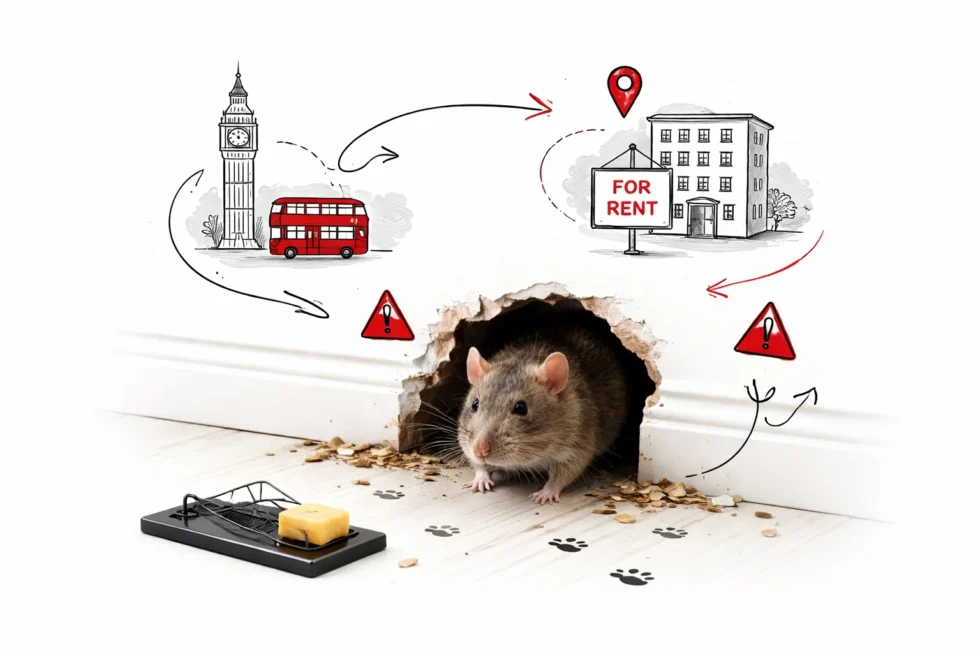
London’s rat problem is no longer urban folklore but a documented housing and public-health crisis. Borough data shows that 76,507 rat infestations were officially reported across Greater London between 2023 and mid-2025, with the highest concentrations in some of the capital’s most densely rented areas. Camden recorded 9,133 cases, followed by Islington with 6,567 and Brent with 6,523, reflecting how rodents thrive in neighbourhoods dominated by converted flats, ageing drainage systems and constant tenant turnover. These are not neglected outskirts — they are core London rental markets where infrastructure is under the most pressure.
The problem is just as severe nationwide. In 2024, councils carried out 291,132 pest-control visits, and 91% were for rats and mice, while public authorities spent around £40 million attempting to contain infestations. Yet the numbers keep rising, indicating that Britain’s pest surge is not about individual hygiene but about systemic failures in waste collection, building maintenance and landlord enforcement, particularly in the private rented sector. Delayed repairs, leaking pipes, unsealed basements and shared bin stores provide ideal breeding grounds that professional call-outs cannot fix without structural intervention.
In London, the rat crisis is intensified by high housing density and transient renting. HMOs, short-let flats and subdivided townhouses allow infestations to spread invisibly between walls, floors and drainage lines, often remaining undiscovered until colonies are fully established. For tenants, the cost can reach £150–£400 per treatment, while the health risks include exposure to bacteria such as leptospirosis and salmonella, which are carried in rodent urine and droppings. As reported by The WP Times editorial desk, citing London borough data and national council statistics.
Why there are rats in London homes
Rats are not spreading because of poverty — they are spreading because London now provides uninterrupted access to food, warmth and movement corridors. According to London Councils, the capital generates more than 7 million tonnes of household and commercial waste each year, much of it concentrated in high-density boroughs with communal bin stores and underground collection points. At the same time, over 40% of London’s housing stock was built before 1945, meaning large parts of the city still rely on Victorian drains, cracked brickwork and air-brick ventilation systems that allow rats to move from sewers directly into basements and wall cavities. This creates what pest engineers call a “closed urban habitat” — rats do not have to cross open streets to survive; they live entirely inside buildings and pipe networks.
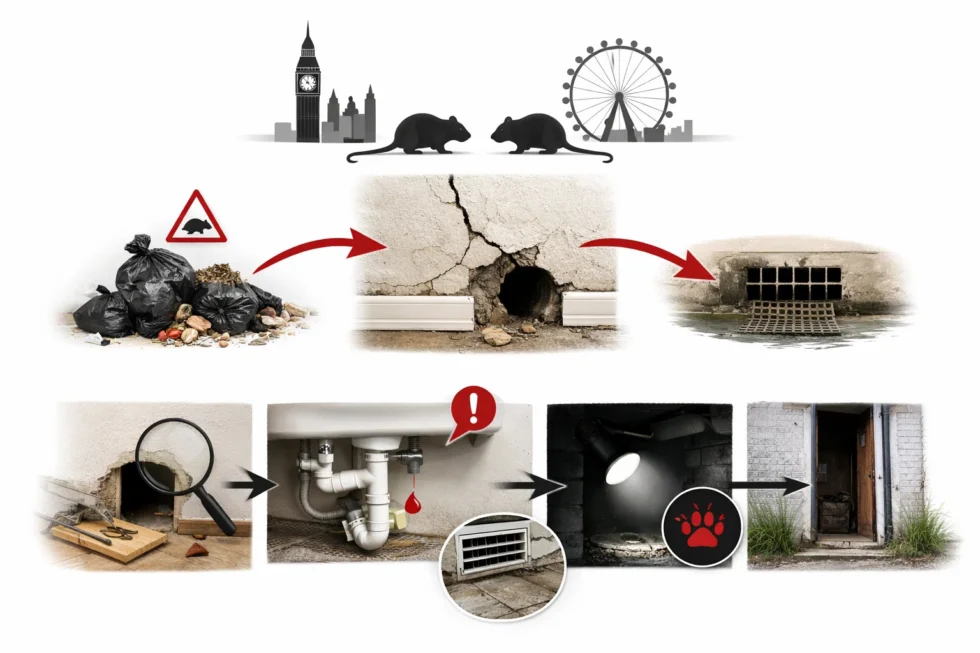
The pandemic reshaped where rats live. Rentokil Pest Control and British Pest Control Association (BPCA) both reported sharp behavioural shifts from 2020 onwards, as restaurant closures, the rise of delivery food and irregular waste collections pushed rodents out of commercial zones and into housing blocks. BPCA data shows call-outs for residential rat infestations rose by more than 30% between 2020 and 2023, while London boroughs such as Camden, Islington and Brent now record some of the highest case densities in the country. Overflowing bins, shared waste rooms and poorly sealed recycling areas in HMOs and converted flats provide stable feeding grounds that rats can access without leaving the building.
Climate change has removed what used to be London’s only natural control mechanism: winter die-off. According to the Met Office, average winter temperatures in southern England are now around 1.5°C higher than in the 1980s, significantly increasing rodent survival rates. A single breeding pair of rats can produce up to 1,200 descendants in a year under stable conditions, according to Public Health England, meaning even small entry points — a broken drain cap, a loose air vent, a cracked cellar wall — can escalate into full infestations within weeks. In a city built on old infrastructure, dense rentals and constant food waste, those conditions now exist almost everywhere.
Structural drivers inside London buildings
London’s rat problem is rooted in the way the city is built. More than 45% of homes in Inner London were constructed before 1945, according to the Office for National Statistics, and much of the private rental sector still operates inside Victorian and Edwardian buildings never designed for modern waste volumes or dense occupation. These properties contain suspended timber floors, service voids, hollow cavity walls, cracked air bricks and unsealed pipe entries that allow rats to move between flats without ever being seen. In converted townhouses and HMOs, a single colony can occupy multiple units at once, travelling vertically through wall cavities and horizontally through shared basements and drainage lines.
Waste density and food supply
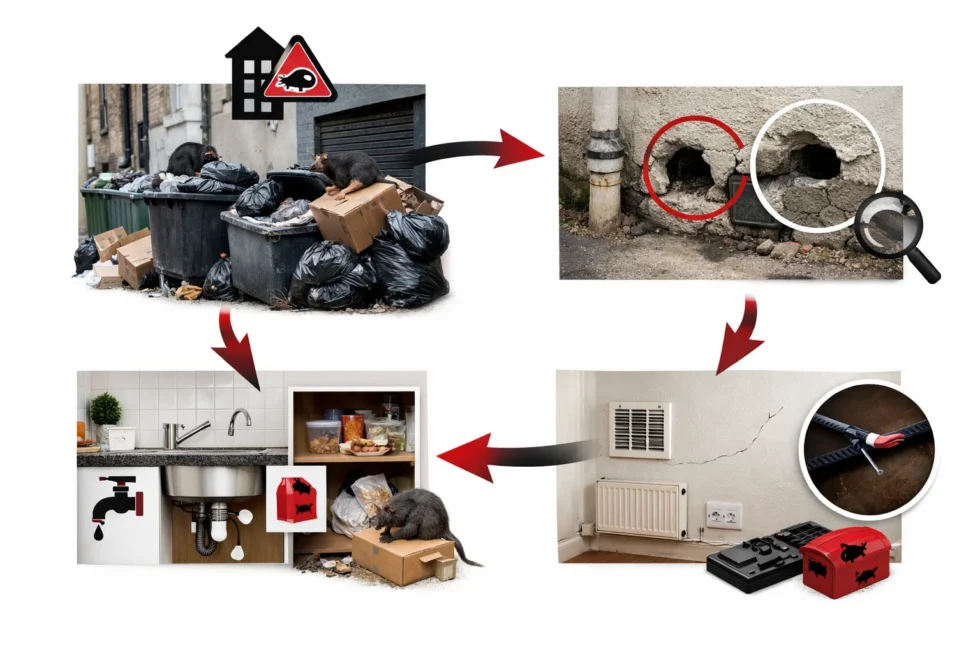
Rats follow food, and London produces it at industrial scale. Greater London generates more than 7 million tonnes of waste each year, much of it stored in communal bin rooms, rear alleyways and street-level bin bays in high-density rental areas. Takeaway clusters, late-night food delivery and poorly controlled recycling systems have turned bin stores into permanent feeding hubs. Pest-control operators warn that one unlocked or damaged bin room can support dozens of rats, which then spread into neighbouring buildings via drains, fences and basement walls, seeding entire streets with infestations.
Climate pressure
The climate is now working in the rats’ favour. The Met Office confirms that average winter temperatures in southern England are around 1–1.5°C warmer than in the 1980s, significantly increasing rodent survival rates. Cold winters once caused natural population crashes; today, rats breed almost year-round, allowing colonies to expand continuously. Public Health England estimates that a single breeding pair can produce hundreds — potentially over a thousand — offspring in a year under stable conditions, meaning even small entry points can quickly lead to major infestations.
What this means for renters
In modern London, the building matters more than the postcode. Prime areas with old housing stock can carry higher rat risk than cheaper new developments. Basement and ground-floor flats are the most exposed, as rats enter through drains, air bricks and external walls. Structural proofing — sealing gaps, repairing pipe entries and securing air vents — is far more effective than baiting, which only removes individual animals without stopping reinvasion. Finally, bin management is the strongest predictor of long-term infestation risk: a clean, locked, well-maintained waste area usually means a rat-free building, while a neglected one almost guarantees repeat problems.
How to rent a rat-free flat in London
People searching for “rat-free flat London” are usually days away from signing a tenancy. They need a repeatable system that works during a 10-minute viewing.
The 7-minute inspection that actually works
Focus on the routes rats use, not the décor.
- Under the kitchen sink – gaps around pipes, droppings, chewed wood
- Behind appliances – grease trails, dark run marks
- Cupboards and utility areas – holes, nesting material
- Doors and vents – gaps, broken air bricks, loose grilles
- Bin store – lids that close, locked doors, visible cleaning schedule
If the bin area smells bad during the day, it is far worse at night.
Questions that force real answers from agents
- Has the flat or building had pest control in the last 12 months?
- Was proofing done or only poisoning?
- Who manages the bin store and cleaning?
- Which company is contracted for pest response?
- Can you provide maintenance or inspection records?
If an agent says “London has rats everywhere”, it usually means nobody manages the building.
If rats appear after you move in
In England, infestations linked to disrepair can make a property legally unfit. That means:
- Report the issue in writing
- Demand proofing and treatment
- Escalate to the local council’s private renting or environmental health team if ignored
Landlords are normally responsible when building defects, drains, vents or bin systems contribute to infestations.
Which London areas have more rat reports — and how to interpret them
Searches like “which areas of London have rats” are common, but borough names alone are misleading. Rats track density, waste and building age, not reputation.

FOI-based reporting published in 2025 shows high reported infestation totals in boroughs including:
- Camden
- Islington
- Brent
- Newham
- Tower Hamlets
- Kensington and Chelsea
- Hackney
These are some of London’s densest rental markets with the largest volumes of converted housing and restaurant activity.
Why even wealthy boroughs appear
High-value areas contain:
- More basements
- Older housing
- More hospitality
- Higher reporting rates
That combination produces more recorded infestations, even when the neighbourhood feels “premium”.
What actually predicts a safer rental
Safer properties are:
- Upper-floor flats
- Professionally managed blocks
- Buildings with sealed service risers
- Locked, cleaned bin rooms
Riskier properties are:
- Basement conversions
- Ground-floor flats near bins
- Buildings with rear alleys and open vents
Borough context with rental-specific risk
| Borough (high reporting context) | Typical risk pattern | What to check first |
|---|---|---|
| Camden | Basement conversions, hospitality streets | Bin stores, pipe gaps |
| Islington | Split terraces, rear alleys | Air bricks, shared bins |
| Brent | High rental churn | Building maintenance |
| Newham | Dense blocks, mixed commercial | Waste room management |
| Tower Hamlets | Heavy footfall, shared areas | Proofing in service ducts |
| Kensington & Chelsea | Basements, luxury conversions | Ventilation, drainage |
| Hackney | Converted houses | Bin storage, proofing |
Digital tools and platforms renters should use
These services let you verify what agents will not tell you.
Property and area risk
- Zoopla – historical price changes, turnover and building type
- Rightmove – how long properties sit unsold or unrented
- StreetCheck – crime, overcrowding, and environmental risk
- Land Registry – ownership and building history
Waste and council services
- Your borough council website – bin collection schedules, pest-control reporting, fly-tipping history
- London Datastore – ward-level housing and environment data
Safety and street conditions
- police.uk – street-level crime and antisocial behaviour
- FixMyStreet – public complaints about bins, vermin, broken drains
A postcode with repeated waste and vermin reports is a stronger warning sign than a glossy listing.
The real rule of London renting
Rats in London are not random events — they are the predictable outcome of waste density, building integrity and maintenance regimes. London Councils and borough pest-control teams consistently show that infestations cluster in properties with communal waste systems, shared drainage and ageing fabric, not in particular postcodes or income brackets. More than 40% of London’s private rented homes sit in pre-1945 buildings, where suspended floors, open service ducts and cracked air bricks create permanent access routes from sewers and bin stores into living space.

What actually protects a tenant is not the area but the management standard of the building. Blocks with sealed pipe penetrations, intact air-brick grills, dry basements and locked, professionally cleaned bin rooms record far fewer repeat infestations, even in high-risk boroughs. By contrast, converted townhouses and HMOs with shared waste rooms and informal maintenance cycles account for a disproportionate share of borough call-outs, because a single structural failure allows rats to reinvade endlessly.
This is why experienced London renters look for maintenance logs, drain inspections and waste-management contracts, not just glossy listings. In practice, a £2,000-a-month flat in a poorly managed Victorian conversion carries more rodent risk than a £1,200 flat in a modern, professionally run block. That is the real rule of London renting — the building, not the postcode, determines whether rats can live with you.
Read about the life of Westminster and Pimlico district, London and the world. 24/7 news with fresh and useful updates on culture, business, technology and city life: Luxury gyms in London: why are the best clubs concentrated in SW1 and Westminster in 2026