
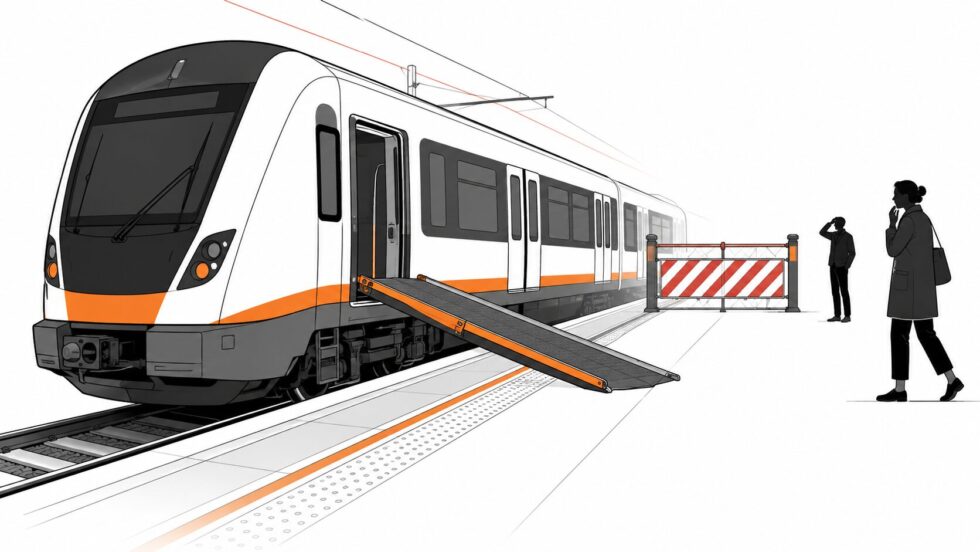
London Overground ramp safety report has set out how a passenger train departed Norwood Junction station with a portable access ramp still attached at around 09:52 on Tuesday, 1 July 2025, before the ramp struck the end-of-platform barrier and fell beside the track. No one was injured, but a member of station staff and a passenger had to move out of the ramp’s path as it travelled down the platform, The WP Times reports, citing the Rail Accident Investigation Branch press release published on 22 June 2026.
The RAIB report is serious not because it describes a fatal accident, but because it shows how several layers of railway safety control failed at the same time. The train was able to close its doors and take traction power while the ramp remained attached, platform staff did not know the ramp was not the correct type for the train, and the driver’s dispatch checks did not identify the hazard before departure. RAIB also found that staff attempts to stop the train were ineffective because the warning signals could not be seen by the driver on the cropped image shown on the in-cab monitor.
London Overground ramp safety report: the key facts from Norwood Junction
The incident happened at Norwood Junction station in south London on Tuesday, 1 July 2025. A portable access ramp had been placed at a doorway to assist a passenger using mobility equipment. The train then departed while the ramp was still attached, and the ramp moved along the platform until it collided with the end-of-platform barrier. RAIB said the ramp was damaged beyond repair and the train sustained minor damage. The investigation found no injuries, but the event created an immediate risk to people on the platform.
The central technical point in the RAIB findings is that the ramp in use was the incorrect type for the train involved. Because of that, its presence at the doorway did not prevent the train door from closing and did not stop traction power from being taken. In practical terms, a safety barrier that should have helped prevent movement did not work as expected in this specific equipment combination. Platform staff were unaware that the ramp being used was not the correct ramp for the train. RAIB also found that the correct ramp had not been available since September 2021, and station checks before the accident had not identified that problem.
| Point checked by RAIB | What the report found |
|---|---|
| Time and date | Around 09:52 on Tuesday, 1 July 2025 |
| Location | Norwood Junction station |
| Train involved | London Overground passenger train |
| Immediate event | Train departed with portable access ramp attached |
| Injuries | No injuries reported |
| Damage | Ramp damaged beyond repair; minor train damage |
| Main equipment issue | Incorrect type of ramp was used |
| Missing correct ramp | Correct ramp unavailable since September 2021 |
| Report publication | 22 June 2026 |
Why the train was able to move with the ramp still attached
RAIB’s investigation found that the ramp did not block the door-closing or traction systems because it was not the correct type for the train. That finding matters because portable access ramps are part of everyday accessible travel for wheelchair users and passengers using mobility scooters. They are not unusual equipment, and they depend on staff knowing which ramp is suitable for which rolling stock. In this case, the wrong ramp created a condition in which the train systems did not detect the remaining obstruction in the way that staff may have expected. The result was a dangerous departure that only became visible once the train had already started moving.
The report also points to a wider management problem rather than a single isolated mistake. RAIB said Arriva Rail London, which operated the London Overground concession at the time of the accident, had not identified the risks associated with using portable access ramps. Processes for checking ramps at stations did not identify which ramp was appropriate for the relevant rolling stock. This meant the absence of the correct ramp remained unnoticed for years. The current London Overground operator is First Rail London, and RAIB’s first two recommendations are directed to it.
Driver distraction, mobile phone use and failed platform warnings
RAIB found that the driver departed Norwood Junction believing it was safe to dispatch the train. The driver’s safety checks during dispatch were ineffective. Although the report says other factors may have been present, RAIB concluded this was probably because the driver was distracted while making a mobile phone call at the time the train departed. That point is one of the most sensitive findings because driver attention during dispatch is one of the final barriers before a train moves.
Platform staff did try to stop the train, but those efforts did not work. RAIB said the warning signals being used by staff could not be seen by the driver because of the cropped image shown on the in-cab monitor. This means the problem was not only the wrong ramp or the driver’s attention. It was also a visibility and communication problem at the exact moment when the train could still have been stopped. In a busy station environment, that combination is precisely the type of chain RAIB investigations are designed to examine.
RAIB identified three underlying factors:
- Arriva Rail London had not identified the risks linked to portable access ramp use.
- Station ramp-checking processes did not identify the correct ramp for the relevant rolling stock.
- Arriva Rail London’s processes for reducing the risk of driver inattention from mobile devices were not sufficiently effective.
What RAIB recommended after the London Overground ramp safety report
RAIB made six recommendations following the Norwood Junction investigation. The first two are addressed to First Rail London, the current operator of the London Overground concession, and are aimed at improving management of portable access ramps. The third and fourth recommendations are addressed to the Department for Transport and the Rail Safety and Standards Board, focusing on legislation and regulations around portable access ramps. The fifth and sixth are addressed to the Rail Safety and Standards Board and the Office of Rail and Road, focusing on mobile device use by drivers.
The recommendations show that RAIB sees this as a system issue involving equipment, checks, regulation and driver-distraction controls. The report does not simply say that one person made one mistake. It describes a chain in which the correct ramp had been missing for years, station checks failed to identify that absence, platform staff did not know the ramp was unsuitable, the train could still take power, the driver’s checks were ineffective, and staff warning signals were not visible in the cab image. That is why the incident is significant even without injuries.
RAIB also identified two learning points. The first reminds railway staff of the risks created by distracting personal issues and the importance of seeking help from their employer. The second reminds train drivers that mobile devices are a major source of distraction and that their use is not permitted during operations. RAIB also stressed in its notes that its investigations are intended to prevent future accidents and improve railway safety, not to establish blame, liability or prosecution.
What passengers should understand from the Norwood Junction ramp case
For passengers, the most important point is that the incident involved equipment used to support accessible boarding. Portable access ramps are essential for many disabled passengers and people using mobility aids. The safety issue here was not the existence of ramps, but the management of the correct ramp type, the checks around station equipment and the way the train was dispatched. The report therefore raises practical questions about how accessible travel equipment is stored, checked, matched to trains and controlled across the network.
The case also highlights why near-miss investigations matter. No one was injured at Norwood Junction, but RAIB’s findings show that the outcome could have been more serious if someone had remained in the ramp’s path or if the ramp had behaved differently after departure. The damaged ramp and minor train damage were visible consequences, but the deeper concern was the failure of safety layers. For London rail users, the report is a reminder that accessible boarding must be treated as an operational safety process, not just a customer-service task.
The publication of Report 09/2026 now puts responsibility on the industry bodies named in the recommendations. First Rail London, the Department for Transport, the Rail Safety and Standards Board and the Office of Rail and Road are all addressed in different parts of RAIB’s response. The test will be whether ramp management, station checks, equipment compatibility and mobile-device controls become stronger after the Norwood Junction incident. The purpose of the report is prevention, and its findings point to clear areas where the railway system is expected to learn.
Read about the life of Westminster and Pimlico district, London and the world. 24/7 news with fresh and useful updates on culture, business, technology and city life: M5 traffic delays after police incident near Avonmouth Bridge: what happened and what drivers need to know