
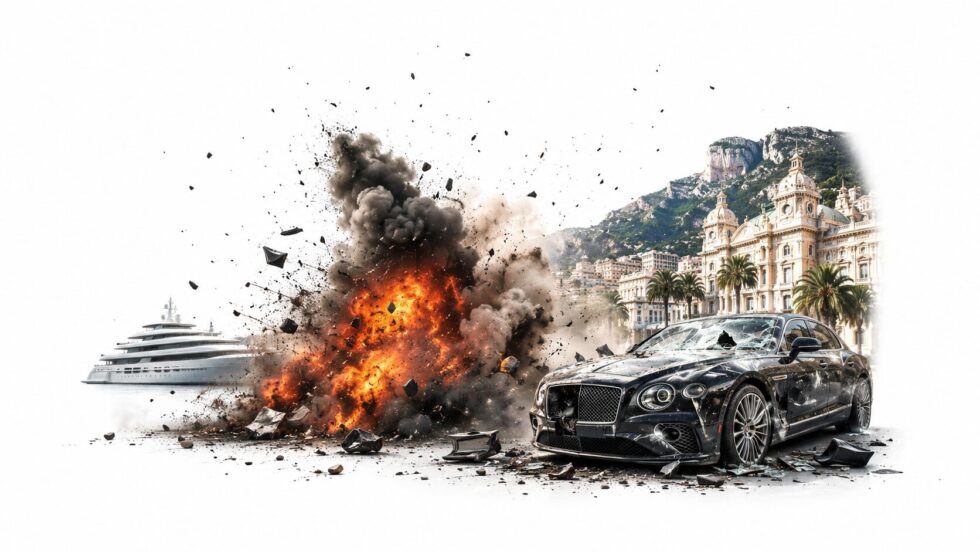
MONACO/DNIPRO — In one of the most secure micro-states in Europe, a shrapnel-packed parcel bomb planted in the lobby of a residential building on Rue Révérend Père Louis Frolla — in the eastern Moneghetti quarter of the principality, right on the French border — detonated shortly before 9pm on Monday evening, critically wounding three members of a family of Ukrainian origin. The reported target, according to French, British and Ukrainian media citing investigators, was 58-year-old Cyprus-passported tycoon Vadym Yermolaiev, the Dnipro-born founder of the Alef conglomerate who has been under Ukrainian sanctions since December 2023 over alleged business ties to Russian-occupied Crimea. The lone suspect — caught on CCTV dropping a bag at the entrance moments before the blast — fled on foot across the open, check-free border into the neighbouring French town of Beausoleil and remains at large, as Monaco's Prosecutor General Stéphane Thibault branded the bombing an "attempted assassination", ruled out terrorism, and launched a cross-border manhunt involving dozens of officers. So who is the man at the centre of this unprecedented case, and what lies behind an attack that has shattered Monaco's reputation as a fortress for the super-rich? This report from The Westminster Pimlico News pulls together the facts, the background and the press accounts.
A blast that shook the world's safest enclave
It was an ordinary Monday night on the Côte d'Azur when the calm of the principality was torn apart. At just before 9pm local time, a powerful explosion ripped through a residential building on Rue Révérend Père Louis Frolla, a narrow street in the Moneghetti district in the east of Monaco, hard against the frontier with France. Three people were wounded, two of them critically.
Monaco's authorities moved quickly towards the conclusion that this was a targeted attack. Minister of State Christophe Mirmand confirmed to French broadcaster BFM TV that the device had been concealed in a bag deposited by an unknown man in the entrance hall of the building. According to Mirmand, the bomb had been packed with nuts and bolts — a chilling detail that lays bare the cold calculation behind it. The device, he said, had effectively been turned into a shrapnel bomb, designed to inflict the maximum possible injury.
French daily Le Figaro and broadcaster BFM TV described it as a "parcel bomb" — a weapon meant not to strike at random, but to maim or kill a specific person. Al Jazeera reported that the principality's public prosecutor confirmed a suspect had left a bag or package in the building's lobby before walking away (Al Jazeera).
Beyond the three principal victims, four more people were treated — for shock or for minor wounds caused by flying glass. The scale of the carnage, in a country renowned as one of the safest addresses on earth, left the principality reeling.
The victims: a couple and a 13-year-old boy
For hours, the official authorities refused to name the wounded. What was clear early on was that this was a family. According to Minister of State Mirmand, two adults — a couple — sustained life-threatening injuries, while a 13-year-old boy, "very likely related to the couple", as he put it, suffered less serious wounds (Al Jazeera).
The accounts of the gravely injured woman are harrowing. Israeli outlet Ynet, citing witnesses, reported that Anna Yermolaiev was found lying in blood with her feet severed by the blast, while a 13-year-old boy believed to be the couple's son lay on the ground covered in blood as a passer-by tried to help him (Ynet). Canadian broadcaster CBC, citing a source familiar with the investigation, reported that the woman — the man's partner — had been "badly wounded from the waist down" (CBC News). She was taken to a hospital in Nice; a transfer to Marseille was also under consideration.
According to surveillance footage, the family appeared to be "returning home peacefully" in the early evening when the device detonated — precisely as the three residents of a ground-floor apartment reached their front door. It was, in other words, no random blast but an attack timed with lethal precision.
Ukraine's Foreign Ministry also weighed in, stating that "according to local emergency services" the three people injured in the explosion were members of "a family of Ukrainian origin" (CNN).
The name behind the headlines: Vadym Yermolaiev
Monaco's authorities pointedly declined to name the victims. Prosecutor Thibault would say only that the adult male victim had been a resident of Monaco since at least 2021. But from investigative circles a name swiftly emerged — one that resonates across Ukraine and far beyond: Vadym Yermolaiev.
The AFP news agency learned from investigators that Yermolaiev was among the casualties. Reuters, AP, BFM TV and Le Figaro all reported that the seriously injured man was the Ukrainian businessman. Reuters went further, reporting that French media described Yermolaiev as the "presumed target" of the attack (Reuters). Bloomberg likewise confirmed that the blast had wounded a "local resident sanctioned by Ukraine for doing business in occupied Crimea" (Bloomberg).
A police source confirmed to CBC that the injured couple were Yermolaiev and his partner, and that the third, less seriously hurt, was his son (CBC News).
But who is this man, whose name has now travelled the globe? The answer leads deep into the world of post-Soviet enterprise, into the construction boom of the Ukrainian industrial city of Dnipro, into the tax havens of the Mediterranean — and into the long shadow of Russia's war.
From Soviet child to multimillionaire: the rise of a property baron
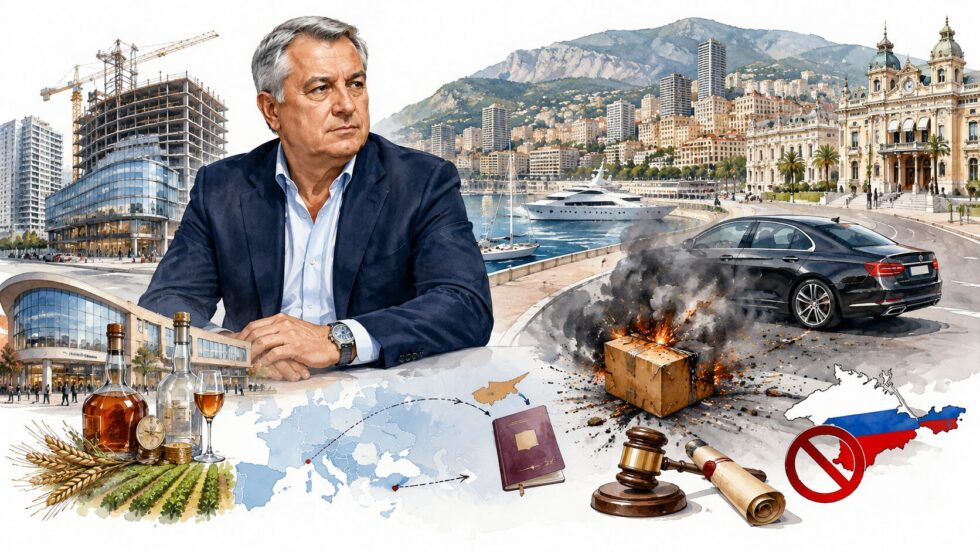
Vadym Yermolaiev was born in Dnipro, the former missile-building powerhouse of the Soviet Union and now a city of nearly a million in eastern Ukraine. He made his name not in the arms industry but in real estate. Through his Alef group he built a conglomerate spanning property development, manufacturing, agriculture and — a detail that would later prove central — the drinks and alcohol trade.
CNN described how Yermolaiev "made his fortune in Dnipro… during the wild post-Soviet years", focusing mostly on real estate and rising at one point to rank among the wealthiest Ukrainians (CNN). He became one of his home city's foremost developers, leading projects that reshaped parts of central Dnipro, including a string of well-known shopping, entertainment and business centres, and the rebuilding of the prominent Pivdennyi Boulevard. AP called him one of the country's "best-known property developers" (AP).
His commercial success was reflected in the rich lists. Forbes Ukraine placed him among the country's 100 wealthiest individuals; in 2020 he ranked 23rd. Ukrainska Pravda described him as a "businessman from Dnipro, founder of the Alef trade and industrial corporation and one of the city's largest property developers" (Ukrainska Pravda).
The break: renouncing citizenship for a Cypriot passport
The first major fracture in Yermolaiev's public biography came when he gave up his Ukrainian citizenship and took Cypriot nationality. (Media accounts variously date this to 2017 and 2019; Yermolaiev himself dated it to 2017 in a Forbes interview, while CBC and CNN cite 2019.)
His justification later drew scrutiny. In an interview with Forbes Ukraine, the businessman explained the renunciation by his desire for "international protection". As CNN quoted him: "The Ukrainian judicial system, to put it mildly, is not perfect, and the tax system is not objective" (Forbes Ukraine, via CNN).
Since giving up his Ukrainian passport, Yermolaiev is said to have divided his time chiefly between Cyprus, London and Monaco. With the onset of Russia's full-scale invasion in February 2022, he shifted his centre of life largely to the principality — the tiny Mediterranean tax haven that has become the bolthole of choice for wealthy Eastern Europeans.
The 'Monaco battalion': an exodus of the elite
Yermolaiev's move was no isolated case. The Kyiv Post reported that he belonged to an elite group who left Ukraine shortly after the start of Russia's war and relocated to the principality, and that a probe had been launched into members of that group (Kyiv Post). Ukrainska Pravda devoted an entire investigation to the phenomenon, in which Yermolaiev featured — the "Monaco Battalion" exposé into Ukrainian businessmen, politicians and oligarchs who settled on the French Riviera during Russia's full-scale invasion (Ukrainska Pravda).
While millions of Ukrainians endured war, nightly bombardment and displacement, some of the country's richest citizens made themselves comfortable in the tax havens of Western Europe — a contrast that provoked considerable anger among the Ukrainian public. Monaco itself acts as a magnet for the super-rich. Reuters characterised it as a place known for "its casino and luxury yachts, its tight security and the luxury lifestyle of its super-rich residents" (Reuters). NPR added that the principality is "a coastal playground for the rich and famous", as renowned for its tax-friendly incentives and Formula 1 Grand Prix as for its glamorous royal family (NPR).
The sanctions: the charge of Crimean business
In December 2023, Ukraine's National Security and Defence Council, under President Volodymyr Zelensky, imposed sanctions on Yermolaiev, thrusting the multimillionaire into the centre of a highly charged political conflict.
The core of the allegation: companies within his Alef group are said to have continued operating on the Russian-occupied Crimean peninsula after its 2014 annexation. Al Jazeera reported that the sanctions reportedly stemmed from his "alcohol business activity in Russian-occupied Crimea" (Al Jazeera). The measures were severe. As reported, a UN Human Rights Council investigation had earlier found that Yermolaiev and his companies were paying taxes to Russia, prompting the freezing of his assets; he is barred for ten years from carrying out financial transactions in Ukraine.
The suspicion of sanctions evasion — and a denial
Yet, according to media reports, the businessman is said to have circumvented much of those sanctions. The method described is as simple as it is effective: Yermolaiev is reported to have transferred his companies — 15 so far — into the name of his daughter or of a German national named Yevhen Steinberg, obscuring the true ownership.
Yermolaiev has consistently rejected the accusations against him. Ynet noted that, like many oligarchs who rose to wealth after the Soviet collapse, he has faced criminal allegations over the years, including money laundering — which he denies (Ynet). Crucially, CNN observed that Yermolaiev "does not have any obvious links to the war in Ukraine" (CNN), and Britain's Guardian has pointed out that he had not publicly presented himself as a supporter of pro-Russian positions (The Guardian). The portrait is therefore more complex than the simple "Putin oligarch" label some outlets have attached to him — a man in a grey zone between formal distance from the Kremlin and the commercial entanglements that earned him his own country's sanctions.
A dark chapter: the son and the €100 million phone scam
Yermolaiev's family history holds another, legally explosive chapter. His son, Artur Yermolayev, was convicted of fraud in Estonia in April this year.
According to court documents cited by CNN, Artur Yermolayev pleaded guilty to creating and running a phone-scam scheme that, under the guise of fake investment opportunities, stole some €100 million between 2019 and 2022 (CNN). He was sentenced to five years' imprisonment but secured a deal under which he would be deported from Estonia after serving just four months.
Whether this chapter connects to the Monaco bombing is entirely open. But it illustrates the shadowy, at times criminal, web surrounding the oligarch — a web the investigators must now untangle as they search for a motive.
The attack: a bag, a lobby, an explosion
Reconstructing the sequence from the press accounts paints the picture of a coldly planned strike. Just before 9pm on Monday, a man left a bag or parcel in the entrance hall of the residential building. Moments later, it exploded.
Prosecutor Thibault confirmed that an unidentified suspect had placed a parcel bomb in the building shortly before 9pm, and that it detonated as the three residents of a ground-floor apartment arrived home (CNN). Le Figaro reported that security cameras captured the suspect placing a bag at the entrance moments before the blast (Le Figaro). According to Ynet, witnesses described a horrific scene: a woman lying in blood, her feet severed; a boy on the ground, covered in blood, as someone tried to help him (Ynet).
Two of the three principal victims, Thibault said on Tuesday, remained in a critical condition; the other adult victim was no longer critical. Investigators had not yet been able to speak to the victims (CNN).
The escape: on foot across an open border
What complicates the manhunt is Monaco's geography. The principality is bounded by the Mediterranean on one side and France on the other — with no border checks between the two states. Italy, too, is close at hand. The suspect exploited that open frontier.
He fled on foot into neighbouring France. Gérard Spinelli, mayor of the French border town of Beausoleil, told a press conference that the suspect had been filmed fleeing into his town (AP). Prosecutor Thibault confirmed the direction of flight into France.
The man's appearance is now documented. BFM TV published a photograph of the reported suspect: a man in a black jumper, light-coloured trousers and a black bucket hat, captured running away (CNN/BFM TV). Ynet described the suspect as wearing a black cap and sweatshirt and white jeans (Ynet). Monaco Matin published its own CCTV image of the man, in a dark hat and top with a white bag over his shoulder (Monaco Matin).
The manhunt: dozens of officers across two countries
The response was substantial. By Tuesday morning, large numbers of police had been deployed across Monaco and the surrounding region. A manhunt involving dozens of officers from both Monaco and France was under way (CNN).
Prosecutor Thibault left no doubt about the authorities' resolve. "In coordination with the French authorities, we are pursuing efforts to identify and apprehend him. I hope that will happen quickly, given the resources we are deploying," he said (Reuters, via CBC News).
The legal framing of the case is significant. Monaco's police opened an attempted-murder investigation but expressly declined to qualify it as terrorism. Thibault called it an "attempted assassination" and ruled out a terrorist motive (CNN). The distinction is telling: it points to investigators treating this as a targeted strike against a specific individual, not an ideologically driven act against the public at large. The attacker, in their assessment, acted alone.
Prince Albert II: 'an odious act'
The shock reached the very top of the state. Prince Albert II of Monaco described the attack as "an odious act", which he said was a shock for all in Monaco (Reuters/CBC News). The Prince stressed that Monaco was working in close coordination with the French authorities to track down the suspect.
Those words underline how deeply the incident has struck at the self-image of the principality. Monaco has for decades sold itself as a haven of safety — a place where the world's wealthy and powerful can live undisturbed and protected. A bomb in the heart of a residential quarter shakes the very foundations of that promise.
Why Monaco? A surveillance state in shock
To grasp the gravity of the incident, one must understand what makes Monaco singular. The principality is considered one of the safest states in Europe, indeed the world. Across its tiny footprint of roughly two square kilometres, the micro-state maintains an extraordinarily dense network of surveillance cameras and a police density that, relative to its population, is exceptionally high.
That is precisely what makes the attack so extraordinary. Minister of State Mirmand captured the disbelief: he was not aware of any comparable case ever having occurred in the principality (NZZ). Yet, as Ynet noted, in recent years Monaco has also been linked to corruption scandals and allegations of money laundering by mafia-style networks, including groups of Ukrainian origin (Ynet) — a more troubling underside to the gilded image.
That dense camera network is now likely to become the decisive factor in the investigation. While the open border eased the escape, the countless surveillance systems have furnished the investigators with valuable footage — from the dropping of the bag, through the detonation, to the suspect's flight. It is a race between the surveillance state's near-total coverage and the head start of a man who slipped across a control-free frontier.
A pattern: violence against the Ukrainian diaspora
The Monaco bombing fits into a disturbing pattern. Time and again, Ukrainian and pro-Russian figures in West European exile have found themselves in the crosshairs. Reuters and CBC both recalled a comparable case: in February this year, a person suspected of killing a former pro-Russian Ukrainian politician outside a school in a wealthy Madrid suburb in 2025 was arrested in Germany (Reuters/CBC News).
That parallel raises questions reaching far beyond the immediate case. Are such attacks part of a deliberate campaign? Are they reckonings within criminal or intelligence networks? Or personal feuds, business disputes, acts of revenge? In Yermolaiev's case, the motive remains, by the authorities' own account, under investigation — and CNN's observation that he has "no obvious links to the war" only deepens the puzzle. The range of possible backdrops is wide. There is the political dimension: his sanctioning by Kyiv, the Crimea allegations, his place in the Ukrainian-Russian fault line. There is the commercial dimension: a conglomerate spanning several countries, a son convicted of a €100 million fraud, a lattice of concealed ownership. And there is the simple possibility of a private quarrel. Investigators face the formidable task of finding the true motive within this thicket.
The many spellings of a single name
Anyone following the international coverage encounters a striking variety of spellings of the name — a reflection of the different transliterations from Cyrillic. British and international press — Reuters, CNN, AP, NPR, Al Jazeera, The Guardian — mostly use "Vadym Yermolaiev". Bloomberg writes "Vadym Iermolaiev"; France's BFM TV uses "Vadim Ermolaev"; German-language outlets render it "Wadym" or "Wadim Jermolajew". Behind every variant stands one and the same person: the 58-year-old oligarch from Dnipro. The confusion is more than a linguistic footnote — it mirrors the transnational existence of a man who shuttled between Ukraine, Cyprus, London and Monaco, an identity no longer contained by any single national frame.
The open questions
Despite the dense reporting, the central questions remain unanswered. Why exactly were Yermolaiev and his family targeted? The honest answer, for now, is that it is unclear, and the investigations in Monaco and France are continuing.
The suspect's identity is also unresolved. Surveillance images exist, but no name. And there is the question of the victims' condition: at the time of the latest updates, the gravely injured woman, her partner and the 13-year-old boy remained in hospital — two of them still critical.
Table: the key facts at a glance
| Aspect | Detail |
|---|---|
| Location | Rue Révérend Père Louis Frolla, Moneghetti, Monaco (on the French border) |
| Time | Monday evening, just before 9pm local time |
| Weapon | Parcel/backpack bomb packed with nuts and bolts (shrapnel) |
| Victims | Couple (critically injured) + 13-year-old boy (less serious) |
| Reported target | Vadym Yermolaiev, 58, Ukrainian-born oligarch |
| Others treated | Four people for shock / glass wounds |
| Suspect | Lone attacker, fled on foot to Beausoleil (France) |
| Legal status | Attempted murder / "attempted assassination"; not terrorism |
| His company | Alef Corporation (real estate, industry, agriculture, drinks) |
| Sanctions | By Ukraine since December 2023 |
| Citizenship | Cypriot (renounced Ukrainian 2017/2019) |
| Wealth ranking | 23rd richest Ukrainian (Forbes 2020) |
The case of Vadym Yermolaiev is far more than a sensational crime story from the glamour-state of Monaco. It is a parable of the globalised existence of the post-Soviet business elite — of the entanglement of wealth, politics and war, and of the vulnerability of even the best-protected people on earth.
Yermolaiev embodies a generation of entrepreneurs who amassed enormous fortunes in the rubble of the Soviet Union and who, when conditions at home grew unstable, withdrew to the tax havens and safe harbours of Western Europe. Monaco, Cyprus, London: these are the way-stations of a life that traded national loyalties for legal and fiscal advantage. Yet, as the attack shows, even the greatest wealth offers no absolute security. The conflicts of the homeland — war, sanctions, business disputes — travel along too.
For Monaco itself, the incident marks a watershed. A principality that built its prosperity on a promise of safety and discretion must now confront whether it can still master the risks its wealthy residents bring with them. When Ukrainian oligarchs, Russian businessmen and international magnates carry their conflicts into the narrow lanes of the principality, the finely balanced equilibrium of glamour and security begins to wobble.
What happens next
The coming days are likely to prove decisive. Central is the question of whether the manhunt succeeds. Thibault has held out the prospect of a swift arrest — though the open borders with France and Italy make the task daunting. Should the man be caught, his testimony could shed light on any handlers and on the motive.
In parallel, the authorities in Monaco and France will pore over the extensive video footage furnished by the principality's many cameras. Forensic analysis of the bomb's remnants — the nuts, bolts and detonator — may also yield clues to the attacker and his possible connections; such devices often carry a distinctive "signature" that can lead investigators towards particular networks. And there remains the question of the victims' fate, which will shape the coverage in the days to come.
The Monaco bombing has critically injured one of Ukraine's richest men and shaken the safest principality in Europe to its core. Vadym Yermolaiev — property baron from Dnipro, sanctioned oligarch, resident of the golden Riviera — has become the target of a coldly planned act whose motives remain in the dark. As dozens of police hunt across the open border into France and Prince Albert II speaks of an "odious act", the central question stays open: who wanted the oligarch dead — and why?
Who Is Vadym Yermolaiev
Vadym Yermolaiev is a 58-year-old Ukrainian-born oligarch who made his fortune in the south-eastern industrial city of Dnipro during the turbulent post-Soviet years, building the Alef conglomerate into one of the region's most powerful business empires. Once ranked among Ukraine's wealthiest individuals, he later renounced his Ukrainian roots, settled among the super-rich on the French Riviera, and became one of the most prominent names on Kyiv's sanctions list — a man whose globalised, controversy-shadowed life made him, according to French and Ukrainian media, the presumed target of Monday's parcel-bomb attack.
The key facts:
- Born: Dnipro, Ukraine; now 58 years old.
- Business: Founder of the Alef Corporation — a conglomerate spanning real estate, industry, agriculture and the drinks/alcohol trade. One of Dnipro's biggest property developers, behind major shopping, entertainment and business centres and the rebuilding of the Pivdennyi Boulevard.
- Wealth: Multimillionaire; ranked 23rd richest Ukrainian by Forbes (2020).
- Citizenship: Renounced his Ukrainian citizenship (2017/2019) and took a Cypriot passport, citing a desire for "international protection".
- Residence: Has lived mainly in Monaco since Russia's full-scale invasion; previously split his time between Cyprus, London and Monaco. Named in Ukrainska Pravda's "Monaco Battalion" investigation into elites who fled to the Riviera.
- Sanctions: Under Ukrainian sanctions since December 2023 over alleged business ties to Russian-occupied Crimea (notably alcohol sales); barred for ten years from financial transactions in Ukraine.
- Controversies: Accused of evading sanctions by transferring companies to his daughter and a German national; has faced money-laundering allegations over the years — all of which he denies. His son Artur was convicted in Estonia of a €100 million phone-scam fraud.
- Note: Despite the "Putin oligarch" label, CNN reports he has "no obvious links to the war", and The Guardian notes he has not publicly taken pro-Russian positions.
The throughline: a self-made post-Soviet tycoon whose wealth, sanctions and tangled cross-border dealings turned him into a figure of intense controversy — and, on Monday night, the apparent target of an assassination attempt.
FAQ – Your questions on the Monaco bomb attack answered
Who is Vadym Yermolaiev?
A 58-year-old, Dnipro-born businessman and founder of the Alef conglomerate (real estate, industry, agriculture, drinks). Once ranked 23rd richest Ukrainian by Forbes (2020), he renounced his Ukrainian citizenship for a Cypriot passport and has lived mainly in Monaco since the war began.
What happened in Monaco?
Just before 9pm on Monday, a parcel/backpack bomb packed with nuts and bolts, left in a building's entrance by an unknown man, exploded on Rue Révérend Père Louis Frolla. Three people were injured, two critically.
Why was Yermolaiev sanctioned?
Ukraine imposed sanctions in December 2023, alleging that companies in his group continued doing business — notably selling alcohol — in Russian-occupied Crimea. He denies the accusations.
Has the attacker been caught?
No. The lone suspect fled on foot into the French border town of Beausoleil. A manhunt with dozens of officers from Monaco and France is under way. CCTV shows a man in a black jumper and black bucket hat.
Is this being treated as terrorism?
No. Prosecutor General Stéphane Thibault is treating it as attempted murder — an "attempted assassination" — and has ruled out terrorism. The motive is under investigation.
Read about the life of Westminster and Pimlico district, London and the world. 24/7 news with fresh and useful updates on culture, business, technology and city life: UFC Freedom 250 UK time: White House card, Trump controversy and why this is not a normal UFC night