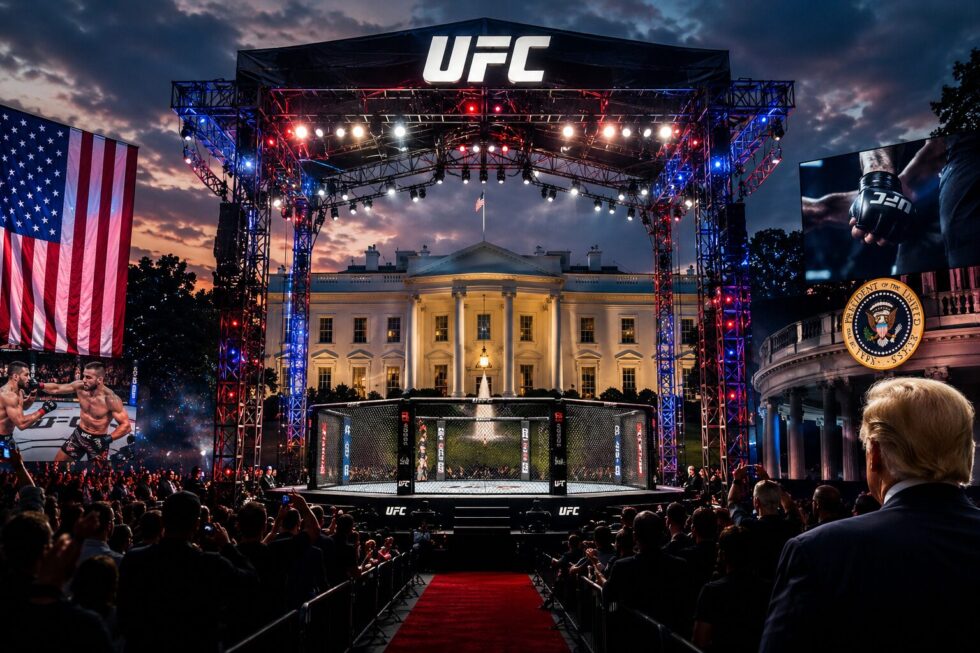
UFC Freedom 250 will take place on Sunday, 14 June 2026, on the South Lawn of the White House, turning one of the most controlled political spaces in the United States into a live mixed martial arts arena for seven fights, two title bouts and a global broadcast built around Donald Trump’s 80th birthday and America’s 250th anniversary celebrations. For UK viewers, the key answer is direct: UFC Freedom 250 UK time is 1am BST on Monday, 15 June, because the main card begins at 8pm ET in Washington, with Ilia Topuria vs Justin Gaethje headlining the night and Alex Pereira vs Ciryl Gane placed underneath as the co-main event, The WP Times reports.
The bigger story is not only when is UFC White House or what time is UFC Freedom 250 in the UK. The bigger story is why a cage-fighting card is being staged at the presidential residence, why Marjorie Taylor Greene has criticised the location despite saying she enjoys UFC, why a Reuters/Ipsos poll found limited public support for the idea, and why the UFC White House card has become a collision of sport, presidential branding, public symbolism, security, money, television rights and political culture. This is not simply UFC 250 with a patriotic name. It is officially UFC Freedom 250, a one-off White House spectacle that uses the language of national celebration while placing a privately run combat-sports promotion at the centre of American power.
UFC Freedom 250 UK time: when is UFC White House and how late will British fans need to stay up
UFC Freedom 250 is scheduled for Sunday, 14 June 2026, at the White House in Washington, D.C., with the main card starting at 8pm Eastern Time. In the United Kingdom, that means the UFC White House card begins at 1am BST on Monday, 15 June, so British fans should treat this as a late Sunday night turning into an early Monday morning broadcast. The card is shorter than a normal numbered UFC event because it is built around seven fights rather than the usual long prelims, early prelims and main card rhythm. That matters for UK viewers because the main event may arrive earlier than a standard pay-per-view main event, although delays remain possible because the show is outdoors and weather in Washington has been a concern. The official UFC listing identifies the event as UFC Freedom 250 and places it at the White House, not at a conventional arena, which is why searches such as UFC Whitehouse, UFC White House 250 and UFC 250 Freedom are all pointing to the same unusual event.
The event starts at a simple time, but the wider schedule is more complicated because it is designed as a political and television spectacle rather than a standard fight-week product. The White House setting means extra security, invited guests, controlled access, a symbolic fan zone nearby and a production structure built around the South Lawn itself. About 4,300 people are expected inside the event area, while a much larger crowd is expected around the nearby fan zone. That split between a limited invite-only arena and a wider public spectacle is central to the story. UFC Freedom 250 is not just being watched by fight fans; it is being read as a public statement about who gets access to the White House and what kind of entertainment belongs there.
UFC White House card UK time and main details
| Detail | Information |
|---|---|
| Official event name | UFC Freedom 250 |
| Common search names | UFC White House, UFC White House 250, UFC 250 Freedom, UFC Freedom |
| Date in Washington | Sunday, 14 June 2026 |
| UK date | Monday, 15 June 2026 |
| Main card UK time | 1am BST |
| Main card US time | 8pm ET / 5pm PT |
| Venue | White House South Lawn, Washington, D.C. |
| Main event | Ilia Topuria vs Justin Gaethje |
| Co-main event | Alex Pereira vs Ciryl Gane |
| Broadcast | Paramount+ in the United States |
| Format | Seven-fight main card |
The practical advice for British readers is to check the bout order close to the start. Outdoor timing, presidential ceremony elements and broadcast pacing can all alter the exact moment when Topuria and Gaethje walk out. But the essential UFC Freedom 250 UK time remains 1am BST.
UFC White House card: Topuria vs Gaethje gives the spectacle real sporting weight
The political setting is extraordinary, but UFC has protected the sporting legitimacy of the night by placing a major lightweight title unification bout at the top of the card. Ilia Topuria vs Justin Gaethje is not a ceremonial exhibition, not a celebrity crossover and not a soft main event designed only for television pictures. Topuria enters as champion with elite finishing power, serious international pull and the confidence of a fighter who has become one of UFC’s most valuable names across Europe and the United States. Gaethje enters as the American pressure fighter, a former interim champion with a career built on violence, pace, durability and the ability to turn technical fights into firefights. In any arena, this would be a serious UFC headline. On the White House South Lawn, it becomes a fight for sporting authority inside a deeply political frame.
The co-main event also gives UFC Freedom 250 weight beyond ceremony. Alex Pereira vs Ciryl Gane is listed as an interim heavyweight title bout, and it brings one of UFC’s most marketable fighters into a high-risk heavyweight assignment. Pereira’s story is already unusual because of his championship success across divisions, and a heavyweight title opportunity would add another layer to his legacy. Gane, meanwhile, offers a very different kind of test: size, movement, distance control and heavyweight technical discipline. The fight gives the card international scope and prevents the entire night from being reduced to Trump, Dana White and the White House backdrop.
The rest of the card is built to balance star recognition, heavyweight appeal and American combat-sport symbolism. Sean O’Malley vs Aiemann Zahabi adds bantamweight name value. Derrick Lewis brings heavyweight familiarity against Josh Hokit. Michael Chandler faces Mauricio Ruffy in a lightweight bout that should attract fans who value pressure and damage. Bo Nickal against Kyle Daukaus gives the event an American wrestling storyline, while Diego Lopes vs Steve Garcia opens the listed card with a featherweight fight likely to produce a fast pace. That structure tells us UFC is not treating this as a throwaway promotional appearance. It is treating the White House as a stage worthy of a card with title stakes.
Full UFC Freedom 250 fight card
| Fight | Division / status | Why it matters |
| Ilia Topuria vs Justin Gaethje | Lightweight title unification | The main event and the sporting centre of the night |
| Alex Pereira vs Ciryl Gane | Interim heavyweight title | Pereira’s attempt to extend his championship legacy |
| Sean O’Malley vs Aiemann Zahabi | Bantamweight | Star power and ranking relevance |
| Josh Hokit vs Derrick Lewis | Heavyweight | Heavyweight name appeal and knockout risk |
| Mauricio Ruffy vs Michael Chandler | Lightweight | A high-action stylistic fight |
| Bo Nickal vs Kyle Daukaus | Middleweight | Grappling, wrestling and American symbolism |
| Diego Lopes vs Steve Garcia | Featherweight | Fast-paced opener for a compact card |
The strongest journalistic point is this: the card is real enough to matter as sport, but the venue is so powerful that the politics cannot be separated from the fights.
Why UFC Freedom 250 is controversial before the first punch is thrown
UFC Freedom 250 is controversial because the White House is not a neutral venue. A fight in Las Vegas, New York, Abu Dhabi or London belongs naturally to the sports and entertainment calendar. A fight on the South Lawn belongs to a different category because that lawn is part of the visual language of American government. It is the place of state arrivals, helicopter departures, ceremonial events and carefully staged presidential imagery. By placing an octagon there, the administration and UFC are changing the meaning of the space for one night. Supporters see that as bold, modern and culturally powerful. Critics see it as inappropriate, self-promotional and too close to the personal branding of a sitting president.
Marjorie Taylor Greene’s criticism matters because it is not coming from a predictable anti-UFC position. Greene said she enjoys UFC fights, but argued that the White House lawn is not the right place for them. That distinction matters. The objection is not simply to mixed martial arts as a sport; it is to the use of the presidential residence as a combat-sport arena. Greene also raised the question of public cost and whether taxpayers should be involved in a show connected to Trump’s birthday and a private sports business. Her criticism lands harder because she was once one of Trump’s most prominent right-wing defenders and has since publicly distanced herself from him.
Reuters/Ipsos polling added another serious layer to the controversy. The poll found that only 16% of Americans considered it appropriate for Trump to hold the UFC event at the White House, while 46% said it was inappropriate and the rest did not express a view. That does not mean the event lacks viewers or cultural power. UFC’s fanbase is large, global and younger than many traditional political audiences. But it does show that public acceptance of the White House venue is limited. A president can stage the event, a judge can decline to block it, and broadcasters can sell it as spectacle, yet still face a basic democratic question: does the country actually want the White House used this way?
Why the backlash has three different layers
- The venue issue: critics argue that the White House South Lawn should not become a private sports arena.
- The cost issue: opponents question what public resources, security and repairs are involved.
- The symbolism issue: the event is tied to America’s 250th anniversary but also lands on Trump’s 80th birthday.
- The commercial issue: UFC receives a historic brand boost from the presidential setting.
- The political issue: Dana White is a long-standing Trump ally, making neutrality impossible to claim.
- The public opinion issue: polling suggests many Americans are uncomfortable with the location.
The legal challenge failed to stop the event, but legal permission is not the same thing as public approval. That is why the story has continued to grow.
Trump, Dana White and UFC Freedom: how combat sport became presidential theatre
Donald Trump and UFC have a long history. Trump hosted UFC events at his Atlantic City casino when mixed martial arts was still fighting for legitimacy and major venues were more cautious about the sport. Dana White has repeatedly supported Trump and has become one of the most visible sports figures in his political orbit. UFC Freedom 250 therefore feels less like a sudden experiment and more like the culmination of a relationship that has connected combat sports, celebrity television, masculine performance and populist politics for more than two decades. The White House event simply places that relationship in the most symbolic location possible. The administration has framed the card as part of America’s 250th anniversary celebrations. That framing is important because it gives the event a national purpose larger than Trump’s birthday or UFC’s brand. The problem for critics is that the date also coincides with Trump turning 80, which makes the separation between national celebration and personal spectacle difficult to maintain. When the president praises the event, when Dana White is involved, when the South Lawn is transformed and when the card is broadcast as a once-in-history show, the political and personal meanings merge. That is why the event cannot be covered only as sport.
The physical production strengthens that impression. The temporary structure known as The Claw, the outdoor octagon, the controlled audience and the fan zone all help create a visual language of power. It is not just a cage on grass. It is a designed image: the White House behind the fighters, the president connected to the sport, the UFC logo sitting inside the architecture of national authority. In modern politics, images often travel faster than policy. UFC Freedom 250 has been built for that reality. The question is whether viewers read the image as patriotic theatre, political excess or simply another evolution in sports entertainment.
What UFC White House means for the sport, the presidency and the next fight over public space
For UFC, the White House card is a brand victory regardless of the political noise. The sport was once denounced by critics as too violent for mainstream acceptance. Now it is being placed at the presidential residence, streamed as a premium event and presented as part of a national anniversary. That journey from rejected cage fighting to South Lawn spectacle says a lot about how American entertainment has changed. Combat sports, influencers, podcasts, streaming platforms and political movements now share audiences that older institutions often struggle to reach. UFC understands that audience. Trump understands it too.
For the presidency, the question is more difficult. Presidents have always used sport. They throw first pitches, invite championship teams, attend games and borrow athletic imagery. But UFC Freedom 250 goes further because it does not merely invite athletes into the White House. It moves the competition itself onto White House grounds. That is the line critics say has been crossed. The event turns the residence into a production venue and makes the president part of the show’s identity, even when he is not fighting, judging or promoting in a formal business role. For future administrations, the precedent may matter more than the result of any single bout. Once the White House has hosted an MMA card, other presidents may be tempted to use the grounds for more entertainment, more sponsored spectacle and more direct appeals to cultural tribes. Some Americans may welcome that as a modernisation of a formal institution. Others may see it as the erosion of a public symbol. UFC Freedom 250 is therefore a fight card with immediate sporting consequences, but its longer consequence may be institutional: it tests what the White House can be used for in a media age where attention is the central currency.
UFC Freedom 250: what to watch when the cage door closes
When the broadcast starts, the first layer will be visual. Viewers will look at the White House, the arena build, the guest list, the security, the fan zone and the way the production frames Trump’s presence. The second layer will be sporting. Topuria vs Gaethje should answer a real lightweight question, Pereira vs Gane should shape heavyweight history, and the supporting fights should offer enough action to keep the event from becoming only political theatre. The third layer will be reaction. How the public, media, fighters and political figures respond after the event may matter almost as much as who wins. The key for readers is not to treat this as either pure outrage or pure sport. UFC Freedom 250 is both. It is a legitimate UFC card with title fights, ranked athletes and real stakes. It is also a political spectacle staged at a location that changes the meaning of every punch thrown. The UK time, the card and the broadcast details answer the fan’s immediate question. The White House setting answers the journalist’s larger question: why has this event become one of the strangest sports-politics stories of 2026? For British viewers searching UFC Freedom 250 UK time, the answer remains 1am BST on Monday, 15 June. For American politics, the answer will take longer. UFC White House 250 may end after seven fights, but the argument over whether the South Lawn should have hosted it will not end when the main event result is read.
Read about the life of Westminster and Pimlico district, London and the world. 24/7 news with fresh and useful updates on culture, business, technology and city life: England Driveway EV Charger Rules: What Homeowners, EV Drivers and Councils Need to Know in 2026