
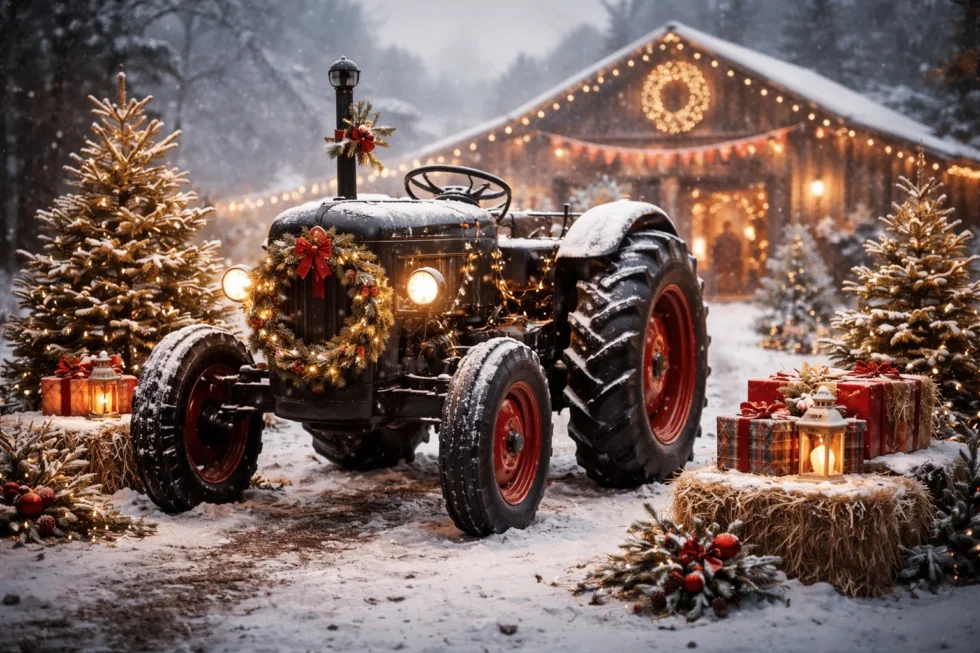
Tractor shows and tractor runs have been a visible part of rural life in Oxfordshire since the late 1950s, combining agricultural heritage, charity fundraising and local identity. In December 2025, a tractor show scheduled to take place near Wantage in the Vale of White Horse, Oxfordshire, was cancelled shortly before its planned date, after organisers confirmed a “misunderstanding” over the use of The WP Times reports that the incident has underscored growing pressure on shared rural venues and the increasing administrative strain facing volunteer-led event planning across England’s countryside.
Background: how tractor shows took root in England
Modern tractor shows in England emerged in the post-war period, particularly between 1948 and the early 1960s, when British agriculture underwent rapid mechanisation. Government-backed productivity drives, labour shortages and the expansion of domestic machinery manufacturing led to a sharp rise in tractor ownership across rural counties.
Oxfordshire, with its mix of arable farms, livestock holdings and historic market towns, became a natural setting for early machinery demonstrations. These gatherings were initially practical in purpose, allowing farmers to compare equipment, exchange technical knowledge and assess new models in working conditions rather than showroom settings.
From machinery displays to community institutions
By the 1970s, the character of tractor events had begun to change. As older machines were replaced, interest grew in preserving pre-war and early post-war tractors. Owners began restoring models dating back to the 1920s and 1930s, and vintage tractor clubs formed across southern England.
Out of this movement came tractor shows as community events rather than trade demonstrations. Tractor runs — organised convoys passing through villages and countryside routes — followed soon after, offering a highly visible way to raise money for local charities while reinforcing rural identity and continuity.
Why Wantage became a regular location
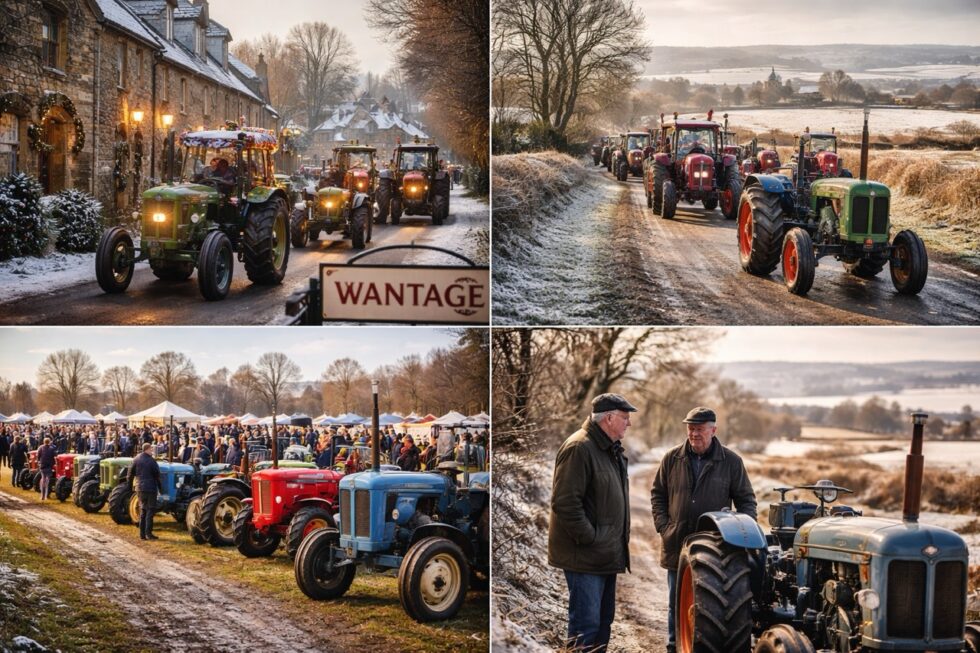
Wantage has long functioned as a rural hub for the Vale of White Horse, serving surrounding villages and farming communities. Its proximity to the A34 corridor and accessibility from Oxford, Didcot and Abingdon made it a practical base for county-wide events involving agricultural machinery.
From the 1980s onwards, farmland and community-managed open spaces on the outskirts of Wantage were frequently used for tractor shows and runs. These sites allowed safe access for heavy vehicles while drawing visitors into the town’s shops, cafés and pubs — a balance that made such events economically and socially valuable.
What the December 2025 cancellation reveals
The cancellation of the December 2025 tractor show did not stem from opposition to the event itself, but from administrative overlap. Both organisers believed the venue had been secured, and the conflict was identified only shortly before the scheduled date.
Such incidents are becoming more common across rural England. Many venues are managed by volunteer committees or charitable trusts, often relying on informal booking systems rather than centralised digital calendars. As event demand increases, the margin for error narrows.
Wider pressures on rural events
Across Oxfordshire and the wider South East, rural communities host thousands of charity and community events each year, from tractor runs and village fêtes to remembrance services and seasonal fundraisers. The majority are concentrated into narrow spring, summer and pre-Christmas windows, when weather, daylight and visitor availability align — placing intense pressure on a shrinking pool of suitable venues.
At the same time, venue availability in rural England has declined. Agricultural land once used informally for public events is increasingly affected by housing development, tighter environmental regulations, and rising public liability insurance costs, particularly for events involving vehicles, crowds or road use. As a result, organisers face fewer options and less flexibility when scheduling long-planned traditions.
Volunteer-led committees, which form the backbone of rural event planning, are also under growing strain. Organisers must now navigate licensing requirements, insurance documentation, traffic management plans, health-and-safety compliance and local authority approvals, often without professional support or digital coordination systems. In this environment, even minor administrative oversights can escalate into last-minute cancellations.
The Wantage tractor show cancellation illustrates how structural pressure rather than local conflict is increasingly responsible for disrupted rural events. Long-established traditions, once sustained through informal agreements and community trust, now depend on precise coordination and formalised processes — a shift that many volunteer organisers struggle to absorb.
Why it matters beyond one event
While a cancelled tractor show may appear minor at national level, its local impact is significant. Such events often raise several thousand pounds for charities in a single day and provide one of the few winter fundraising opportunities in rural areas. For communities like Wantage, tractor shows are not simply leisure attractions. They are expressions of continuity — linking post-war agricultural history with present-day rural life — and their disruption reflects deeper structural pressures facing England’s countryside.
Read about the life of Westminster and Pimlico district, London and the world. 24/7 news with fresh and useful updates on culture, business, technology and city life: What is Boxing Day in Britain — how it is celebrated, why it exists, and how London does it differently