
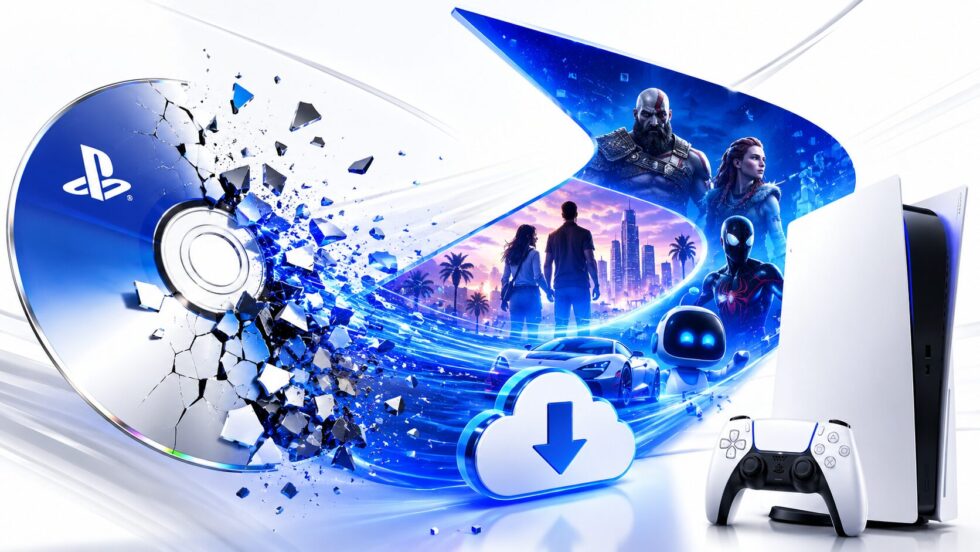
Sony has confirmed it will stop manufacturing Blu-ray discs for new PlayStation games from January 2028, a decision that pushes every future release — Grand Theft Auto VI already among them — onto digital downloads and turns the boxes on shop shelves into little more than printed cards carrying a code. The announcement, made on the official PlayStation Blog on 1 July, reaches every studio and publisher because Sony is the sole supplier of PlayStation game discs, and it lands at a moment when the physical games trade has all but collapsed across Britain — from the shuttered GAME shops of the high street to the thinning games aisles you'll now struggle to find anywhere in Westminster, reports The WP Times editorial team.
For a generation of players who grew up trading cartridges in a school playground and hunting for bargains in a Saturday-afternoon queue outside GAME, this is the quiet end of an era that stretches back nearly thirty years to the original grey PlayStation of 1995. What follows is a plain-English guide to exactly what Sony has announced, what it means for the discs already sitting on your shelf, why “digital-only” almost certainly won’t make your games any cheaper, and what a gamer in Westminster, Pimlico or anywhere else in the capital should actually do about it.
The short version
- Sony stops making PlayStation game discs from January 2028. Every new game after that is digital-only.
- Discs you already own — and any released before January 2028 — keep working forever. This is not retroactive.
- GTA 6 (out 19 November 2026) is already digital-only: £69.99 Standard, £89.99 Ultimate. The "physical" box holds a download code, not a disc.
- Britain's games shops have already collapsed: GAME is gone from the high street, and CeX is the last chain standing.
- Digital-only is unlikely to make games cheaper, and it quietly kills the second-hand and trade-in market.
- The PlayStation 6 (expected 2027–2028) may launch with no disc drive at all.
- Do this now: buy any disc you truly want before 2028, keep a disc-drive PS5, and use CeX trade-ins while they last.
What Sony has actually announced
The core of it is simple and, for many, unwelcome. In a post attributed to Sid Shuman, a senior director in Sony Interactive Entertainment's communications team, the company said that physical disc production for all new games releasing on PlayStation consoles will be discontinued from January 2028. After that date, new games will be sold only in digital formats — either directly from the PlayStation Store or through high-street and online retailers offering download codes rather than discs.
Sony framed the move as a "natural direction" for the business, arguing that consumer preference for digital media now significantly outweighs demand for physical discs. In the company's own telling, the change simply brings its distribution into line with how the majority of its community already buys and plays. It is a corporate way of saying something blunter: the disc is a legacy format that most customers have already abandoned, and Sony no longer sees a commercial case for pressing plastic.
Three details matter enormously for anyone trying to work out how this affects them.
First, the change is not retroactive. Any game that has already been released on disc — or that reaches shops on disc before the January 2028 cut-off — is entirely unaffected. Your existing collection will keep working exactly as it does today. There is no kill switch, no forced conversion, no expiry date on the discs you already own. If your PlayStation 5 has an optical drive, it will still read those discs for as long as the hardware lasts.
Second, this affects every publisher, not just Sony's own studios. Because Sony is the only company that manufactures PlayStation discs, its decision to stop pressing them removes the option for everyone. A third-party publisher who might have preferred to keep shipping a physical edition simply won't have anywhere to have the discs made. From 2028, the choice is taken out of their hands.
Third, the boxes won't necessarily vanish overnight. Sony and its retail partners are expected to continue selling physical boxes in shops — but those boxes will contain a download code rather than a disc. You'll still be able to buy something to unwrap, wrap up as a gift or line up on a shelf. You just won't be able to play it without an internet connection and enough storage to download the whole game first.
GTA 6 got there first — and normalised it
If Sony's announcement feels less like a bombshell and more like a formality, that's largely down to Rockstar Games. When Rockstar confirmed the details of Grand Theft Auto VI — the most anticipated entertainment release of the decade, due on 19 November 2026 — it quietly did something that would once have caused an uproar. It announced there would be no disc.
GTA 6 launches on PlayStation 5 and Xbox Series X|S as a digital-only title. There is a "physical" edition you can buy from Amazon, from the concession that GAME has become, and from the supermarket shelves at Argos and beyond — but open the box and you'll find a download code, not a Blu-ray. Rockstar effectively pre-empted Sony's policy by more than a year, and in doing so it tested the water for the entire industry. The reaction was grumbling rather than revolt. When the biggest game on the planet ships without a disc and sells regardless, every other publisher takes note.
That is why Sony's move, however significant, arrives with a sense of inevitability. The company that once mocked its rivals for restricting how players could share and resell physical games — Sony's famous 2013 clip of one executive simply handing a game box to another was a direct dig at Microsoft — is now the company retiring the disc altogether. The wheel has turned.
The pricing tells its own story. GTA 6 costs £69.99 for the Standard Edition and £89.99 for the Ultimate Edition in the UK, figures that would have been unthinkable a console generation ago. Anyone hoping that cutting out the disc, the case, the printed manual and the shipping would translate into cheaper games has already been given their answer.
A timeline of the shift
For readers trying to keep the moving parts straight, here is how the transition breaks down.
| Date | What happens |
|---|---|
| 19 November 2026 | Grand Theft Auto VI launches digital-only on PS5 and Xbox; "physical" boxes contain a download code |
| July 2027 (reported) | PlayStation Store for PlayStation 3 and PS Vita expected to close, ending official digital sales for those legacy platforms |
| January 2028 | Sony stops all new PlayStation disc production; new games become digital-only from this point |
| 2027–2028 (rumoured) | PlayStation 6 expected to launch — widely tipped to ship without an optical drive as standard |
The dates around the PlayStation 6 remain unconfirmed, but Sony has signalled it does not intend to sell the next console at a heavy loss, and the industry consensus points to a late-2027 or 2028 window. Whenever it arrives, a machine with no disc drive would fit neatly with the January 2028 policy — and would make the PlayStation 6 potentially the first major console in history launched with no meaningful second-hand game market at all.
Your existing games are safe — but "ownership" is getting complicated
The single most important reassurance for worried collectors is worth repeating: nothing you already own stops working. The discs in your cupboard, the games in your PlayStation library, the titles you buy on disc between now and January 2028 — all of it remains fully functional. Sony's decision is about what gets manufactured in future, not about disabling what already exists.
But the shift to digital-only raises a thornier question that the games industry has spent years trying not to answer too loudly: when you buy a digital game, what exactly do you own?
The uncomfortable truth is that, in most cases, you are buying a licence to access a game, not the game itself. Storefront terms and conditions across the industry make clear that a digital purchase can, in principle, be revoked, that titles can be delisted, and that a game bought today may not be re-downloadable in a decade if the servers are switched off or the publisher pulls it. It is why some digital storefronts in certain jurisdictions have been required to add wording clarifying that customers are buying a licence rather than a product.
With a disc, that ambiguity largely disappears. A disc is a physical object you can lend, sell, gift, or simply keep in a drawer for twenty years and dust off. It does not depend on an account remaining active, a server staying online, or a company's continued goodwill. As the disc disappears, so does that certainty — and campaigners have started to push back. The "Stop Killing Games" movement, which gathered significant momentum across Europe and Britain, argues that publishers should be legally obliged to leave games in a playable state even after official support ends. Sony's announcement will only sharpen that debate.
For the ordinary player, none of this means your PlayStation library is about to evaporate. But it does mean the long-standing assumption — that buying a game means owning it outright — no longer holds in the way it once did. Digital convenience comes with a quiet transfer of control from the player to the platform.
The British games shop is already dead
Here is the part of the story that gives Sony's decision its sting on this side of the Channel: for British buyers, the physical games shop has, to all intents and purposes, already gone.
The collapse has been brutal and recent. GAME — the chain that at its peak ran more than 600 shops across the UK, that swallowed rival Gamestation in 2007, and that was for two decades the default destination for a launch-day midnight queue — entered administration for a second time and closed all of its remaining standalone shops in February 2026. Its managing director departed. What survives is a website and a scattering of concessions tucked inside Sports Direct and House of Fraser, where the games are increasingly outnumbered by merchandise, plush toys and pop-culture tat. The chain that defined games retail in Britain no longer has a single dedicated shop of its own.
The numbers behind that collapse are stark. Boxed game sales now account for roughly 4% of total games spending in the UK, after a year-on-year decline of around a third. Supermarkets have quietly dropped their games ranges. HMV moved games online. What physical stock remains is scattered across Argos concessions inside Sainsbury's, a thin shelf in Currys, the toy aisles of Smyths, and a dwindling handful of online specialists such as ShopTo. The dedicated British games shop — a genuine cultural institution for anyone who grew up in the 1990s and 2000s — has essentially ceased to exist.
That leaves one survivor standing: CeX.
CeX, London's last games shop, and the second-hand question
Computer Exchange — universally known as CeX — is the closest thing Britain has left to a real games shop, and it is a London story at heart. Founded in the capital, its Tottenham Court Road and Rathbone Place presence became a pilgrimage site for import-hunters through the 1990s and 2000s, when its shelves groaned with Japanese and North American games you couldn't buy anywhere else in the country. Today CeX operates through hundreds of franchised branches nationwide and has become, almost by default, the last high-street chain where a physical game changes hands over a counter. But there is a catch, and it matters for the years ahead. CeX deals overwhelmingly in second-hand stock — trade-ins, pre-owned discs, and used hardware. Its entire model depends on physical games existing in the first place so that they can be bought, sold and traded again. And that is precisely the supply Sony is switching off.
Think it through. If new games stop shipping on disc from January 2028, then over time there are no new discs entering the second-hand ecosystem. The pool of tradeable physical games freezes at whatever exists on the day production stops, and then slowly shrinks as discs are lost, scratched or binned. A pre-owned market can only recycle what was pressed. Cut off the supply of new discs and you are, in effect, putting a long fuse under the entire second-hand trade — including trade-ins, the retro market, and the simple act of selling a game you've finished to fund the next one.
There is a real consumer cost hidden in that. For years, buying physical and trading it back in was one of the few ways British players could offset the eye-watering rise in game prices. Sell a finished single-player game for £20 and the next £70 blockbuster suddenly costs you £50. Digital-only removes that lever entirely: there is no second-hand market for a download code, no way to resell a title you no longer want, and no bargain bin of last year's hits at a fraction of launch price. The loss falls hardest on younger players and those on tight budgets, for whom trade-ins were a lifeline.
Where you can still buy a physical game in Britain
For now — and for the next eighteen months at least — the disc is not dead yet. If you value owning a physical copy, here is the honest state of play across UK retail.
| Retailer | What you can get | The catch |
|---|---|---|
| CeX | New and pre-owned discs, trade-ins, used hardware | Second-hand focus; stock depends on what's traded in |
| Amazon | Boxed new releases while discs last | Increasingly ships download-code boxes, not discs |
| Argos (in Sainsbury's) | A rotating range of mainstream titles | Limited catalogue; blockbuster-led |
| Smyths | Family and mainstream titles | Games share space with toys; patchy range |
| Currys | A thin selection of big releases | Not a genuine games specialist |
| ShopTo / online specialists | Competitive prices on new discs | Online only; delivery costs |
| GAME (concessions) | Reduced range inside Sports Direct / House of Fraser | No standalone shops remain; merchandise-heavy |
The practical takeaway is straightforward. If a game you love is available on disc today and you want a physical copy you can keep, lend or resell, the window to buy it is now — not in 2028. Once production stops, that disc becomes a finite, non-replaceable object.
Does going digital make games cheaper? Almost certainly not
There is a comforting logic to the idea that cutting out physical manufacturing should lower prices. No Blu-ray to press, no case to mould, no cover art to print, no pallets to ship across oceans, no cut for the retailer standing between publisher and player. In theory, all of those savings could flow back to the customer. In practice, the industry's recent history points firmly the other way. Over the past decade, as digital sales have climbed toward total dominance, game prices have marched steadily upward rather than down. The long-standing £50-ish price point for a new blockbuster gave way to £60, then to £70, and GTA 6 has now landed at £69.99 for the standard edition and £89.99 for its Ultimate tier. Nintendo pushed first-party pricing to new highs with the Switch 2. Console prices themselves have risen sharply — Sony hiked the price of its disc-equipped PlayStation 5 during 2026, and rivals followed suit.
The savings from eliminating the disc are real, but there is little sign they are being passed to players. Instead, the removal of the physical option quietly strengthens the publisher's hand in two ways. It closes off the second-hand market that used to cap what people would pay, and it makes discounting a matter of storefront strategy rather than shelf-clearance. A boxed game that isn't selling gets marked down by a shop desperate for the floor space; a digital title stays at full price until the publisher decides otherwise. For the British buyer already squeezed by rising prices across every category of spending, digital-only is unlikely to feel like a bargain. It is a change that suits the seller more than the customer.
Preservation: the quiet crisis behind the convenience
Beyond price and ownership sits a longer-term worry that games historians and archivists have been sounding the alarm about for years: preservation.
Physical media, for all its inconvenience, is durable in a way that digital distribution is not. A disc is a self-contained artefact. It survives the closure of an online store, the shutdown of a server, the bankruptcy of a publisher. Decades from now, a working console and a clean disc will still boot a game exactly as it launched. Digital-only titles carry no such guarantee. When a storefront closes — as the PlayStation 3 and PS Vita stores are reportedly set to do in 2027 — the games sold there can become effectively unobtainable through official channels, leaving only used discs to keep them alive. Remove the discs and you remove the last lifeline.
This is not an abstract concern. Studies by preservation bodies have repeatedly found that the overwhelming majority of games from earlier eras are already commercially unavailable, surviving only through second-hand copies and the goodwill of collectors and archivists. A fully digital future, where nothing is pressed and everything depends on a live server and an active account, risks accelerating that loss dramatically. The games of the late 2020s could prove far harder to preserve than the cartridges of the 1990s — a paradox that sits awkwardly with an industry that likes to talk about its heritage.
For Britain, which has a proud games-development history and a growing museum and archive sector interested in preserving it, the disappearance of physical media is a genuine cultural question, not merely a consumer one.
The environmental angle Sony didn't lead with
Sony's announcement leaned on consumer preference rather than sustainability, but there is an environmental case buried in the shift. Manufacturing discs, moulding plastic cases, printing inserts and shipping physical boxes around the world carries a carbon and waste cost that downloads avoid. On paper, cutting all of that out looks like an environmental win.
The picture is more complicated than the headline suggests. Digital distribution shifts the burden rather than eliminating it: enormous data centres, the electricity to run and cool them, the bandwidth to deliver ever-larger downloads — a modern blockbuster can run to well over 100GB — and the storage hardware inside every console all carry their own footprint. There is a legitimate environmental argument for going disc-free, but it is not the clean victory it first appears, and it was notably not the argument Sony chose to make. The company's stated reasoning was about consumer trends and commercial alignment, not the planet.
PlayStation 6: a console with no disc drive?
All of this points toward a next-generation console designed for a diskless world. Sony has confirmed little about the PlayStation 6 beyond a reluctance to sell it at a heavy loss, but the direction of travel is hard to miss. If disc production ends in January 2028, and the PlayStation 6 arrives in roughly that window, then a machine built without an optical drive as standard would be the logical conclusion.
That would carry real consequences. A disc-drive-free PlayStation 6 could not play the disc-based games of previous generations even if you owned them, unless Sony offered an add-on drive as it did with certain PlayStation 5 models. It would make the console the first mainstream Sony machine with no native way to buy, sell or trade a physical game — and, by extension, the first launched into a world with essentially no second-hand market of its own. For a company that once weaponised the second-hand disc as a marketing tool against Microsoft, it is a remarkable reversal.
Nothing here is confirmed, and Sony may yet surprise the market. But every signal — the disc decision, the store closures, the pricing, the rumoured hardware — points the same way.
What Westminster and Pimlico gamers should actually do
Enough context. Here is the practical, local advice for anyone reading this from a flat in Pimlico, a house share in Victoria, or anywhere across Westminster and central London who wants to make sensible decisions rather than panic.
1. Buy the discs you truly want now — not in 2028. If there are games you love and want to own physically, forever, buy them on disc while they're still being pressed. The window closes in January 2028, and after that the disc becomes a finite object. Central London still has physical stock: CeX branches, the games shelves at Argos concessions, and online specialists that deliver next-day. Don't leave it until the deadline, when supply will be scarce and prices for sought-after physical editions may climb.
2. Keep a disc-drive PlayStation 5 if you have one. If you already own a PlayStation 5 with an optical drive, hold on to it. It is your ticket to a working physical library for years to come, regardless of what the PlayStation 6 turns out to be. If you're buying a PS5 second-hand — and demand for used disc-drive consoles has been rising — the drive is now a feature worth paying a little extra for.
3. Use CeX while the second-hand market still functions. For the next couple of years, trade-ins and pre-owned discs remain a genuine way to cut the cost of gaming. Central London is well served by CeX, whose heartland has always been the capital. Sell finished games to fund new ones while that market still has fuel in the tank — it won't last forever once new discs stop entering circulation.
4. Understand what you're buying digitally. When you buy a download, treat it as a long-term licence, not outright ownership. Keep your account secure, be aware that storefronts and titles can be delisted, and factor that reality into big purchases. It shouldn't stop you buying digitally — for most players, convenience wins — but go in clear-eyed.
5. Sort your storage and your broadband. Digital-only means downloads, and downloads mean space and bandwidth. Modern games routinely run past 100GB. If you're going disc-free, a larger SSD and a reliable broadband connection stop becoming nice-to-haves and start becoming essentials. For flat-dwellers on shared or slower connections across parts of central London, that's worth planning for before GTA 6 lands in November and everyone tries to download 100GB-plus on the same evening.
6. Support preservation if it matters to you. If the disappearance of physical media troubles you, the campaigns pushing for legal guarantees that games remain playable after support ends are worth a look. Consumer pressure is one of the few forces that has ever moved this industry on ownership and access.
The bottom line
Sony's decision to end PlayStation disc production from January 2028 is not a shock so much as a full stop. The physical games trade in Britain has been dying for years — GAME gone from the high street, boxed sales down to a sliver of the market, CeX standing alone — and GTA 6 proved that even the biggest release on earth can ship without a disc and barely dent its sales. Sony is simply confirming, in policy, what the market had already decided in practice.
For players, the change is real but not immediate. Your existing games are safe. There is still time to buy physical copies of the titles you love. But the direction is unmistakable: the disc is on its way out, the second-hand market is quietly running out of road, ownership is becoming a licence, and the next PlayStation may not even have a slot to put a disc into. The convenience of downloading everything is genuine — but so is the cost, in resale value, in preservation, and in the simple, old-fashioned certainty of holding a game you own in your hand.
For anyone in Westminster who grew up queuing outside a games shop that no longer exists, the message is worth acting on before 2028: if you want the disc, buy it now.
Frequently Asked Questions
When exactly does Sony stop making PlayStation discs? From January 2028. After that date, all new games releasing on PlayStation consoles will be sold digitally only — either from the PlayStation Store or as download-code boxes at retailers.
Will my existing PlayStation discs still work after 2028? Yes. The change is not retroactive. Every disc released before January 2028, and every game you already own, continues to work exactly as it does now, for as long as your console lasts.
Is GTA 6 on disc? No. Grand Theft Auto VI, out on 19 November 2026, is digital-only. You can buy a "physical" box, but it contains a download code rather than a Blu-ray disc.
How much does GTA 6 cost in the UK? £69.99 for the Standard Edition and £89.99 for the Ultimate Edition on PlayStation 5 and Xbox Series X|S.
Does digital-only mean games will get cheaper? There's little sign of it. Despite removing the cost of discs, cases and shipping, game prices have risen steadily as digital sales have grown. Digital-only also removes the second-hand market that used to keep prices in check.
Can I still buy physical games in London right now? Yes, for now. CeX remains the main high-street option, alongside Argos concessions, Smyths, Currys and online specialists such as ShopTo. But the window closes in January 2028, so buy sooner rather than later if physical ownership matters to you.
Will the PlayStation 6 have a disc drive? Sony hasn't confirmed, but with disc production ending in January 2028 and the PS6 expected around 2027–2028, a console with no built-in optical drive looks increasingly likely.
What happens to the second-hand games market? It slowly winds down. With no new discs being pressed from 2028, the pool of tradeable physical games freezes and shrinks over time. Trade-ins and pre-owned sales will become harder as the years pass.
Can my PS5 still play disc games after 2028? Yes, if it has an optical drive. A disc-equipped PlayStation 5 will keep reading any disc it can read today. The change only affects what gets manufactured in future, not your hardware or your library.
Is Sony stopping Blu-ray film discs as well? Sony's announcement covers PlayStation game discs specifically. It has not confirmed whether film and other Blu-ray disc production is affected, though it has already wound down its Blu-ray recorder and recording-media businesses in recent years.
Where can I trade in games in London? CeX is the main high-street option across the capital, with branches throughout central London and beyond. It buys, sells and trades pre-owned discs and hardware — but that model relies on physical games existing, so it's worth using while the second-hand supply lasts.
Should I buy a disc-drive PS5 now? If you want a guaranteed way to play physical games for years to come, a disc-drive PS5 is a sensible buy while they're still sold. Demand for used disc-drive consoles has been rising, so the drive is increasingly worth paying a little extra for.
Read about the life of Westminster and Pimlico district, London and the world. 24/7 news with fresh and useful updates on culture, business, technology and city life: Why could PlayStation 6 cost more in Britain as Sony rules out deep console losses