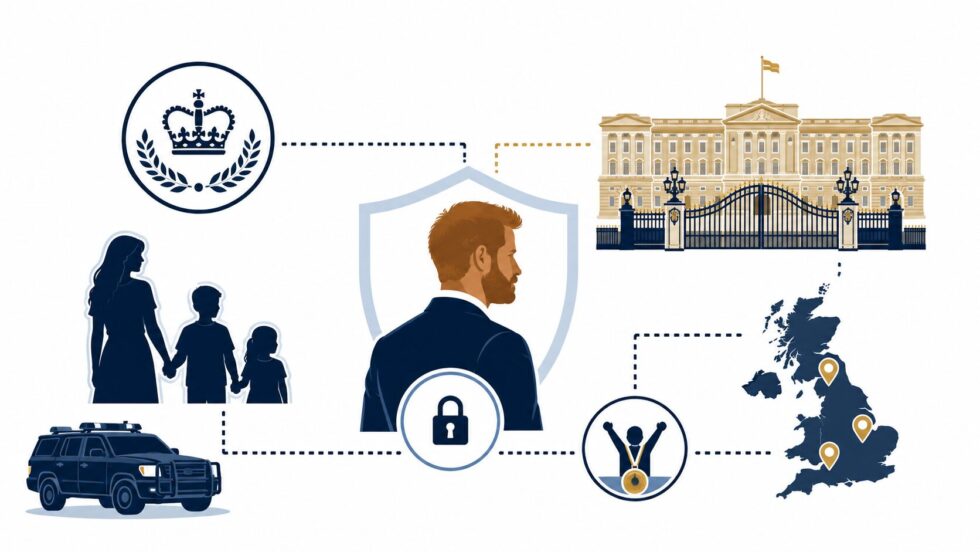
Prince Harry UK security arrangements have become the decisive issue before the Duke of Sussex’s planned July return to Britain with Meghan, Prince Archie and Princess Lilibet, after officials declined to provide full-time police protection for the family outside protected royal accommodation, The WP Times reported. The visit is linked to events around the Invictus Games in Birmingham and would mark the Sussex children’s first UK trip since 2022, but the dispute has reopened the long-running question of how Britain protects a non-working royal who still faces a high public profile and specific security concerns.
Harry is still exploring “every available option” to make the journey proceed safely, according to statements reported by British and US outlets, while King Charles has offered the family accommodation on a royal estate where security would already be in place. The difficulty is travel between engagements: Harry’s team argues that risk follows the person, not only the building, while the Home Office position remains that protective arrangements for high-profile figures are not discussed in detail and must be “rigorous and proportionate”.
What happened with Prince Harry UK security arrangements before the July visit
The latest row began after plans emerged for Harry, Meghan and their children to come to Britain for engagements connected to the Invictus Games and other charitable work. Reports said the Sussexes expected to travel around the country, including London and Birmingham-linked events, but were told they would not receive full-time taxpayer-funded police protection during the whole trip.
Vanity Fair reported that Harry was left “devastated and close to tears”, citing a source close to the situation, after RAVEC did not change the protection model for the visit. The same report said the Duke had hoped the presence of Meghan, Archie and Lilibet, combined with the King’s offer of royal accommodation, might lead to broader police protection. The official issue is not whether the Sussexes can stay somewhere secure. The central question is whether they receive protection while moving between public and private engagements. Harry’s spokesperson has stressed that safe accommodation is only one part of a protective plan because the risk is attached to the person, not simply the address.
Why RAVEC is central to Prince Harry’s police protection dispute
RAVEC, the Royal and VIP Executive Committee, decides protective security for senior royals and other public figures in the UK. After Harry and Meghan stepped back as working royals in 2020, the Duke no longer received automatic full-time police protection in Britain. Instead, his arrangements have been assessed on a case-by-case basis.
Harry challenged that position through the courts, arguing that the security model did not properly reflect the risk to him and his family. In May 2025, he lost his Court of Appeal challenge over the UK Government’s decision on his police protection. Reuters reported that Harry said he was “devastated” after the judgment and told the BBC he could not safely bring his family to Britain under the current position. The legal defeat did not end the practical problem. Harry’s team has continued to press for a fuller risk assessment, while reports say a RAVEC review has not yet been concluded. That unresolved process is now feeding directly into the uncertainty around the July visit.
What is expected on the UK visit by Harry, Meghan, Archie and Lilibet
The trip is expected to support the build-up to the Invictus Games in Birmingham, with Harry’s programme also reported to include London engagements and charity-related events. BBC reporting said that, as things stood, Meghan and the children were still expected to travel if security arrangements could be put in place.
The family has not made a joint UK visit since 2022, when they were in Britain around the death and funeral of Queen Elizabeth II. Since then, Harry has returned alone on several occasions, including for legal hearings and visits connected to family and charity commitments. For King Charles, the visit also carries personal weight because Archie and Lilibet have spent little time in Britain in recent years. The King’s offer of royal accommodation is therefore important, but it does not resolve Harry’s concern about movements outside secure residences.
Key facts in the Prince Harry UK security row
| Issue | What it means |
|---|---|
| Main dispute | Whether Harry, Meghan and the children receive full-time police protection during the visit |
| Decision body | RAVEC, which assesses royal and VIP protection |
| Current model | Case-by-case security, not automatic full-time protection |
| Royal offer | King Charles has offered accommodation on a royal estate |
| Harry’s concern | Security while travelling between engagements |
| Wider context | Harry lost a legal challenge over UK police protection in May 2025 |
| Visit purpose | Invictus Games-related events and other engagements |
| Family significance | First planned UK family visit since 2022 |
What Prince Harry’s team has said about the security risk
Harry’s spokesperson has said the Duke is exploring every available option to allow the visit to proceed safely and to give his children the chance to spend time in the UK. The line from his team is that the issue is not only where the family sleeps, but how they are protected when travelling through public spaces and attending engagements. That argument reflects Harry’s long-standing position: private security cannot replicate the powers and intelligence access of UK police protection. It is also why the Duke has treated the RAVEC process as a matter of family safety rather than royal privilege.
The Home Office has not commented on Harry’s individual arrangements, in line with normal security policy. Government statements reported in the coverage say the UK’s protective security system is designed to be rigorous and proportionate, while detailed arrangements are not disclosed because that could compromise security.
Why this matters beyond one royal visit
The dispute matters because it sits at the intersection of public money, royal status and personal safety. Harry is no longer a working royal, but he remains the King’s son, a former senior royal, a military veteran and one of the most recognisable figures in the world. That makes the security question unusually sensitive. For critics of Harry’s position, the issue is simple: he stepped back from official duties in 2020 and should not expect automatic taxpayer-funded protection. For Harry’s side, the issue is risk, not status: they argue the threat level should be assessed independently and proportionately, especially when children are involved.
The immediate question is whether the July programme can go ahead as planned. The wider question is whether Britain’s security system has found a workable model for a royal figure who is outside the working institution but still exposed to the risks that come with global visibility.
The next step is practical rather than symbolic. Harry’s team must decide whether the family can travel under the protection offered, whether the schedule should be shortened or changed, or whether Meghan and the children should remain away from Britain again. As of the latest reporting, the Duke is still trying to make the visit happen. But unless the travel-security issue is resolved, the family’s return remains uncertain — and the argument over Prince Harry UK security arrangements will continue to define every planned Sussex visit to Britain.
Read about the life of Westminster and Pimlico district, London and the world. 24/7 news with fresh and useful updates on culture, business, technology and city life: What are the World Cup 2026 last-16 fixtures and when do England play Mexico