
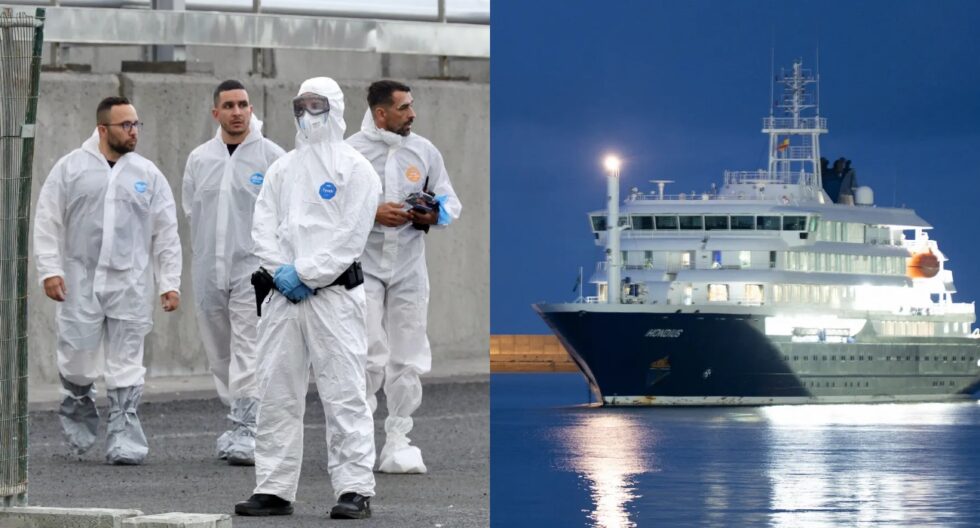
Rat virus cruise passengers have begun leaving the MV Hondius in Tenerife after a deadly hantavirus outbreak killed three people, triggered international quarantine plans and forced Spain to manage one of Europe’s most sensitive maritime health operations since Covid. The first evacuees were Spanish passengers and one crew member, screened on board before being transferred to special aircraft for medical observation in Madrid, reports The WP Times via thesun.
The Dutch-flagged expedition vessel arrived near the Port of Granadilla on Sunday morning after days of mounting international pressure, emergency negotiations and growing public concern on the Canary Islands. Health authorities boarded the ship in full protective equipment shortly after dawn while police secured the surrounding port area. More than 140 passengers and crew linked to the vessel are now part of one of the largest controlled maritime health evacuations in Europe in recent years. European health officials continue to classify those onboard as high-risk contacts while screening operations continue.
How passengers are being evacuated from the MV Hondius
Spanish passengers were the first allowed to leave the ship after strict onboard medical checks confirmed they were asymptomatic. Small groups were escorted through side access points onto waiting boats before being transported to shore under security supervision. French and Canadian nationals followed shortly afterwards, while evacuation plans for British, Dutch, Irish, Turkish and American passengers were coordinated separately.
Officials are attempting to avoid unnecessary exposure inside commercial airport terminals by moving passengers directly between secured transport corridors. British nationals are expected to return aboard a specially arranged Titan Airways flight linked to UK government operations. Authorities say all evacuees will undergo monitoring and extended isolation after arrival in their home countries.
The evacuation process currently includes:
- onboard symptom screening;
- nationality-based disembarkation groups;
- direct airport transfer;
- medical observation after arrival;
- controlled quarantine procedures;
- continued monitoring of all close contacts.
A senior WHO official said during operational briefings: “The operation has started and is going very well. We appreciate the cooperation.”
British passengers face quarantine at Arrowe Park Hospital
British passengers from the ship are expected to be transported to Arrowe Park Hospital in Merseyside, the same facility used during the first Covid quarantine operations in 2020. UK health authorities said asymptomatic passengers would still undergo extended monitoring because of the rare transmission risks associated with some hantavirus strains.
The UK Health Security Agency confirmed that none of the British passengers currently waiting to leave the ship were showing symptoms during the latest assessment phase. However, officials remain cautious because two British-linked infections have already been associated with the outbreak. A British crew member, identified in reports as Martin Anstey, was earlier airlifted from the vessel for specialist treatment in the Netherlands.
Passengers are expected to remain under observation for up to 45 days because hantavirus incubation periods can vary significantly. Medical experts say the Andes strain remains especially sensitive because rare person-to-person transmission has previously been documented in South America.
Health monitoring measures include:
- daily temperature checks;
- respiratory symptom monitoring;
- isolation protocols;
- laboratory testing;
- contact tracing;
- specialist infectious disease assessment.
A UK health source involved in the operation said the quarantine system was designed to ensure “maximum caution without triggering unnecessary public alarm.”
WHO attempts to calm fears in Tenerife
The arrival of the MV Hondius created significant anxiety on Tenerife, where memories of Covid restrictions and cruise ship outbreaks remain politically sensitive. Protesters gathered near government buildings and port access routes demanding more transparency about the evacuation process and potential health risks.
Port union representatives warned they were prepared to disrupt operations unless authorities provided further guarantees regarding worker safety. Riot police and security units were deployed near Granadilla port throughout the operation as a precaution against disruption.
WHO Director-General Tedros Adhanom Ghebreyesus issued an open appeal aimed directly at Tenerife residents. He acknowledged the trauma caused by the pandemic while attempting to distinguish the current outbreak from Covid-era fears.
Tedros wrote: “I know that you are worried. I know that when you hear the word outbreak and see a ship coming towards your shores, memories return that none of us have fully escaped.”
He added: “This is not another Covid. The current public health risk from hantavirus remains low.”
The WHO chief also defended the decision to use Tenerife as the evacuation point, stating that the island had the infrastructure and medical capacity necessary to complete the operation safely.
Dramatic military parachute mission to Tristan da Cunha
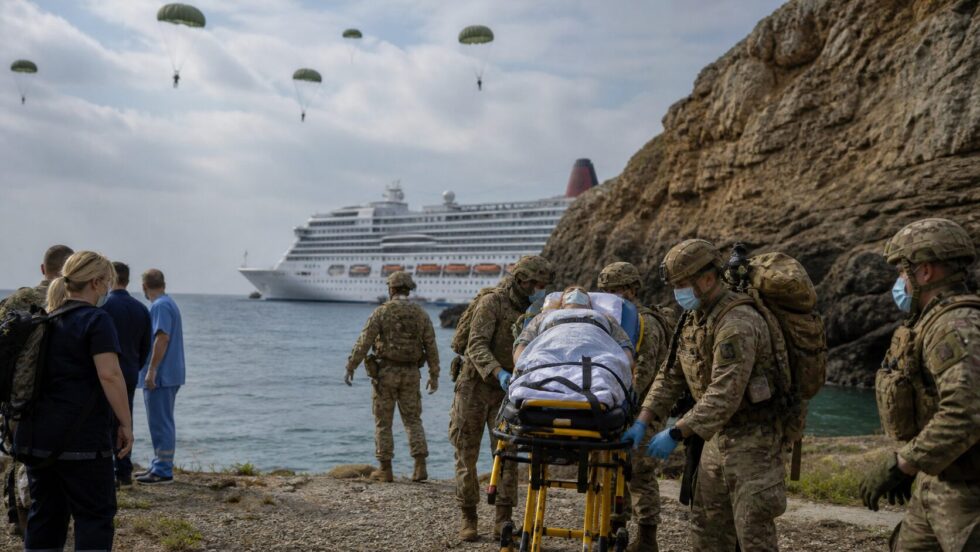
The most extraordinary part of the international response unfolded thousands of kilometres from Tenerife on Tristan da Cunha, one of the most isolated inhabited islands in the world. British military personnel parachuted medics and oxygen supplies onto the remote territory after fears emerged that a suspected hantavirus patient linked to the ship required urgent treatment.
Because the island has no airport runway and is normally accessible only by sea, British defence planners authorised an airborne insertion operation involving military parachutists, RAF-linked medical personnel and emergency medical equipment.
The suspected Tristan da Cunha case is believed to involve a person who had contact with passengers from the MV Hondius during an earlier stop near the South Atlantic territory. During that visit, passengers reportedly mixed with island residents, entered local facilities and visited community locations including a school and pub.
The UK Ministry of Defence said: “Because oxygen supplies on the island were at critical levels, the airborne insertion of medical staff was the only way to deliver life-saving care in time.”
Military teams also delivered:
- oxygen systems;
- emergency medication;
- protective equipment;
- infectious disease support kits;
- additional medical supplies.
Officials described the mission as one of the most complex emergency medical support operations involving Tristan da Cunha in decades.
Investigators examine how the outbreak began
International investigators are still reconstructing how the outbreak spread through the ship during its South American route. Reports linked the suspected original exposure to rodent-contaminated environments visited earlier in the expedition, including a landfill area in Argentina known among birdwatchers.
Dutch ornithologist Leo Schilperoord, identified in multiple reports as the suspected “zero patient”, reportedly visited a bird observation area connected to rodent activity before later developing symptoms onboard. He later died during the voyage. His wife also reportedly died after leaving the vessel during onward travel.
Medical officials are now attempting to determine:
- how many passengers had close exposure;
- whether secondary transmission occurred onboard;
- which strain of hantavirus is involved;
- whether additional infections remain undetected;
- how many international contacts require tracing.
One senior regional official on Tenerife warned that weather conditions created an extremely limited evacuation window. Alfonso Cabello, spokesman for the Canary Islands regional government, said: “The window is very limited.”
Authorities fear worsening Atlantic conditions could delay the remaining evacuation stages and leave the ship stranded offshore for days longer than planned.
Pressure grows as authorities race to finish operation
Local anger intensified before the ship’s arrival as workers and residents questioned why Tenerife had been selected for such a sensitive operation. Protesters threatened to block port access roads while union officials demanded additional health guarantees for employees involved in handling the evacuation.
Elena Ruiz, spokesperson for the Tenerife Port Workers Union, said: “We are prepared to block the port if we do not receive answers to our concerns.”
Security units, including riot-control police vehicles, remained positioned near the port throughout the operation while buses transported evacuees toward Tenerife South Airport. Temporary field-style medical facilities were also established near the docking zone with stretchers, medical supply stations and isolation equipment prepared in advance.
Despite the tensions, authorities continue to insist the operation remains under control and that the risk to the wider public remains low. The evacuation now represents a major international test of post-Covid outbreak management involving multiple governments, military support units, infectious disease teams and emergency transport systems operating simultaneously across several continents.
Read about the life of Westminster and Pimlico district, London and the world. 24/7 news with fresh and useful updates on culture, business, technology and city life: Why Ryanair wants an airport alcohol ban before 6am flights as passenger disruption rises