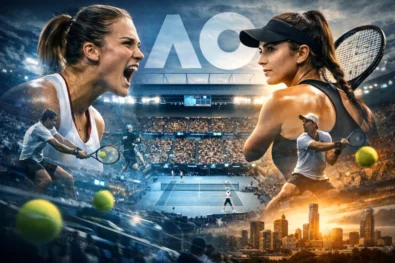
On Sunday 28 December 2025, the world’s No.1 female tennis player Aryna Sabalenka will face Nick Kyrgios in the officially titled “Battle of the Sexes – The Dubai Showdown” at Dubai’s Coca-Cola Arena, in what has become one of the most commercially ambitious exhibition matches in modern tennis. The event will be broadcast live in the United Kingdom on BBC One and BBC iPlayer from 3:45pm GMT, with the first ball expected shortly after 4:00pm GMT, and it is understood to be backed by multi-million-dollar appearance fees funded through broadcast and sponsorship rather than a conventional prize fund, The WP Times reports.
What this event is and why it exists
The Dubai Showdown is not part of the ATP or WTA calendar and awards no ranking points. It exists as a television-driven global sports property, created to test whether elite mixed-gender tennis can attract mainstream audiences in prime time. The organisers have deliberately staged it during the Christmas week, when the tennis tour is quiet but television audiences are large, and they have chosen Dubai because it offers an indoor arena, global broadcast reach and a time zone that allows the match to be shown live across Europe, the Middle East and Asia.
In essence, this is not a sporting experiment but a media experiment: can a carefully balanced male-versus-female tennis match generate ratings, debate and commercial value on the same scale as traditional elite sport?
When and where Britain will see it
The match takes place at the Coca-Cola Arena in Dubai on Sunday 28 December 2025. The venue lists the start time as 8:00pm local time, with doors opening at 6:00pm. For viewers in the UK this corresponds to a broadcast window beginning at 3:45pm GMT, with the first serve expected around 4:00pm GMT depending on production and introductions.
The BBC will show the event nationally on:
- BBC One
- BBC iPlayer
This places the match firmly in the UK’s mainstream sports schedule for the holiday weekend.
Player dossier: Aryna Sabalenka
Aryna Sabalenka enters the Dubai Showdown as the WTA world No.1 and one of the most dominant forces in women’s tennis. She is a multiple Grand Slam champion, a regular winner at the biggest tournaments and a player known for her explosive power, heavy groundstrokes and attacking mindset. Unlike many players who rely on consistency and defence, Sabalenka plays first-strike tennis, aiming to end points quickly with pace and aggression.
From a commercial point of view, she is also the face of modern women’s tennis: visible, outspoken and instantly recognisable. That is why the organisers needed her for this project. Without the world No.1 on court, the Battle of the Sexes would look like a novelty. With Sabalenka involved, it carries sporting credibility.
However, she also carries real reputational risk. If she is beaten heavily, even under handicap rules, public debate will not be kind. If she wins, critics may argue the format was tilted. Either way, she is staking her status as the sport’s leading woman on a globally televised stage.
Player dossier: Nick Kyrgios
Nick Kyrgios arrives in Dubai from a very different place in his career. Once a Wimbledon finalist and one of the most gifted shot-makers in the men’s game, he has spent much of 2025 limited by injuries, playing only a small number of competitive matches and falling far down the rankings. Yet his commercial value has barely declined.
Kyrgios remains one of the most watched and discussed figures in tennis because he combines:
- a huge, devastating serve
- the ability to hit winners from impossible positions
- and a volatile on-court personality that makes every match unpredictable
For broadcasters, he is priceless because he attracts viewers who are not traditional tennis fans. He also brings controversy, which is part of the Battle of the Sexes brand.
Like Sabalenka, Kyrgios is taking a reputational gamble. Losing a globally televised mixed-gender match can be socially uncomfortable for any male athlete, which is why few players would accept this role.
Comparing their real sporting strengths

In pure professional terms, Sabalenka and Kyrgios are at very different points in their careers.
| Area | Sabalenka | Kyrgios |
|---|---|---|
| Current status | World No.1 | Outside top 500 |
| Match fitness | Elite tour rhythm | Limited by injury |
| Titles | Multiple Grand Slams | None |
| Peak weapon | Power from both wings | Serve and first strike |
| Weakness | Can be error-prone | Inconsistent, fitness |
Sabalenka brings consistency, physical conditioning and competitive sharpness. Kyrgios brings explosiveness, unpredictability and serving power. The handicap format is designed to stop Kyrgios’s serve from deciding the match on its own and to allow Sabalenka’s pressure game to have real effect.
How the money works
The Dubai Showdown does not publish a prize fund because it is not a conventional tournament. Instead, both players are paid through:
- guaranteed appearance fees
- television and streaming rights
- sponsorship and hospitality revenue
At this level of global broadcast exposure, it is normal for players to earn seven-figure sums for a single appearance. These payments reflect their media value, not their ranking.
This is why the event can afford to stage such a high-profile match without selling tickets on the scale of a Grand Slam.

How the rules create a real contest
The handicap system used in the Dubai Showdown is not cosmetic. It is the financial and sporting foundation of the entire event. Without it, the match would be unwatchable, commercially unsellable and reputationally dangerous for both players.
A fully fit male professional can dominate a female opponent almost entirely through serve velocity, reach and second-serve safety. That is why the organisers have removed the very mechanisms that normally decide men’s tennis.
The format is built on four pillars:
- One serve only (no second serve)
- A reduced court for Sabalenka
- Best-of-three sets
- A match tie-break if required
The one-serve rule is the most important. It removes Kyrgios’s ability to hit a high-risk first serve and fall back on a safe second serve. Every service point becomes a gamble. That increases double faults, short returns and break opportunities, which keeps Sabalenka in points she would otherwise never reach.
The adjusted court size then shifts the physical balance. Kyrgios can no longer rely on raw speed and wingspan to cover angles, while Sabalenka is rewarded for depth and pressure rather than being forced into defensive scrambling.
The shorter set structure and match tie-break complete the design. They compress the match into high-volatility phases, where a few points can swing the entire outcome. That is crucial for television because it creates drama, comeback narratives and uncertainty late in the broadcast.
This is not about sporting purity. It is about engineering a match that can justify million-dollar appearance fees and global broadcast rights. The rules exist because the business model collapses if the match becomes predictable after ten minutes.
Why this match matters far beyond the result
The Dubai Showdown is not being staged to decide who is the better tennis player. It is being staged to answer a much bigger commercial question: can mixed-gender elite sport work as prime-time television?
The BBC’s involvement is critical. Public-service broadcasters do not pay for novelty. They pay for audience reach, debate and cultural relevance. If this match delivers strong UK viewing figures, it will prove that gender-balanced elite sport can be packaged and sold at the highest level.
That would unlock a new category of sports entertainment, one where broadcasters, sponsors and promoters are willing to invest millions in events that sit outside the traditional tour structure. If it fails, the format will quietly disappear, because without ratings there is no financial justification for these appearance fees.
That is why this Battle of the Sexes carries far more weight than an ordinary exhibition. It is a live test of a new commercial model for global sport, played out in front of millions of viewers, with two careers and a future television format riding on the outcome.
Read about the life of Westminster and Pimlico district, London and the world. 24/7 news with fresh and useful updates on culture, business, technology and city life: What is Boxing Day in Britain — how it is celebrated, why it exists, and how London does it differently