
Scottish election counting has begun across Scotland after millions of voters elected 129 MSPs in one of the most unpredictable Holyrood contests in recent political history. Early projections suggest the SNP is on course to remain the dominant force in Scottish politics while Reform UK could achieve a major parliamentary breakthrough and both Labour and the Conservatives risk suffering historic losses, The WP Times reports.
Scottish election officials opened count centres from 09:00 on Friday morning instead of the traditional overnight process used in previous UK elections, with first declarations expected around lunchtime and full national results anticipated later this evening. Polling models from YouGov and Survation indicate John Swinney’s SNP could secure a fifth consecutive term in office, although the party may once again fall just short of an outright majority in the 129-seat Scottish Parliament.
What projections suggest for the Scottish election
The Scottish election campaign entered counting day with polling organisations projecting a fragmented political landscape beyond the SNP’s continued dominance. Multiple final MRP models published before voting day pointed towards a parliament reshaped by Reform UK gains, a strengthened Green presence and collapsing support for the traditional unionist parties. YouGov’s final projection estimates the SNP could win around 62 seats, narrowly below the 65 required for a parliamentary majority. Survation’s model placed the nationalists slightly lower on 59 seats but still comfortably ahead of every rival party.
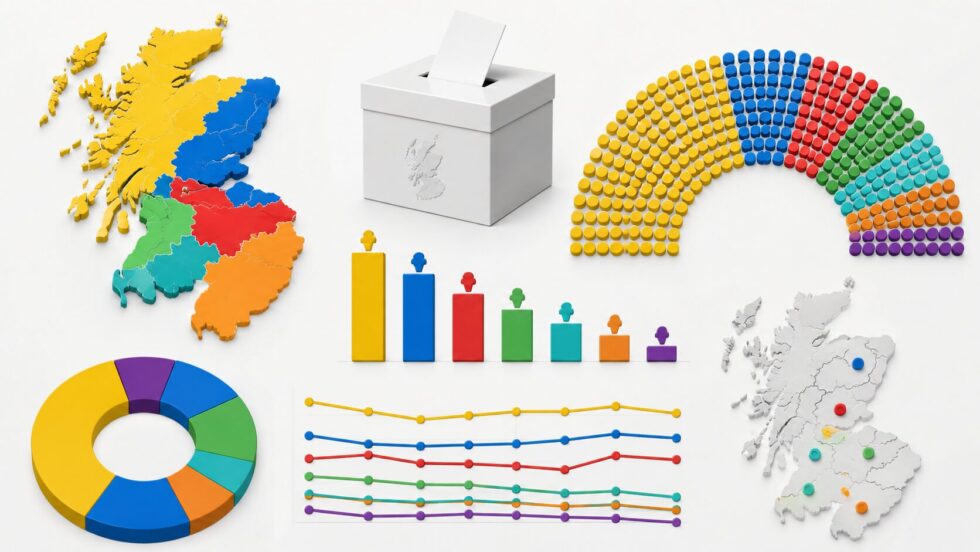
Projected seat estimates include:
| Party | Projected Seats | 2021 Result |
|---|---|---|
| SNP | 59–62 | 64 |
| Reform UK | 18–19 | 0 |
| Labour | 17 | 22 |
| Conservatives | 7 | 31 |
| Greens | 16 | 8 |
| Liberal Democrats | 8 | 4 |
The figures suggest Scotland may be heading towards one of the most pro-independence parliaments in Holyrood history, with the SNP and Greens together projected to hold a clear governing majority.
SNP expected to dominate constituencies again
The Scottish election system combines constituency seats with regional proportional representation. Of the 129 MSPs elected, 73 come from constituency contests decided by first-past-the-post voting, while 56 are selected through regional lists.
Despite a decline in overall vote share compared with previous elections, the SNP is still projected to dominate constituency races across much of Scotland. Polling models suggest the party could win more than 50 constituency seats directly. John Swinney’s party appears particularly strong in:
- Glasgow constituencies
- Dundee and Tayside
- Central Belt seats
- Highland nationalist strongholds
- Several marginal seats previously targeted by Labour
Analysts say opposition fragmentation has benefited the SNP in many constituencies, especially where Labour, Conservatives and Reform UK divide unionist support. Several races remain extremely close, including:
- Dumbarton
- Eastwood
- Edinburgh Southern
- Glasgow Kelvin and Maryhill
- Dumfriesshire
- Cunninghame North
In some seats projected winning margins are within only a few percentage points.
Reform UK eyes historic Scottish breakthrough
By the morning of 7 May, Reform UK had become one of the central uncertainties of the Scottish election, not because it was expected to win power, but because polling models suggested it could enter Holyrood at scale for the first time. YouGov’s final MRP projected 19 Reform UK MSPs, while Survation’s final model put the party on 18 seats, potentially enough to challenge Labour for second place in the Scottish Parliament. The party had no MSPs after the 2021 election, making even a mid-teen result a structural shock to Scottish politics. Its support appeared strongest on the regional list vote, where proportional allocation gives newer parties a clearer route into parliament than constituency contests.
Reform UK’s strongest areas of opportunity were concentrated in:
- south-west Scotland;
- Ayrshire;
- parts of the North East;
- post-industrial towns;
- economically pressured communities;
- seats where Conservative support had fractured.
| Seat to watch | Why it matters |
|---|---|
| Cunninghame North | Survation identified it as a close SNP–Reform contest |
| Airdrie | Reform was projected to be competitive despite not being a 2021 force |
| Dumfriesshire | Conservative, SNP and Reform pressures overlap |
| Galloway and West Dumfries | Right-of-centre vote fragmentation could reshape the result |
The wider significance is not only whether Reform UK wins individual constituencies, but whether it becomes a permanent list-seat force in all eight Scottish regions. That would change the balance of opposition politics at Holyrood and deepen the pressure on the Conservatives, who have held the role of Scotland’s main unionist opposition for much of the past decade.
Labour and Conservatives face historic pressure
The Scottish election is also a direct test of Labour’s post-2024 Westminster momentum. Keir Starmer entered Downing Street with Labour dominant at UK level, but the final Scottish polling before election day suggested that success had not translated into a Holyrood revival.
YouGov projected Labour on 17 seats, down from 22 in 2021, while Survation also placed the party at around 17 MSPs. That would leave Scottish Labour far from government and at risk of being overtaken or matched by Reform UK and the Greens.
The Conservative position looked still more severe. YouGov’s final model projected the party falling from 31 seats in 2021 to only seven, a result that would mark a dramatic collapse in its Holyrood presence. The main explanation is not a single swing, but a broken unionist field: Reform UK has taken support from the right, the Liberal Democrats have become more competitive in selected areas, and the SNP remains strong enough to hold many constituencies on a divided opposition vote. The pressure points are clear:
- Labour has not recovered enough in former Central Belt strongholds.
- Conservatives face heavy leakage to Reform UK.
- Tactical anti-SNP voting is harder when three unionist parties are competing.
- Cost-of-living pressure has weakened incumbent parties across Britain.
- Scotland’s electoral system rewards regional list strength, helping Reform and Greens.
Greens could record strongest Holyrood result ever
The Scottish Greens entered polling day with a realistic chance of their strongest Holyrood result. YouGov and Survation both projected the party at around 16 MSPs, double its 2021 total of eight. Their support is strongest on the regional list, particularly in urban areas such as Glasgow, Edinburgh and the Lothians. The party is also competitive in Glasgow Kelvin and Maryhill, where polling models suggested a serious constituency challenge to the SNP.
If the SNP and Greens together secure more than 65 seats, Scotland would retain a clear pro-independence parliamentary majority even without an SNP majority. That would make the post-election question less about whether nationalist parties can control Holyrood, and more about the terms of cooperation between them.
How the Scottish election count works
The Scottish Parliament election uses the Additional Member System. Voters cast one ballot for a local constituency MSP and another for a regional list. There are 73 constituency seats and 56 regional seats, making 129 MSPs in total.
Unlike traditional overnight Westminster counts, the 2026 Scottish election count was scheduled to begin at 09:00 on Friday, 8 May, with first declarations expected around lunchtime and the full picture expected later in the day.
| Stage | Expected timing |
|---|---|
| Verification and counting begins | Friday morning |
| First declarations | Around lunchtime |
| Regional list allocation | Afternoon |
| Overall result | By evening, barring delays |
The key question is whether the SNP finishes close enough to 65 seats to govern alone, or whether it again needs Green support to command a working majority.
Read about the life of Westminster and Pimlico district, London and the world. 24/7 news with fresh and useful updates on culture, business, technology and city life:Birmingham local elections 2026 could trigger historic Labour collapse in Britain’s second city
Sources used during preparation included reporting and election data from BBC News, BBC Radio Scotland, YouGov and Survation.