
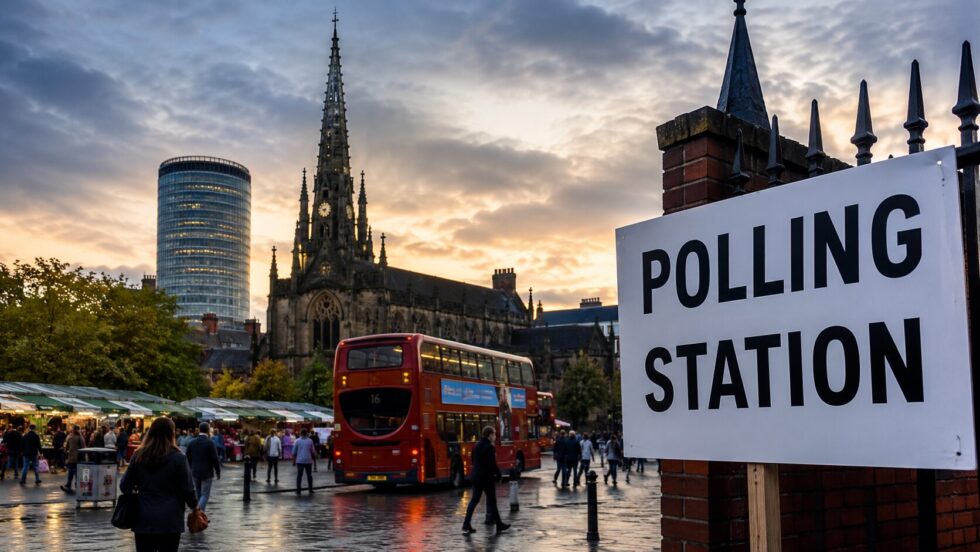
Birmingham local elections 2026 are emerging as one of the most politically significant local votes in Britain, with new polling suggesting Labour could suffer its largest defeat in the history of Birmingham City Council as Reform UK surges across dozens of wards amid deep voter frustration over bin strikes, council bankruptcy, tax rises and declining local services. The projected political upheaval would radically reshape the balance of power inside Britain’s largest local authority outside London and could become one of the clearest national warning signs yet for Prime Minister Keir Starmer, The WP Times reports.
Birmingham local elections 2026 have rapidly evolved from a routine municipal contest into a symbolic national referendum on trust in traditional political parties, with polling indicating that Labour’s decades-long dominance in Birmingham may be nearing collapse as Reform UK, independents and smaller parties gain momentum among working-class voters, suburban communities and frustrated residents across the West Midlands. Analysts increasingly describe the election as one of the most volatile local political moments seen in England since the collapse of traditional two-party council structures in major industrial cities during the 1990s.
Why Birmingham local elections 2026 matter far beyond the city
The scale of the projected political shift is extraordinary because Birmingham has historically been regarded as one of Labour’s strongest urban power bases in England. For years, control of Birmingham City Council symbolised Labour’s dominance across multicultural urban Britain. But Birmingham’s political environment has changed dramatically following years of financial instability, service cuts and public anger linked to the council’s effective bankruptcy declaration, equal pay liabilities, rising council taxes and prolonged disputes over waste collection services.
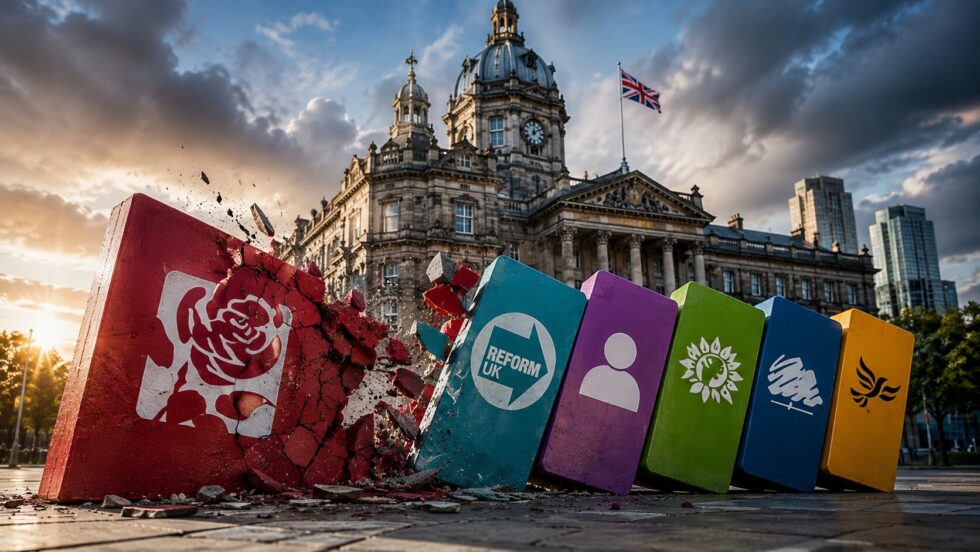
Polling published ahead of the election suggested Labour could fall to only 14 seats, while Reform UK could potentially secure 47 seats and independents could emerge as the second-largest bloc inside the council chamber. If replicated in the final vote, the result would represent:
| Projected party outcome | Estimated seats |
|---|---|
| Reform UK | 47 |
| Independents | 17 |
| Labour | 14 |
| Greens | 12 |
| Conservatives | 6 |
| Liberal Democrats | 5 |
The significance extends beyond Birmingham itself because the city is often viewed as a political bellwether for wider urban England. A collapse of Labour support in Birmingham would likely intensify pressure on the national Labour leadership ahead of future parliamentary elections.
Reform UK surge transforms Birmingham political landscape
One of the most striking developments in Birmingham local elections 2026 is the rapid rise of Reform UK across districts traditionally dominated by Labour. Polling indicates Reform UK has benefited from frustration surrounding:
- Birmingham bin collection disputes
- rising council tax levels
- declining public services
- anti-establishment sentiment
- concerns about crime and infrastructure
- dissatisfaction with traditional parties
Unlike previous election cycles where Labour and Conservatives dominated council politics, Birmingham voters now appear increasingly fragmented across several competing political forces. Reform UK’s projected rise also reflects broader national trends visible across England, where local elections have increasingly become protest votes against Westminster politics rather than purely municipal contests focused on local administration. Political strategists note that Birmingham’s “first past the post” electoral structure magnifies even relatively small vote-share changes into dramatic seat shifts. That means a narrow lead in individual wards can rapidly translate into disproportionate council representation.
Labour faces growing anger over bankruptcy and local services
Much of the pressure facing Labour in Birmingham stems from the city’s severe financial crisis. In recent years, Birmingham City Council has faced:
| Major issue | Impact on residents |
|---|---|
| Equal pay liabilities | Major financial pressure |
| Effective bankruptcy | Emergency spending controls |
| Bin strikes | Waste collection disruption |
| Service cuts | Reduced public services |
| Council tax increases | Higher household costs |
| Infrastructure complaints | Public dissatisfaction |
The political consequences have become increasingly visible across neighbourhoods where residents say they no longer feel the city functions effectively.
Public dissatisfaction has particularly intensified around visible quality-of-life issues including litter, road conditions, public transport connectivity and deteriorating maintenance of parks and community facilities. Some Birmingham voters interviewed during the campaign described frustration with years of political stagnation and accused both Labour and Conservatives of failing to address everyday concerns affecting working-class communities. Others argued Birmingham still retains enormous strengths including its cultural diversity, universities, food scene, arts sector and green spaces, but warned the city requires stronger civic leadership and investment.
Birmingham voters focus on transport, safety and public spaces
Transport infrastructure emerged as one of the defining themes of Birmingham local elections 2026.
Many residents have called for:
- expanded tram networks
- safer roads
- more cycle lanes
- improved rail integration
- stronger public transport connectivity
- better maintenance of parks and public spaces
The debate reflects wider concerns about Birmingham’s long-term urban competitiveness compared with other major European cities.
Local campaign discussions also focused heavily on Sutton Park parking charges, youth facilities, health initiatives and environmental maintenance.
Community activists argued years of underinvestment have damaged some of Birmingham’s most important public assets, particularly green spaces and recreational infrastructure.
Others highlighted concerns over declining activity levels and public health challenges across the West Midlands, which continues to record some of the lowest physical activity rates in England.
Could Birmingham local elections 2026 reshape national politics
The national implications of Birmingham local elections 2026 are difficult to overstate. Although local elections rarely produce direct national political consequences overnight, Birmingham’s scale makes the result symbolically important for all major parties.Several factors explain why Westminster is closely monitoring the outcome:
| Political factor | Why it matters |
|---|---|
| Labour urban support | Key foundation of national strategy |
| Reform UK growth | Potential fragmentation of right-wing vote |
| Independent rise | Decline of traditional party loyalty |
| Birmingham bankruptcy | National scrutiny of council management |
| Voter anger | Indicator of broader economic dissatisfaction |
For Labour, losses in Birmingham could raise deeper questions about voter confidence less than two years after entering government nationally.
For Conservatives, Reform UK’s rise presents an equally serious challenge because it further divides centre-right support across England.
Meanwhile, independents and Greens continue benefiting from voters seeking alternatives outside Britain’s traditional party system.
Electoral mathematics could produce dramatic council outcomes
One of the key reasons Birmingham local elections 2026 remain difficult to predict is the distortion created by Britain’s electoral system.
Under “first past the post,” parties can win large numbers of seats even without overwhelming overall vote share dominance.
Polling suggested Reform UK could secure around 26% of the vote while Labour could still retain roughly 23%, yet the final seat distribution could differ dramatically because victories are decided ward by ward.
Political analysts warn that local election polling also carries larger margins of error than national parliamentary polling because turnout patterns vary heavily between wards and voter participation is less predictable.
However, the polling sample used in several Birmingham surveys was unusually large for local elections, increasing confidence that significant political movement is genuinely occurring.
Birmingham’s political identity is entering a new phase
For decades, Birmingham politics largely revolved around Labour-versus-Conservative competition.That structure now appears increasingly unstable.The rise of Reform UK, independents and Greens reflects broader changes across British politics where many voters feel disconnected from traditional party identities that once dominated industrial cities.Birmingham’s political transformation also reflects wider economic and social pressures affecting urban Britain:
- rising living costs
- infrastructure strain
- declining trust in institutions
- frustration with local governance
- growing anti-establishment sentiment
- fragmented political loyalties
Whether Labour ultimately loses control of Birmingham City Council or merely suffers major losses, the election already signals a deeper restructuring of local political behaviour across England’s major cities.The final declarations from Birmingham local elections 2026 are therefore likely to be studied nationally not simply as municipal results, but as an indicator of where British politics itself may be heading next.
Read about the life of Westminster and Pimlico district, London and the world. 24/7 news with fresh and useful updates on culture, business, technology and city life: Election results 2026: Reform UK surge reshapes UK politics overnight
Sources used in reporting and verification include:
BBC News, ITV News, Birmingham City Council, More in Common UK