
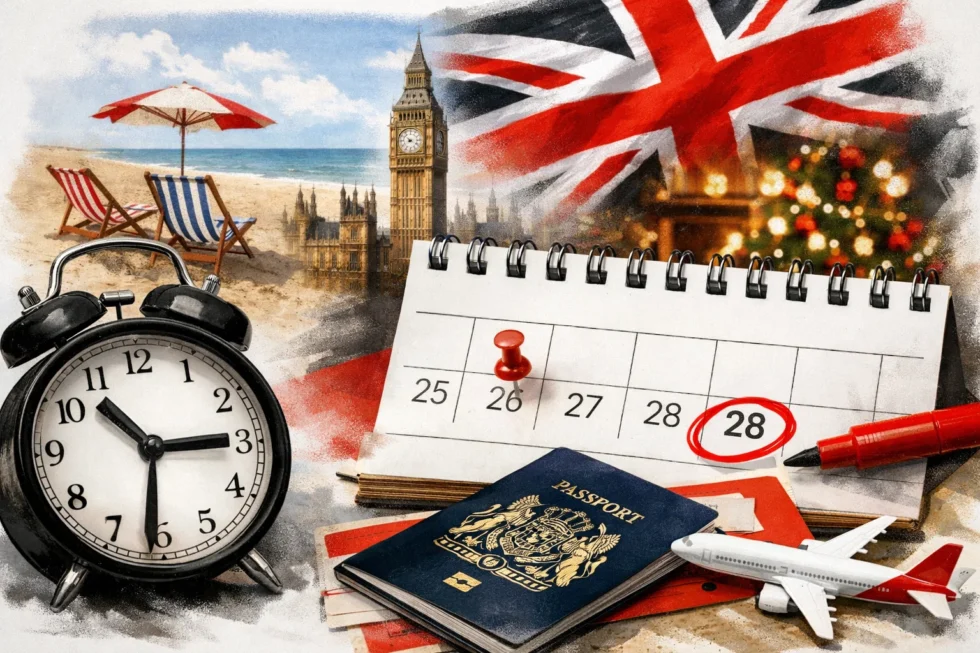
The UK’s official bank holiday calendar for 2026 has now been confirmed, giving households, employers, airlines and schools the first clear picture of how the year’s working and travel rhythms will fall. The most significant change is that Boxing Day will be observed on Monday 28 December rather than on its traditional date of 26 December. The shift happens because 26 December falls on a Saturday in 2026, triggering the government’s long-standing substitute-day rule that guarantees workers a weekday public holiday when a fixed-date holiday lands on a weekend, The WP Times editorial team reports.
While no extra one-off holidays have been added for national events, the way weekends, Easter and Christmas align in 2026 means the calendar will feel very different for families and businesses compared with 2025. In practice, the year creates longer winter breaks, altered Easter travel peaks and unusually concentrated summer holiday periods — all of which matter for wages, staffing, tourism and household budgets.
Why Boxing Day is moving in 2026
Boxing Day is legally fixed on 26 December, but UK employment law and government holiday rules require that when a public holiday falls on a Saturday or Sunday, it must be replaced with a “substitute day” on the following weekday.
In 2026, 26 December falls on a Saturday, which means workers would otherwise lose their paid day off. To avoid that, the government has designated Monday 28 December as the public holiday instead.
This has several real-world consequences:
- Many people will enjoy a four-day Christmas weekend from Friday 25 December to Monday 28 December
- Retail, logistics and hospitality businesses must now plan staffing for an extended festive trading period
- Trains, flights and hotels are expected to be busier than usual across the Christmas–New Year corridor
The pattern last occurred in 2021, when Christmas and Boxing Day also fell on a weekend, and travel demand spiked sharply as workers used the substitute days to take longer breaks with fewer annual-leave days.
The full England and Wales bank holiday calendar for 2026
The confirmed dates are:
- Thursday 1 January – New Year’s Day
- Friday 3 April – Good Friday
- Monday 6 April – Easter Monday
- Monday 4 May – Early May bank holiday
- Monday 25 May – Spring bank holiday
- Monday 31 August – Summer bank holiday
- Friday 25 December – Christmas Day
- Monday 28 December – Boxing Day (substitute day)
That makes eight bank holidays, the same number as in 2025, but their spacing through the year is very different.
How Easter shifts the year’s rhythm
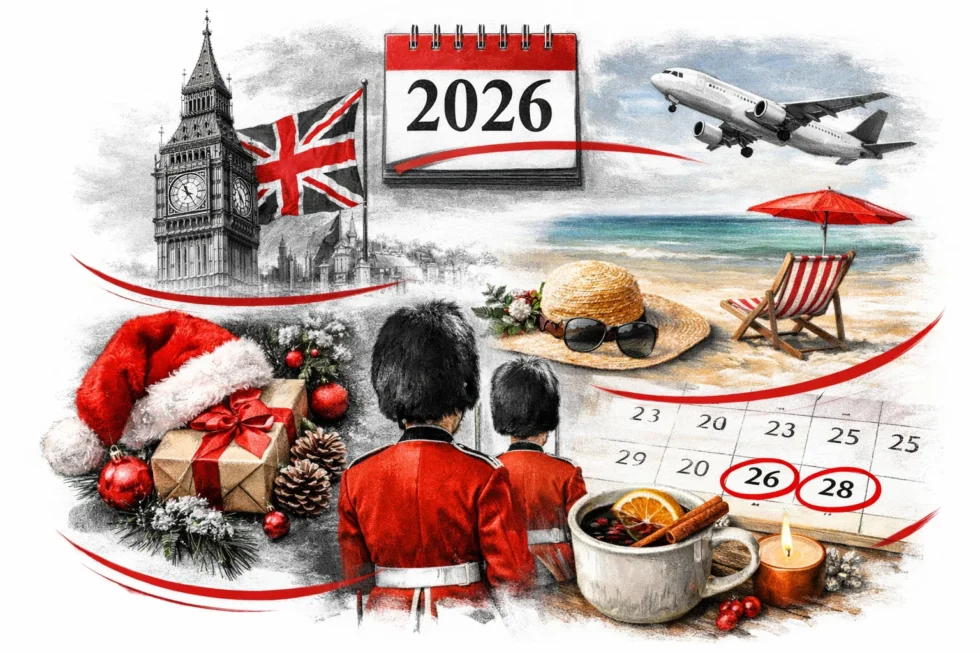
Easter in 2026 falls relatively early. Good Friday is on 3 April and Easter Monday on 6 April, meaning schools, businesses and travel operators will experience the first major holiday surge much earlier in the spring.
This has knock-on effects across the economy:
- Families face earlier childcare disruptions
- Airlines and Eurostar will see Easter demand hit in early April rather than mid- or late-April
- Hospitality businesses in coastal and tourist areas may see an early-season boost
- Retailers will bring forward Easter promotions, affecting first-quarter sales patterns
For parents, the early Easter also means the gap between the Christmas holidays and the next major school break is shorter, which can help with childcare planning — but also compresses spending into the first four months of the year.
No extra bank holidays — and why that matters
Despite rumours at the end of 2025, the government has not added any additional bank holidays for 2026. There is no jubilee, coronation or major national celebration scheduled that would justify an extra day off.
That matters because extra bank holidays have measurable economic effects. Studies from the Office for National Statistics show that each additional public holiday typically reduces UK GDP for that quarter by 0.1–0.3 percentage points, due to lower industrial output and office closures. With inflation only just easing and productivity still under pressure, ministers have opted to keep the standard eight-day structure.
What this means for workers
A key misunderstanding every year is whether employers are legally required to give paid leave on substitute days.
In short: no — unless your contract says so.
UK law does not guarantee paid time off on bank holidays. Employers can include them within the statutory 5.6 weeks of paid holiday, or require staff to work them. However, most contracts — particularly in the public sector and large private firms — treat bank holidays as paid days off.
For 2026, this means:
- Workers whose contracts say “plus bank holidays” will get Monday 28 December off
- Those on fixed annual leave without bank holidays may be required to use a day of leave if they want it off
- Shift workers and retail staff should expect heavy demand over the extended Christmas weekend
The Christmas–New Year effect in 2026
Because Christmas Day falls on a Friday and Boxing Day’s substitute day is Monday, many workers will be able to take just three days of leave (29–31 December) and get a ten-day break from 25 December to 4 January.
This will likely:
- Drive a surge in winter travel bookings
- Increase pressure on airports, Eurostar and UK rail
- Push up prices for hotels and package holidays
- Create staffing challenges for NHS, care homes and retail
Travel companies already expect late-December 2026 to be one of the busiest festive periods of the decade.
Summer holidays and the August pinch
The 31 August Summer Bank Holiday again falls on a Monday, which means school holidays and family travel will peak in the final week of August.
This concentrates demand for:
- Flights to Europe
- UK coastal accommodation
- Motorway travel
In recent years this “August pinch” has pushed prices up by as much as 25–40% compared with late June or early July, and 2026 is expected to follow the same pattern.
Why bank holiday timing really matters
Bank holidays don’t just create days off — they shape the entire flow of the economy. They affect:
- Wage bills and overtime costs
- Retail sales peaks
- Transport congestion
- Hotel pricing
- School attendance
- NHS staffing
The 2026 calendar, with its early Easter and long festive block, will front-load activity into spring and late December while making the middle of the year feel comparatively compressed.
For families, it offers better opportunities for long breaks with fewer leave days. For businesses, it means tighter staffing and higher costs during key weeks.
The shift of Boxing Day to Monday 28 December is more than a technical detail — it reshapes the UK’s end-of-year rhythm, creating one of the longest and most travel-intensive festive periods in years. Combined with an early Easter and the usual August squeeze, 2026 will be a year where timing matters more than ever for anyone booking holidays, planning childcare or running a business.
Read about the life of Westminster and Pimlico district, London and the world. 24/7 news with fresh and useful updates on culture, business, technology and city life: What is Boxing Day in Britain — how it is celebrated, why it exists, and how London does it differently