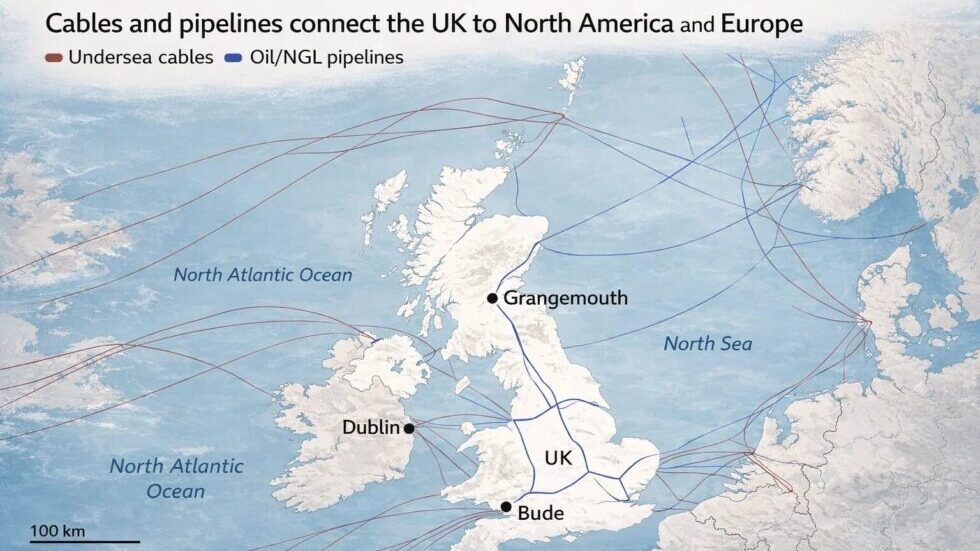
The United Kingdom's Ministry of Defence has confirmed that a high-stakes maritime standoff occurred in the North Atlantic on Thursday, April 9, 2026, involving three Russian submarines and a coordinated Royal Navy response. Defence Secretary John Healey revealed that the Russian Federation initiated a "covert" surveillance mission specifically targeting the 60 undersea data cables and multiple energy pipelines that sustain 90% of the UK’s daily internet traffic and 77% of its gas imports reported by The WP Times citing BBC.
The operation involved an Akula-class nuclear-powered attack submarine acting as a tactical diversion while two highly specialized GUGI (Main Directorate for Deep Sea Research) spy vessels conducted mapping of critical subsea assets. Although the MoD reports "no evidence" of physical damage to the 870,000-mile global cable network, the deployment of the frigate HMS St Albans, the tanker RFA Tidespring, and Merlin anti-submarine helicopters signals a severe escalation in North Atlantic security protocols.
Anatomy of the Russian Underwater Mission: GUGI vs. the Royal Navy
The specific threat identified by Whitehall involves the secretive GUGI unit, a directorate that reports directly to President Vladimir Putin and specializes in deep-sea sabotage and reconnaissance. Unlike standard naval fleets, GUGI operates from a secluded Arctic base at Olenya Bay and utilizes "motherships" to launch uncrewed, miniature submarines capable of operating at extreme depths where standard sensors often fail. During this particular encounter, the Royal Navy utilized active and passive sonar buoys to track the "malign" activity, demonstrating to Moscow that their movements were transparent to NATO intelligence.
Security analysts at the Royal United Services Institute (RUSI) indicate that even when monitored, these Russian assets likely gathered significant acoustic and structural data regarding the Langeled pipeline, which stretches 724 miles between Norway and the UK.
Technical Components of the Russian Surveillance Fleet
Akula-Class Submarine: A nuclear-powered vessel used to draw British sonar away from the primary spy units.
GUGI Spy Vessels: Specialized craft equipped with deep-sea "mini-subs" for cutting or interdicting fiber-optic cables.
Diversionary Tactics: Deployment of naval assets during periods of global distraction, such as conflicts in the Middle East.
Mapping Capability: High-resolution scanning of seafloor topology to identify "blind spots" in Western monitoring.
Strategic Implications of Hybrid Warfare on UK Energy and Data Security
The UK’s reliance on undersea infrastructure makes it uniquely vulnerable to the "hybrid warfare" tactics currently employed by the Kremlin. These acts, which remain below the threshold of attributable lethal attacks, are designed to test NATO's resolve and prepare the battlefield for potential future hostilities. Defence Secretary Healey explicitly warned that any attempt to damage these energy lifelines would result in "serious consequences," a statement aimed at deterring Russia from activating pre-positioned devices on the seabed.
The incident has sparked a domestic political debate, with opposition leaders demanding the immediate publication of the Defence Investment Plan to ensure the Royal Navy remains operational at a level sufficient to protect 1.4 million kilometers of global cabling.
Critical Vulnerabilities in UK Subsea Assets
Internet Traffic: Over 90% of UK data travels through cables surfacing in East Anglia and South West England.
Energy Imports: 77% of UK gas is supplied via Norwegian pipelines, making the Langeled route a primary target.
Economic Impact: Disruption to these cables could freeze financial transactions and destabilize the national power grid.
Attribution Difficulty: Hybrid attacks are designed to be deniable, complicating the legal basis for a military response.
Defense Secretary’s Direct Warning to President Putin
In a rare and pointed televised briefing from Downing Street, John Healey addressed the Russian leadership directly, stating, "We see you. We see your activity over our cables and our pipelines." This public disclosure of intelligence is intended to strip away the "deniability" factor that Russia relies on for its hybrid operations.
By dropping sonar buoys directly over the GUGI submarines, the Royal Navy signaled that Moscow no longer possesses the advantage of "covert" movement in the North Atlantic. The Prime Minister, Sir Keir Starmer, echoed this sentiment, emphasizing that the British public should not "pay the price for Putin's aggression" through inflated energy bills caused by infrastructure tampering.
"Our armed forces left Russia in no doubt that they were being monitored, that their movements were not covert, as President Putin planned, and that their attempted secret operation had been exposed," — Defence Secretary John Healey, April 9, 2026.
International Cooperation and the North Sea Corridor
The tracking of the three Russian submarines was not a solo effort; the UK coordinated closely with several NATO allies, specifically mentioning Norway as a key partner in the operation. This joint surveillance is part of a broader "Maritime Security Nadir" response, aiming to bolster the protection of the North Sea Continental Shelf. Despite the decommissioning of some UK support vessels, such as the RFA Wave Knight, the integration of Merlin helicopters and Norwegian sea-power has created a temporary shield over the Langeled pipeline.
Experts suggest that the next phase of defense will involve "recoverable surveillance assets"—devices left behind by the MoD to monitor Russian mapping patterns long after their submarines have returned to their Arctic bases.
Steps Taken to Harden Maritime Defenses
Sonar Buoy Screens: Deployment of active "pinging" buoys to deny Russian subs the ability to hide in thermal layers.
NATO Intelligence Sharing: Real-time data exchange between UK, Norwegian, and US naval commands.
Aerial Patrols: Continuous Merlin helicopter sorties to provide "eye in the sky" verification of underwater anomalies.
Infrastructure Monitoring: Increasing the use of private sector sensors on pipelines to detect unauthorized robotic sub activity.
The Russian Response and Future Projections for 2026
The Russian Embassy in London has historically dismissed these reports, claiming it has "no interest in British underwater communications," despite repeated sightings of vessels like the Yantar loitering near the English Channel. Security officials expect these "cat-and-mouse" games to intensify throughout 2026 as Russia seeks to capitalize on Western geopolitical distractions. The primary concern for the MoD remains the potential for Russia to "seed" the Atlantic floor with sleeper sabotage devices that could be triggered remotely in the event of a full-scale war.
Consequently, the Royal Navy is shifting its focus toward a "standing start" readiness posture, ensuring that frigate HMS St Albans and similar vessels are permanently positioned near high-value landing points.
Read about the life of Westminster and Pimlico district, London and the world. 24/7 news with fresh and useful updates on culture, business, technology and city life: UK exposes covert Russian submarine activity near Atlantic infrastructure and warns Kremlin of consequences