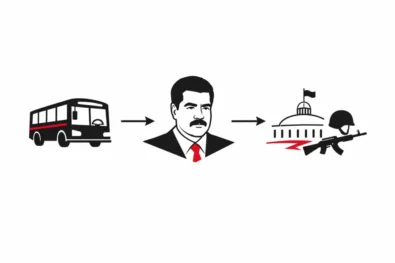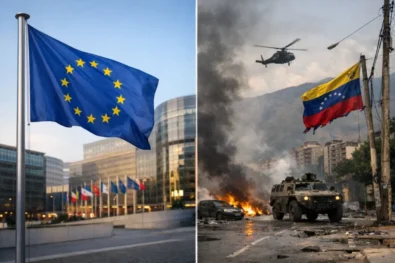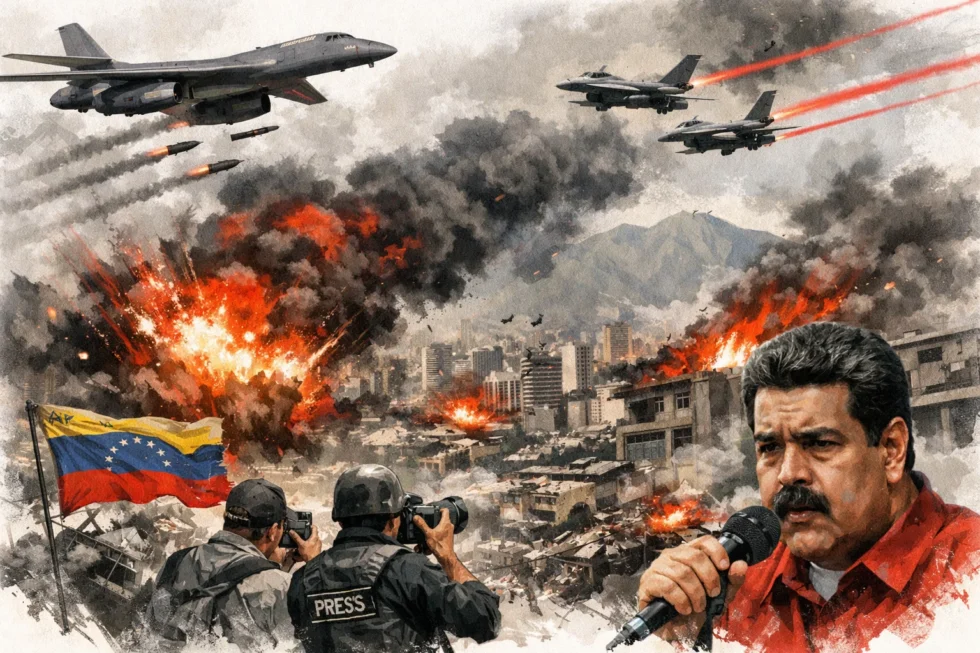
CARACAS / WASHINGTON — Saturday. In the early hours of Saturday, 3 January 2026, the United States launched air strikes on Venezuela, with explosions hitting areas in and around Caracas and prompting President Nicolás Maduro to declare a nationwide state of emergency as the country was placed on a war footing.
Residents across the Venezuelan capital reported multiple powerful blasts shortly after 2am, followed by the sound of low-flying military aircraft over the city and thick columns of smoke rising from several districts. Power cuts were recorded across parts of southern Caracas, particularly in neighbourhoods located near major military and security installations, as emergency forces were deployed across the capital. Local journalists and emergency services said at least seven explosions were heard, while US and international media confirmed that American military aircraft were operating over Venezuelan airspace during the strikes, The WP Times reports.
Targets hit
According to Venezuelan officials and local media, a number of high-profile military and government sites were struck, including areas near Fort Tiuna, the country’s main military complex, and Generalissimo Francisco de Miranda Air Base, both located in the south of the capital.
Reports also indicated damage near the National Assembly building and to property linked to Defence Minister Vladimir Padrino López, though these claims could not immediately be independently verified.
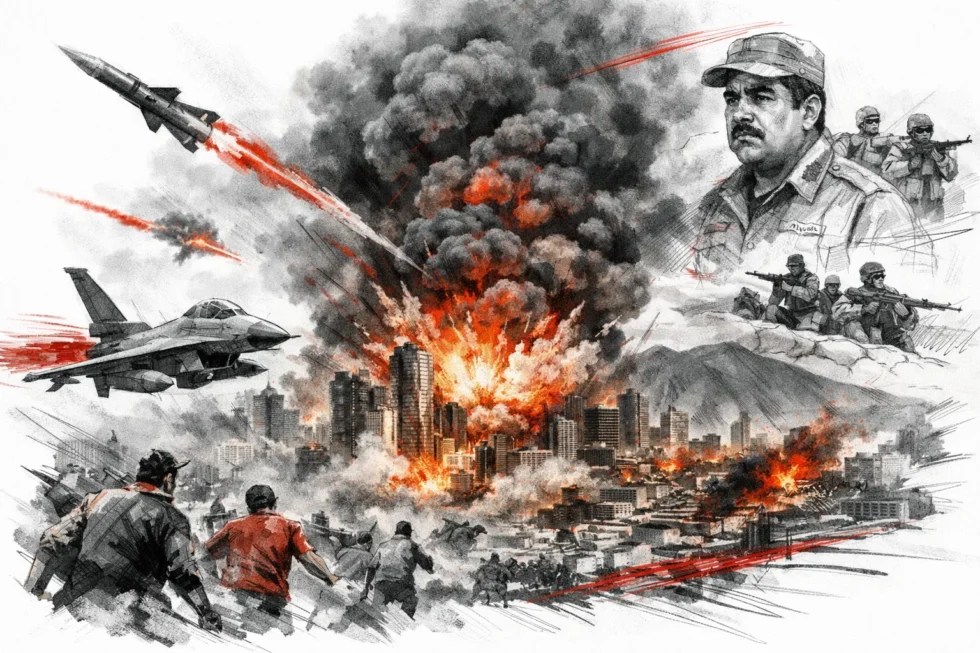
Outside Caracas, explosions were reported at the La Guaira naval base on the Caribbean coast, which houses Venezuela’s naval academy, as well as near the main port facilities serving the capital. Further strikes were reported on Margarita Island, where significant Venezuelan military infrastructure is located.
US response
US officials did not immediately issue a formal statement as the operation was under way. According to CBS News, the White House and the Pentagon were aware of reports of explosions and aircraft activity but declined to comment while the mission was ongoing.
Fox News, citing American officials, later reported that US forces were carrying out targeted strikes against Venezuelan military and government facilities. The Wall Street Journal reported that the White House planned to release an official statement once US aircraft had left Venezuelan airspace, suggesting the operation was designed as a limited air campaign rather than a full-scale invasion.
The US Federal Aviation Administration (FAA) issued an emergency Notice to Air Missions (NOTAM) at 1am Eastern Time, banning all American aircraft from flying at any altitude within Venezuelan airspace.
Maduro declares emergency
Venezuela’s foreign minister, Yván Gil Pinto, condemned the strikes as an act of military aggression by the United States. He said both civilian and military sites had been hit in Caracas and in the states of Miranda, Aragua and La Guaira.
President Maduro announced what he called an “external state of emergency”, ordering the activation of the country’s integrated defence command and the implementation of a national defence plan. The Venezuelan government did not disclose his location, citing security concerns.
The foreign minister said Venezuela would take its case to the United Nations Security Council, the UN Secretary-General and regional organisations, while reserving the right to self-defence under international law.
Trump’s earlier warnings
The strikes follow weeks of escalating rhetoric from US President Donald Trump, who has repeatedly warned that Washington was prepared to use force against the Maduro government.
Last month, Trump announced a blockade of sanctioned oil tankers entering or leaving Venezuelan waters, aiming to cut off what the White House describes as the regime’s primary source of revenue. US forces have since intercepted two oil vessels and forced another to flee into the Atlantic.
The US Treasury Department has imposed a new wave of sanctions on Venezuelan and Iranian nationals, shipping firms and energy traders accused of facilitating illegal oil exports, weapons transfers and sanctions evasion in support of the Maduro government. In December, the Trump administration went further by formally designating the Venezuelan government a foreign terrorist organisation, accusing senior officials of running a state-backed narco-trafficking and smuggling network.
There is still no verified information on the number of casualties or the full extent of the damage caused by Saturday’s US air strikes. With Venezuelan airspace closed, airports on emergency footing and US forces pulling back from the region, attention is now turning to whether Caracas will order a military response and how quickly the crisis could escalate beyond Venezuela’s borders.
The scope of the strikes — hitting military bases, airfields, ports and government-linked facilities across several regions — suggests the operation was designed to cripple Venezuela’s command, defence and revenue systems without triggering a full-scale invasion, making it the most significant direct US military action against the Maduro regime in years.Read about the life of Westminster and Pimlico district, London and the world. 24/7 news with fresh and useful updates on culture, business, technology and city life: German politicians debate sending Bundeswehr troops to Ukraine as part of a future peacekeeping mission
Sources used in the preparation of this report: local media, Reuters, CBS News and Fox News.