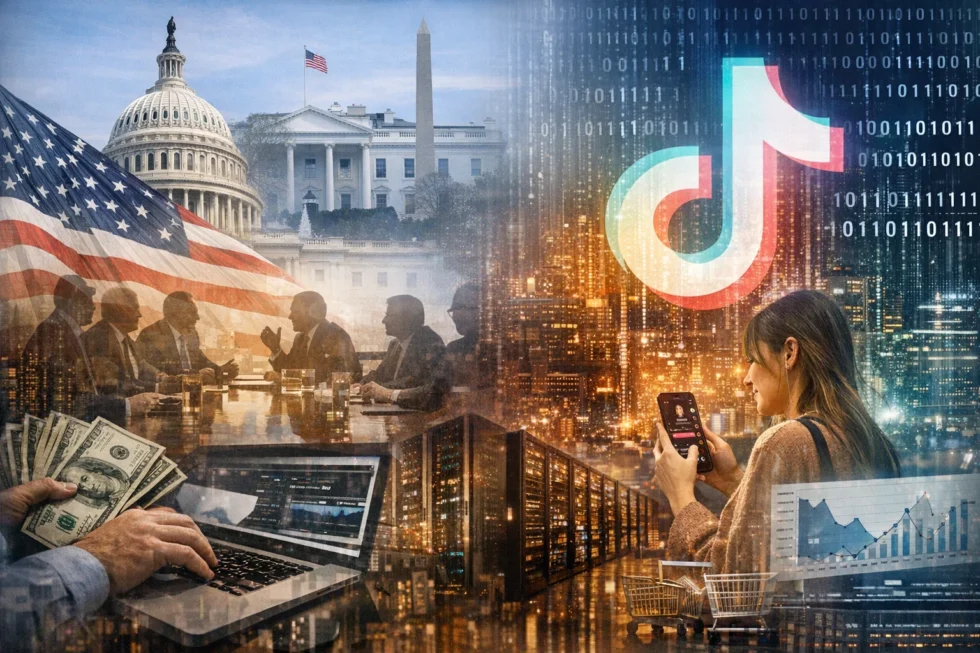
January 2026 marked a decisive turning point for TikTok in the United States. After more than five years of political pressure, legal threats and negotiations spanning two US administrations and multiple sessions of Congress, the Chinese-owned platform formally agreed to separate its American operations from its global business.
The agreement, finalised this month, allows TikTok to continue operating in a US market of nearly 200 million users and around 7.5 million businesses, but only under a new ownership and governance structure that transfers control over US user data and core algorithmic systems to an American-led entity and caps parent company ByteDance’s stake at 19.9%. The move fundamentally reshapes how one of the world’s most influential technology platforms can operate in Western markets, The WP Times reports, citing statements from TikTok and analysis by the BBC.
How the TikTok standoff began
Concerns over TikTok’s handling of user data first moved to the centre of US politics in mid-2020, when then president Donald Trump signed an executive order seeking to remove the app from American app stores. Lawmakers from both parties argued that TikTok posed a national security risk, citing fears that US user data could be accessed by the Chinese state or that Beijing might exert influence over the platform’s content distribution.
At the time, TikTok — owned by ByteDance — was expanding at exceptional speed, particularly among younger users. By the early 2020s it had become one of the most influential consumer platforms globally, with current estimates suggesting that roughly one in seven people worldwide now uses the app in some form.
In response to mounting political pressure, ByteDance unveiled Project Texas in 2022, a proposal designed to ring-fence US user data from the rest of TikTok’s global operations. Under the plan, American user data would be stored on domestic servers operated by Oracle, alongside additional security controls, auditing mechanisms and US-based oversight.
TikTok also shifted parts of its operational footprint to Singapore and Los Angeles — moves widely interpreted in Washington as attempts to distance the company from Beijing and to demonstrate a willingness to compromise. At the time, these steps were regarded by some policymakers as significant concessions. They ultimately failed to resolve core concerns around ownership, governance and algorithmic control.
The 2024 law that forced the deal
In 2024, the US Congress passed legislation threatening a nationwide ban on TikTok unless ByteDance substantially reduced its ownership stake and restructured the platform’s US operations. While the law stopped short of mandating a full divestment, it made explicit that control over user data, technical infrastructure and recommendation systems could no longer remain under Chinese ownership.
Following prolonged negotiations between TikTok, ByteDance and US authorities, a final agreement was concluded in January 2026. Under the terms of the deal:
- TikTok’s US business is carved out into a newly created, consortium-led American entity
- ByteDance retains a 19.9% minority stake, allowing limited revenue participation
- Control of US user data storage and algorithm training transfers to the American entity
- ByteDance licenses its recommendation technology to the US operation, in a deal valued by the Trump administration at approximately $14bn
Why the algorithm matters
TikTok’s defining competitive advantage lies in its recommendation engine — a system that analyses vast volumes of behavioural data to deliver highly personalised content at scale.
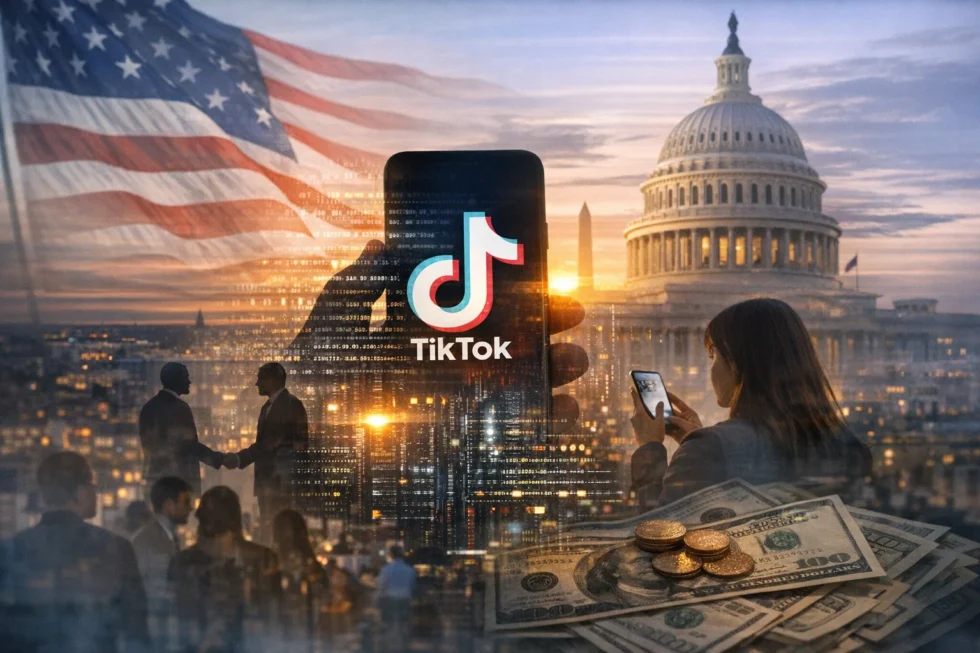
Industry analysts warn that separating the US algorithm from TikTok’s global system will have lasting strategic consequences. Kelsey Chickering, a principal analyst at Forrester, describes the algorithm as “the core of TikTok’s power”, cautioning that retraining it exclusively on US user data will inevitably alter how the platform functions. A US-only algorithm is widely expected to:
- reduce global content virality
- weaken cross-border discovery for creators
- reshape engagement patterns for advertisers
For international brands, this shift is likely to mean higher costs for US-specific campaigns and reduced organic reach compared with TikTok’s previous globally integrated model.
Financial impact on TikTok and ByteDance
TikTok’s global revenue in 2024 is estimated at between $20bn and $26bn, with around $10bn generated in the US, largely through advertising. The restructuring is expected to put pressure on margins in the American market as a result of:
- duplicated engineering and product teams
- parallel governance and compliance structures
- increased regulatory and oversight costs
Charlie Dai, another principal analyst at Forrester, notes that maintaining separate US and global systems adds operational complexity, slows product development and drives up long-term costs. ByteDance, however, continues to benefit financially through its retained minority stake and ongoing licensing revenues tied to the algorithm.
Lessons from India — and why this time is different
TikTok’s forced exit from India in 2020 — when New Delhi banned around 200 Chinese apps — was previously viewed as ByteDance’s most severe geopolitical setback. India had been TikTok’s largest single market, with an estimated 200 million users. Despite that loss, the company continued to expand elsewhere, underlining its global resilience.
The US case differs in a crucial respect. TikTok has not been banned outright. Instead, it has been permitted to remain operational under strict political and regulatory constraints — a model that contrasts with companies such as Huawei, which were effectively excluded from Western markets altogether.
A new model for Chinese tech abroad
Analysts increasingly view the TikTok agreement as evidence of a broader shift in Western regulatory strategy. Rather than imposing blanket bans, governments are moving towards:
- partial ownership caps
- algorithm licensing arrangements
- data localisation requirements
- enhanced political and regulatory oversight
Chris Stokel-Walker, author of TikTok Boom, argues that the debate has expanded beyond data security to encompass broader questions of influence, culture and control over digital speech.
What it means for the UK and Europe
Although the agreement applies only to the United States, it sets a precedent that regulators in the UK and the EU are expected to scrutinise closely. For advertisers, creators and technology firms based in London, the implication is clear: global platforms may increasingly operate under region-specific algorithms, governance frameworks and data regimes.
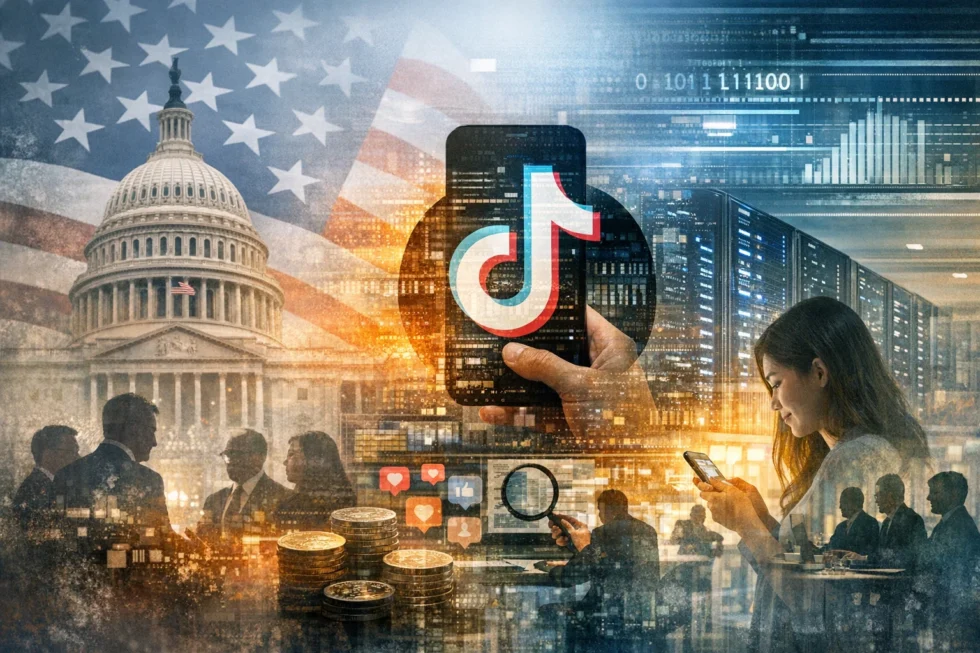
UK regulators, including Ofcom, are already expanding their oversight of digital platforms, and the TikTok deal is likely to reinforce that trajectory. The agreement points to a new reality for Chinese technology champions: international expansion remains possible, but increasingly comes at the cost of autonomy, control and political neutrality.
Read about the life of Westminster and Pimlico district, London and the world. 24/7 news with fresh and useful updates on culture, business, technology and city life: Audi unveils first Formula 1 team kit with adidas ahead of 2026 debut in UK