
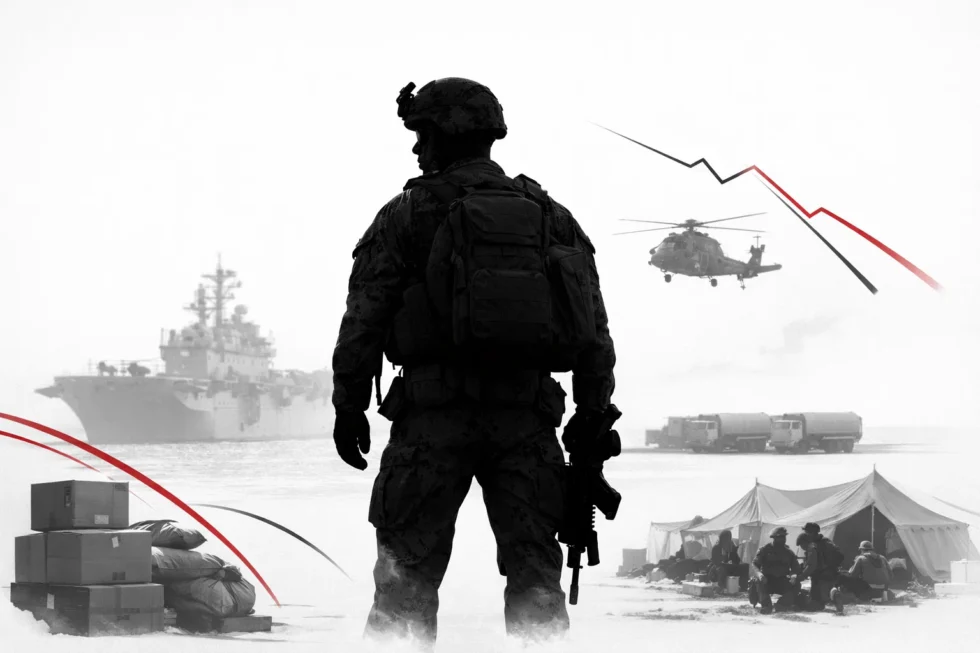
USS Tripoli deployment food has emerged as a frontline operational concern after US Marines aboard the amphibious assault ship reported reduced meal portions and limited fresh supplies during a prolonged deployment linked to the Iran conflict, with images and first-hand accounts indicating rationing and logistical strain across vessels operating in the Gulf, as military mail routes remain suspended and resupply timelines uncertain, The WP Times reports, citing The Times.
The issue has intensified as families of deployed personnel describe care packages—containing food, hygiene products and basic comforts—being held indefinitely due to airspace restrictions and military transport disruption, creating a dual pressure on morale and sustainment aboard ships such as USS Tripoli and USS Abraham Lincoln, where crews have been at sea for extended periods without routine port access or replenishment cycles.
Supply disruption and rationing during USS Tripoli deployment food operations
Operational conditions tied to the Iran war have disrupted standard supply chains supporting US Navy and Marine Corps deployments in the Middle East. Military postal deliveries to multiple overseas ZIP codes were suspended in early April due to restricted airspace and transport instability, directly affecting the flow of supplementary goods to deployed personnel.
On board vessels, this has translated into tighter ration control and reduced variety in meals. Service members describe limited portions and an absence of fresh produce, consistent with extended time at sea without resupply. Key logistical constraints affecting USS Tripoli deployment food:
- Suspension of military mail delivery to multiple Middle East ZIP codes
- Airspace closures limiting transport aircraft routes
- Delayed or rerouted supply shipments
- Lack of scheduled port calls for replenishment
- Increased operational tempo reducing resupply windows
These factors together create a closed-loop environment where onboard provisions must last longer than originally planned, increasing reliance on stored and processed food.
Reported meal conditions and onboard realities
Accounts from service members and families indicate a shift in both quantity and quality of food available during deployment. Shared images and descriptions point to minimal meal compositions and reduced nutritional diversity. Reported characteristics of meals:
| Component | Reported condition |
|---|---|
| Protein | Small portions, often processed or dry |
| Vegetables | Limited, occasionally basic (e.g. carrots) |
| Fresh produce | Largely unavailable |
| Portions | Reduced, with rationing in place |
| Variety | Low, repetitive meal cycles |
In some cases, personnel described meals consisting of small servings of shredded or processed meat with minimal accompaniments, reflecting constrained supply conditions rather than standard naval provisioning.
“Morale is going to be at an all-time low”
Statements shared with families highlight the operational and psychological impact of the situation, particularly during extended deployments without clear timelines for resupply or rotation.
“We eat when we can, and we split food evenly when someone gets more,” (message from US sailor aboard USS Tripoli, shared with family, March 2026).
“Supplies are going to get really low… morale is going to be at an all-time low,” (same source, Middle East deployment communication).
Family members have responded by organising and sending care packages containing food, vitamins, hygiene products and personal items. However, many shipments have not reached their destinations due to the ongoing suspension.
Additional reported shortages include:
- Hygiene products (toothpaste, deodorant, shampoo)
- Comfort food and snacks
- Coffee and basic onboard amenities
- Clean clothing items such as socks
This gap between need and delivery has become a central concern for families supporting deployed personnel.
Military and postal authorities have framed the suspension of deliveries as a consequence of operational conditions rather than a breakdown in supply. Officials say parcels already dispatched are being held in secure facilities and will move once routes reopen, pointing to a system paused by conflict dynamics rather than one that has failed. The disruption is driven by restricted airspace across the region, reliance on tightly controlled military logistics corridors, and the prioritisation of mission-critical cargo over personal shipments. Any resumption is tied to an assessment of transport stability by commanders on the ground, reflecting the degree to which distribution networks are dependent on both security conditions and air traffic access. While delays to military mail have occurred in previous conflicts, a broad suspension across multiple deployment zones is less typical in recent operations, underlining the scale of the current disruption.
At sea, the effect is compounded by the duration and intensity of deployment cycles. The USS Tripoli has been operating for weeks without routine port calls, a scenario that places sustained pressure on onboard stocks and limits opportunities for replenishment. Similar patterns have been observed across carrier and amphibious groups, where extended missions, constrained maintenance windows and increased consumption rates steadily erode buffer capacity built into provisioning systems. In such conditions, even minor interruptions in supply flow can translate into visible reductions in food variety and quantity, turning day-to-day meals into a direct reflection of logistical strain rather than standard naval provisioning.
Taken together, the USS Tripoli deployment food situation illustrates how modern naval operations remain exposed to wider geopolitical and transport disruptions. The issue is not a single failure point but the convergence of restricted mobility, prioritised logistics and sustained operational demand. In practical terms, this increases reliance on pre-loaded supplies, reduces flexibility in extending deployments, and heightens dependence on the timely restoration of air and sea routes. It also sharpens the impact on morale, where basic living conditions—food, hygiene and communication—become critical indicators of overall readiness. Even within resilient military systems, prolonged disruption without resupply introduces cumulative pressure that extends beyond nutrition into the broader effectiveness of deployed forces.
Read about the life of Westminster and Pimlico district, London and the world. 24/7 news with fresh and useful updates on culture, business, technology and city life: How many people are affected by the 2026 London Legionnaires' outbreak