
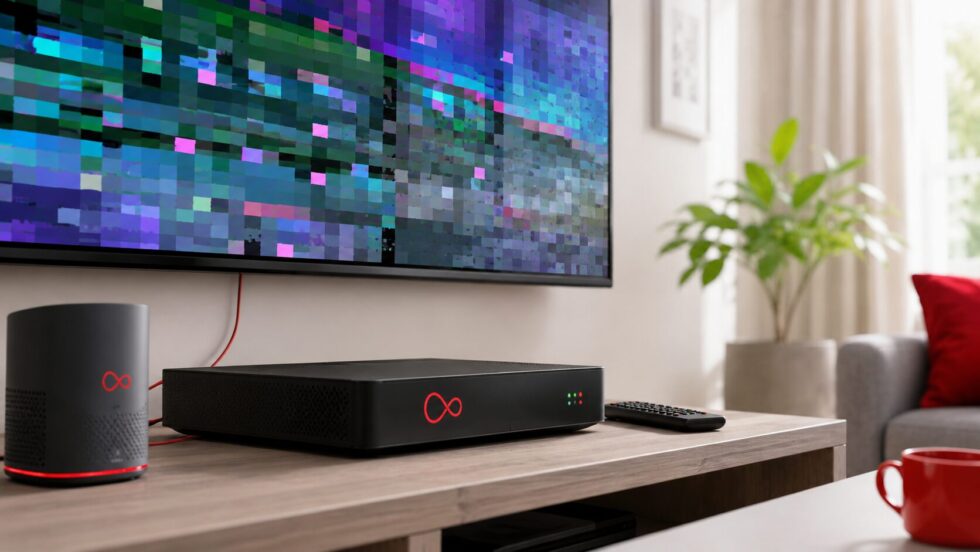
Virgin Media down reports escalated rapidly across the UK on Thursday morning, as thousands of households experienced disruption to Virgin TV services, with channels becoming pixelated, unstable or completely unwatchable. Users began searching “is Virgin Media down” in large numbers after noticing sudden deterioration in signal quality, particularly on TiVo boxes and live broadcasts, while broadband connections in many cases remained operational. Data from outage monitoring platforms shows a sharp spike in complaints shortly after 11:00 BST, with more than 3,600 users reporting issues within a short period, pointing to a coordinated Virgin Media outage affecting the broadcast layer rather than isolated local faults, The WP Times reports.
The incident has been characterised by a clear split between services: while Virgin TV output has been widely disrupted, broadband performance has remained largely stable, suggesting a failure in signal encoding, distribution or broadcast infrastructure rather than a full network collapse. Virgin Media acknowledged the disruption and confirmed that engineers are actively investigating the issue, though no estimated resolution time has been provided. The lack of immediate clarity on Virgin Media service status has led to increased frustration among users already concerned about recurring Virgin Media problems in recent months.
Virgin Media service status: technical scope and real impact on households
The current Virgin Media service status indicates a partial but highly visible outage, primarily affecting television services rather than full connectivity. This distinction is critical: although the phrase “Virgin Media down” is widely used, the actual failure appears limited to specific layers of the network. For households, this creates a confusing situation where some services work normally while others fail completely. This asymmetry leads many users to initially suspect faults in their own equipment, which delays recognition of a broader outage and contributes to the surge in “is virgin media down” queries online.
Key symptoms reported across the UK
These symptoms have been consistent across multiple regions, indicating a centralised fault rather than localised disruptions. The uniformity of complaints strengthens the conclusion that this is a systemic Virgin Media outage.
- Virgin TV channels appearing pixelated or distorted
- Sudden degradation in picture quality during live viewing
- Error messages when attempting to check Virgin Media service status
- Reboot attempts of set-top boxes failing to restore service
- Broadband functioning normally in parallel
The persistence of these symptoms despite user intervention confirms that the issue is network-side, not device-specific.
Virgin Media outage timeline: how the disruption unfolded
The Virgin Media outage developed rapidly and spread nationwide within minutes, reflecting the interconnected architecture of modern telecom networks. When a central node fails, the effects cascade almost instantly across regions.
This timeline also illustrates how quickly user awareness evolves—from isolated complaints to a confirmed nationwide issue within less than an hour.
Timeline of events
Each phase of the timeline corresponds to a shift in both technical impact and public perception, with search trends mirroring the escalation of the outage.
- Shortly after 11:00 BST: First reports of Virgin Media issues emerge
- Within 10–15 minutes: Surge in “virgin media down” and “is virgin media down” searches
- 11:20–11:30 BST: Thousands of users report pixelated Virgin TV channels
- Midday: Virgin Media confirms investigation into the issue
- Early afternoon: No confirmed fix time provided
The absence of an immediate resolution timeframe suggests that engineers are dealing with a fault that requires deeper system-level diagnostics.

What is causing Virgin Media problems: broadcast vs broadband failure explained
Understanding the root cause of Virgin Media problems requires distinguishing between different layers of service delivery. Not all outages are equal, and identifying the affected layer is key to diagnosing the issue. In this case, all available evidence points toward a broadcast-layer disruption, rather than a failure in core broadband infrastructure.
Broadcast (TV) infrastructure
This layer is responsible for delivering television signals and is particularly sensitive to encoding and transmission errors. Even small disruptions can degrade signal quality across a wide area.
- Uses dedicated signal distribution systems
- Relies on encoding, compression and routing of video streams
- Vulnerable to faults in signal processing or transmission
Failures here typically result in visual artifacts such as pixelation rather than complete signal loss.
Broadband (internet) infrastructure
Broadband operates on a separate system that is more resilient to isolated faults. This explains why many users still have internet access during the Virgin Media outage.
- Based on IP data transmission
- Separate routing and network management systems
- More resilient to isolated broadcast failures
The separation between these systems is why the outage appears selective rather than total.
Virgin TV disruption: why pixelation happens at scale
Pixelation is a technical symptom that reflects deeper issues in signal integrity. It is often the first visible sign of a broadcast failure affecting large numbers of users simultaneously. In large-scale outages, pixelation tends to appear uniformly across channels, indicating a problem upstream rather than at the consumer end.
Key technical triggers
Each of these factors can independently cause pixelation, but when combined, they create widespread disruption across the network.
- Data packet corruption in video streams
- Signal compression instability
- Transmission bandwidth fluctuations
- Synchronisation errors between broadcast nodes
The presence of multiple triggers suggests a complex fault rather than a single point of failure.
Customer response: real-world impact of Virgin Media outage
Customer reactions highlight the human impact of technical failures. While the issue is technical in nature, its consequences are immediate and visible to users. The consistency of feedback across platforms reinforces the scale and seriousness of the Virgin Media problems.
“Virgin TV completely pixelated – everything was fine minutes earlier, now impossible to watch.” (user report)
“Broadband works, TV doesn’t. Can’t even check Virgin Media service status properly.” (customer feedback)
“Rebooted the box several times – no change at all.” (UK user) These accounts demonstrate how quickly trust in service reliability can erode during outages.
Is Virgin Media down: how to verify the outage correctly
Determining whether Virgin Media down reflects a personal technical fault or a wider Virgin Media outage requires a structured, evidence-based approach. In large-scale incidents like the current one, the key signal is not a single error message but the simultaneous surge of identical complaints across regions, platforms and devices. When thousands of users begin searching “is Virgin Media down” within minutes, it typically indicates a network-level failure rather than isolated household issues.
In this case, the pattern of Virgin Media issues—pixelated Virgin TV, stable broadband, failed service checks—aligns with a systemic disruption. The consistency of symptoms across geographically separate users is one of the strongest indicators that the problem sits within Virgin Media’s infrastructure, not within customer equipment.
Reliable ways to check Virgin Media service status
Verifying Virgin Media service status requires relying on aggregated, real-time data rather than individual assumptions. The most accurate picture emerges when multiple independent sources converge on the same conclusion.
- Official Virgin Media service status page
This remains the primary source for confirmed outages, though updates may lag behind real-time events. It is useful for validation rather than early detection.- Outage tracking platforms (e.g. DownDetector)
These platforms provide immediate visibility into spikes in user reports. A sudden increase in complaints—especially into the thousands—is a strong indicator of a widespread Virgin Media outage.- Verified updates on social media (X, support channels)
Real-time responses from the provider often confirm awareness of Virgin Media problems before formal statements are published.- Cross-checking with local users
If multiple households in different areas report identical Virgin TV issues, the probability of a network fault increases significantly.These sources function as a distributed diagnostic system, where user-generated data fills the gap between technical failure and official confirmation.
Ineffective actions during network outages
During a confirmed or suspected Virgin Media down scenario, many standard troubleshooting steps become redundant. In fact, they can delay proper understanding of the situation.
- Rebooting routers or set-top boxes repeatedly
- Resetting network settings without evidence of local faults
- Reinstalling applications or reconnecting devices
- Attempting to “force refresh” service status tools
Such actions do not address infrastructure-level faults and often lead to unnecessary frustration. Recognising a network outage early is therefore critical to avoiding wasted effort.
Official statement and investigation progress
Virgin Media’s response reflects a typical telecom incident protocol: acknowledge the issue, initiate investigation, and avoid premature timelines. The company has confirmed awareness of Virgin Media issues affecting TV services, with engineers assigned to identify the root cause. From an operational standpoint, the absence of an estimated fix time is significant. It suggests that the fault is not immediately identifiable and may involve:
- Signal encoding systems
- Broadcast routing nodes
- Regional distribution hubs
In large-scale Virgin Media outages, diagnosis often requires isolating the failure point across multiple layers of infrastructure. This explains why communication tends to remain cautious until engineers confirm the exact source of disruption.
Broader implications: reliability challenges in modern telecom services
The current Virgin Media outage illustrates a structural challenge in modern telecom ecosystems: service integration increases vulnerability to partial failures. Providers like Virgin Media deliver bundled services—TV, broadband, on-demand streaming—through interconnected but distinct systems. When one layer fails, such as the broadcast infrastructure affecting Virgin TV, the overall user experience is disrupted even if other services remain operational. This creates a perception of total failure despite partial functionality. From an industry perspective, this raises key questions:
- How resilient are broadcast systems compared to IP networks?
- Are redundancy mechanisms sufficient for peak-time failures?
- Is communication during outages keeping pace with user expectations?
The increasing frequency of Virgin Media problems reported by users may intensify scrutiny from regulators and accelerate investment in infrastructure resilience.
What users should do now during Virgin Media outage
During an active Virgin Media down event, the most effective strategy is not technical intervention but adaptive response. Users should prioritise continuity of access rather than attempting to resolve network-level faults themselves.
Immediate actions
- Confirm whether broadband remains functional
- Identify whether the issue is limited to Virgin TV or broader services
- Monitor official updates and verified outage trackers
These steps allow users to quickly understand the scope of the problem without unnecessary troubleshooting.
Short-term alternatives
- Switch to streaming platforms using broadband
- Use mobile data as a temporary fallback if required
- Access content via secondary devices (laptops, tablets)
Importantly, users should avoid repeated resets of equipment, as this has no impact on centralised outages and may complicate device settings.
Outlook: how long will Virgin Media problems last
The duration of the current Virgin Media outage depends on the complexity of the underlying fault. Based on comparable incidents, most broadcast-related disruptions are resolved within several hours to one working day. However, the absence of a clear resolution timeline suggests that this incident may involve deeper infrastructure components. If so, restoration could require:
- Reconfiguration of broadcast nodes
- Signal recalibration
- Network-wide updates
Repeated Virgin Media problems of this nature may also lead to longer-term consequences, including regulatory review and increased pressure on service reliability standards across the UK telecom sector.
The incident occurs against a backdrop of rapid transformation in the tech sector, where consumer expectations are rising alongside innovation. Telecom providers are no longer judged solely on connectivity but on the stability of integrated digital ecosystems. As companies expand into:
- Streaming services
- Smart home integration
- Multi-device connectivity
…the tolerance for outages decreases significantly. A disruption in Virgin TV, even without broadband failure, now carries greater reputational risk than in previous years. This Virgin Media down event therefore reflects not just a technical fault, but a broader tension between innovation, scale and reliability in modern telecommunications.
Read about the life of Westminster and Pimlico district, London and the world. 24/7 news with fresh and useful updates on culture, business, technology and city life: Jet2 flight fuel supply update as UK flights to Rome, Naples, Pisa and Venice face delays on 11 May 2026
Used materials: Tech, Tech news, Virgin Media, Virgin Media O2, DownDetector, user reports, X (Twitter) posts