
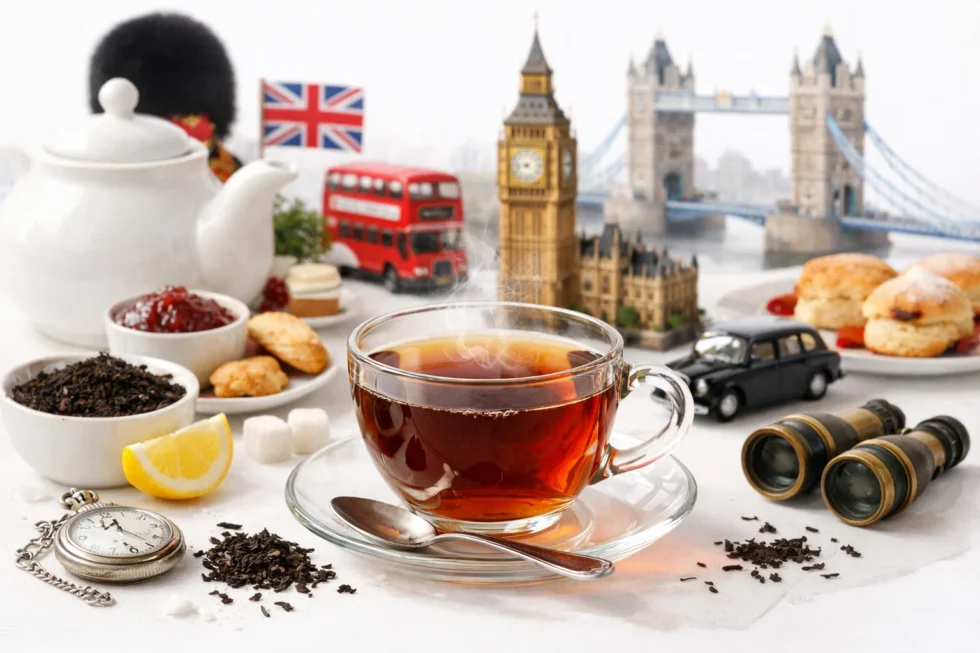
In London, black tea is not consumed for pleasure alone. It functions as a social stabiliser — a habit that absorbs shock, anxiety and uncertainty. Surveys by the UK Tea & Infusions Association show that over 84% of British adults drink tea daily, with London accounting for one of the highest concentrations of habitual tea consumption due to office culture, public-sector employment and dense urban routines. Black tea, in particular, remains the dominant choice. This persistence is not accidental; it reflects centuries of political decisions, wartime necessity and cultural self-discipline. This is reported by the editorial team of The WP Times.
London as the engine of Britain’s black tea culture
London’s role in shaping British tea culture is structural rather than symbolic. By the late 19th century, London docks handled the majority of tea imports entering the UK. At its peak, Britain imported over 400 million pounds of tea annually, most of it routed through London. The city did not merely consume tea; it standardised it.
London-based blenders developed formulas that prioritised:
- strength over aroma,
- consistency over origin,
- compatibility with milk over subtlety.
This approach distinguished British black tea from continental or East Asian tea cultures. In London, tea was engineered to be reliable — a drink that tasted the same in Whitehall, Hackney or Croydon.
War, rationing and why black tea became non-negotiable
The two world wars transformed black tea from habit into necessity. During the Second World War, Britain introduced strict rationing on sugar, meat and fats — but tea was never fully removed from civilian supply. Even at its lowest point, the weekly tea ration stood at 2 ounces per person.
The Ministry of Food openly acknowledged tea’s psychological importance. In London during the Blitz, communal tea-making became routine in shelters and damaged homes. Contemporary diaries and press archives repeatedly reference tea as the first action after an air raid.
Tea served three wartime functions:
- Physiological — caffeine and warmth.
- Psychological — restoring calm after shock.
- Social — reinforcing shared behaviour under pressure.
These patterns embedded tea into Britain’s emotional memory, especially in London, which endured sustained bombing.
London tea traditions: not nostalgia, but discipline
Modern London tea culture is often misrepresented as quaint or ceremonial. In reality, it is functional. The most common tea moment in London is not afternoon tea, but the unscheduled tea break — a pause triggered by tension, delay or bad news.
A “proper English tea hour” in London typically follows unspoken rules:
- tea is brewed with freshly boiled water, never reheated;
- steeping time is respected (3–5 minutes);
- milk is added after pouring, not before;
- conversation is restrained, not performative.
The purpose is not indulgence but recalibration. Tea is used to slow decision-making and reduce emotional escalation — a behavioural trait visible in London’s political and media environments.
Is black tea equally central in Scotland
Yes — and measurable data confirms it. According to grocery retail panels and household consumption surveys, average per-capita tea consumption in Scotland is estimated to be 5–10% higher than in England, with black tea accounting for the overwhelming majority of purchases. Major UK retailers consistently report higher sales volumes per household in Scotland, particularly in northern and western regions where climate and daily routines reinforce hot beverage consumption.
Scottish households also differ in how tea is consumed. Market studies show a preference for:
- stronger brews (longer steeping times),
- larger serving sizes (mugs rather than cups),
- higher daily frequency, especially in the morning and early evening.
This pattern reflects both environmental and cultural factors. Colder average temperatures and shorter daylight hours increase reliance on hot drinks, while domestic social life places greater emphasis on hospitality at home rather than in cafés.
Unlike London, where tea often functions as a professional stabiliser — a tool to manage pace in offices, public institutions and media environments — in Scotland black tea retains a primarily social role. Offering tea is not merely polite; it signals openness and willingness to engage. Refusing tea can still be interpreted as social distance, particularly in informal or domestic settings.
While whisky dominates Scotland’s global branding, it plays little role in everyday routine. Consumption data shows that tea outpaces all other non-alcoholic hot drinks combined in Scottish households. In this sense, black tea — not whisky — structures daily life.
These differences reinforce a broader conclusion: black tea’s centrality in Britain is not uniform in expression, but universal in function. Whether in London or Glasgow, tea operates as a shared social language — one that manages comfort, connection and continuity across regions.
Where Londoners buy quality black tea — and why brands matter
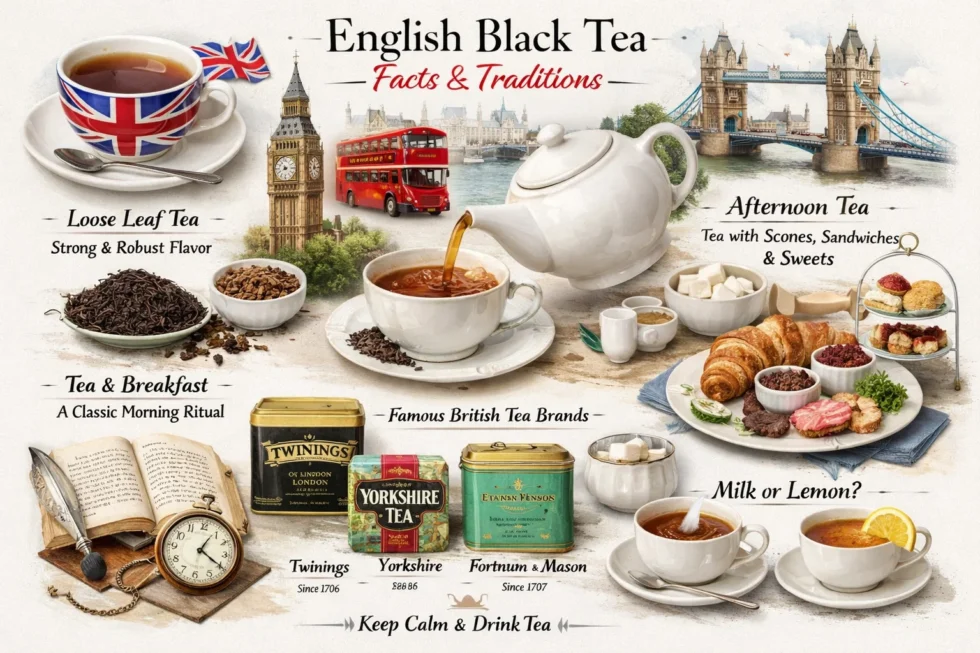
London’s black tea market is shaped less by consumer experimentation and more by institutional trust. Unlike wine or specialty coffee, tea in London is not expected to express individuality. It is expected to perform reliably, across millions of cups, in environments where consistency matters more than distinction. As a result, the city’s tea retail landscape favours heritage brands with industrial-scale blending discipline, not innovation-led newcomers.
The dominance of established names reflects this demand. Twinings operates less like a boutique and more like a standard-setting body. As a long-term supplier to British institutions, it has shaped what “English Breakfast” means in practical terms — strength, balance and repeatability. For offices, hotels and public bodies, this matters more than novelty.
Fortnum & Mason occupies a different but equally functional position. While associated with luxury, its tea operation prioritises controlled sourcing, batch testing and ageing stability. The appeal is not exclusivity, but assurance: customers know that a Fortnum blend will behave predictably, particularly when served formally or as a gift where failure is reputationally costly.
Whittard of Chelsea succeeds by mediating between heritage and accessibility. Its role in London is pragmatic — offering consistent blends to a broad consumer base without demanding specialist knowledge. This reinforces tea’s status as an everyday stabiliser rather than a connoisseur product.
Finally, Yorkshire Tea dominates daily consumption because it optimises for workplace reality. In offices, hospitals and public services, tea must perform under pressure: brewed in bulk, consumed with milk, and repeated throughout the day. Yorkshire Tea’s success lies in meeting these conditions without degradation.
Taken together, these brands illustrate why branding in British tea is not about storytelling, but risk reduction. They minimise variation, absorb supply volatility and protect consumers from inconsistency. In London — a city dependent on institutional continuity — this reliability is not a preference but a requirement.liability is a virtue.
How to judge the quality of British black tea
In Britain, black tea quality is judged by performance, not provenance. Claims about rare estates or exotic origins carry little weight if the tea fails in everyday use. Instead, professional tasters and London retailers apply a functional set of criteria:
- Liquor colour: the brewed tea should be clear and amber-toned. Cloudiness usually signals poor leaf grade or improper storage.
- Aroma: quality black tea smells clean and malty, without sourness or sharp acidic notes that indicate oxidation or age.
- Leaf grade: British blends favour broken leaf over fine dust. Dust infuses quickly but sacrifices depth and balance.
- Milk compatibility: a defining test in Britain. The flavour must retain structure and character after milk is added, not collapse into bitterness or thinness.
- Freshness: stale tea loses both aroma and its calming effect. Once that happens, the drink ceases to perform its core function.
For this reason, reputable London retailers focus as much on storage discipline as on sourcing. Protection from light, moisture and heat is essential to preserving consistency — the quality most valued in British black tea.
Where Britain sources its black tea today
Britain produces virtually no tea at scale. As a result, more than 90% of black tea consumed in the UK is imported, with supply concentrated in three regions chosen for reliability rather than prestige:
- India (Assam) — valued for body, maltiness and strength;
- Sri Lanka (Ceylon) — used to add brightness and clarity;
- Kenya — essential for colour, briskness and consistency.
London-based blenders do not sell origin stories; they sell repeatability. Their task is to ensure that a cup of tea brewed in London tastes the same in January as it does in July, regardless of climate shifts or harvest variation. Blending is therefore treated as an industrial discipline rather than an artisanal narrative.
This focus on uniformity explains why British tea identity is defined not by terroir, but by balance. In Britain, quality is measured by how reliably tea performs with milk, across volumes, and under everyday conditions. Consistency — not distinction — remains the core value.
Why black tea still anchors London life
In London, black tea functions less as a beverage and more as a behavioural tool. In a city governed by deadlines, formal hierarchies and constant pressure, tea provides something structurally valuable: a repeatable pause that requires no explanation. It interrupts escalation without demanding justification, whether in a government office, newsroom or private kitchen.
Unlike coffee, which sharpens urgency, or alcohol, which suspends control, black tea stabilises tempo. Its preparation forces a short delay; its temperature slows consumption; its familiarity removes decision-making. In London’s working culture, this combination matters. Tea allows people to stop without appearing idle and to reset without signalling weakness.
Crucially, black tea does not offer comfort as an emotional promise. It offers conditions — warmth, routine and social permission to pause — within which calm can re-emerge. That distinction explains its durability. Trends shift, consumption habits evolve, and new beverages enter the market, yet black tea remains embedded because it performs a function no alternative replaces.
Read about the life of Westminster and Pimlico district, London and the world. 24/7 news with fresh and useful updates on culture, business, technology and city life:World’s Best Hotels 2025: Which Luxury Properties Made the Prestigious Gold List