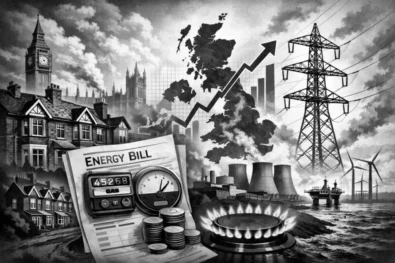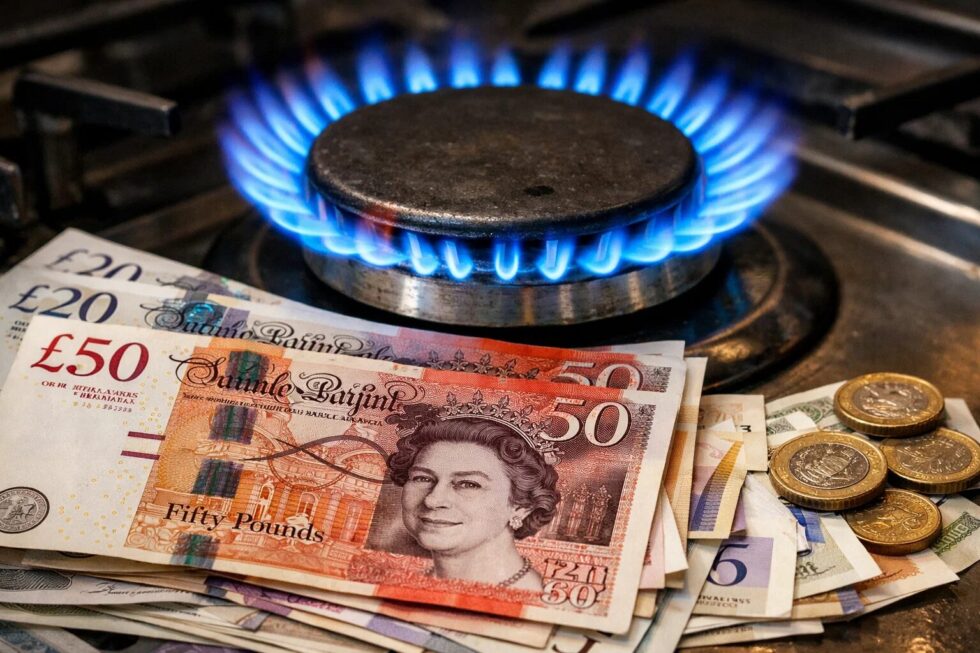
Household energy bills in Great Britain are forecast to fall by an average of £117 a year from 1 April 2026 after the UK government decided to remove green subsidy levies from domestic bills and transfer those costs into general taxation. Energy consultancy Cornwall Insight predicts that Ofgem’s quarterly price cap will decrease from £1,758 to £1,641 per year for a typical dual-fuel household, despite slightly higher wholesale market prices. The Treasury has stated that around £150 will be taken off bills from April, although higher network and infrastructure costs will offset part of the saving. This was reported by The WP Times, citing The Guardian.
Ofgem energy price cap April 2026: forecast figures and mechanism
The Ofgem energy price cap sets a maximum unit rate and standing charge that suppliers can apply to households on standard variable tariffs in England, Scotland and Wales. It is updated quarterly and reflects wholesale energy prices, network costs, environmental levies, and supplier operating margins.
According to Cornwall Insight’s forecast published on 18 February 2026, the cap for the period from 1 April to 30 June 2026 is expected to fall to £1,641 per year for a typical household using 2,700 kWh of electricity and 11,500 kWh of gas annually. The current cap for January–March 2026 stands at £1,758. The projected reduction of £117 represents a decline of approximately 6.6%.
Ofgem is scheduled to confirm the final cap level in the week beginning 23 February 2026. Once announced, the revised rates will automatically apply to customers on default tariffs from 1 April 2026.
Rachel Reeves Budget decision: removal of green levies from bills
In the November 2025 Autumn Budget, Chancellor Rachel Reeves confirmed that certain environmental and social levies would no longer be collected through household electricity bills. Instead, these costs will be funded through general taxation.
The levies include support mechanisms for renewable energy generation, such as Contracts for Difference (CfD), and components of energy efficiency programmes previously financed by bill payers. The government also confirmed that a bill payer-funded energy efficiency scheme would be discontinued, with future support mechanisms to be redesigned.
Cornwall Insight estimates that the removal of these levies reduces the average annual bill by approximately £145. However, because wholesale market prices have edged up and network charges have continued to rise, the net forecast reduction is £117 rather than the full £145.
The Treasury has stated that from 1 April 2026 the policy will remove around £150 in costs from the average domestic bill. The final effect will depend on Ofgem’s formal cap calculation.
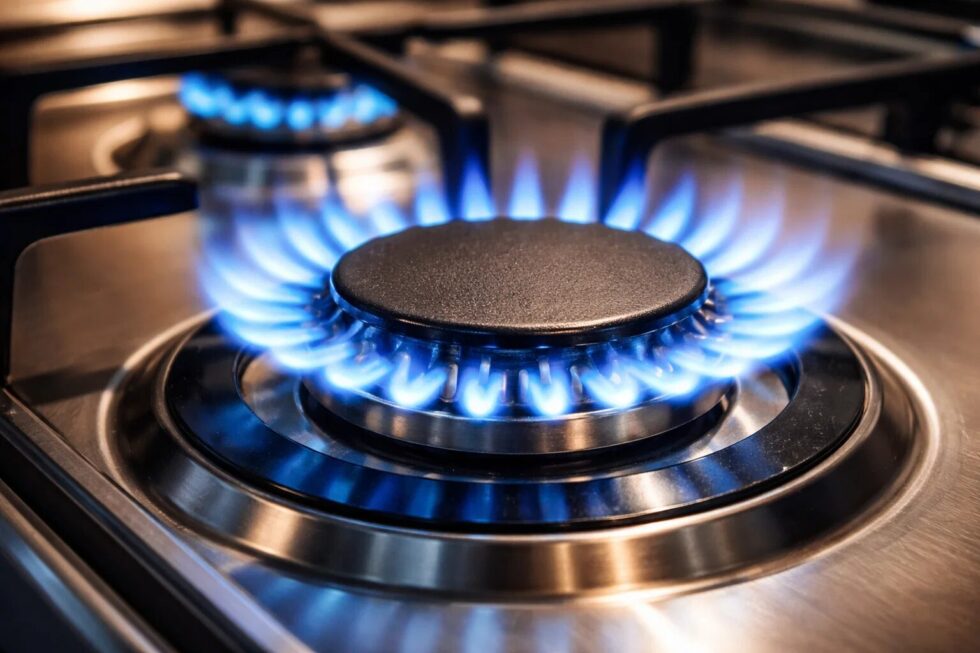
Wholesale gas prices and energy network costs
Despite the expected reduction, structural pressures remain in the UK energy system. Wholesale gas prices continue to influence electricity costs because gas-fired power stations frequently set the marginal price in the electricity market.
Since 2022, when Russia’s invasion of Ukraine triggered an energy crisis across Europe, wholesale gas prices have remained above pre-crisis levels. According to industry analysis, wholesale market costs are still around £170 per year higher than four years ago for a typical household.
At the same time, regulated network costs — which fund the maintenance and expansion of transmission and distribution infrastructure — have increased significantly. Cornwall Insight estimates that network charges are approximately £143 per year higher than in 2022.
These increases reflect ongoing investment in grid resilience, decarbonisation, and system upgrades designed to accommodate renewable energy sources and electrification.
Energy bills compared with pre-2022 levels
Even if the April 2026 cap falls to £1,641 as forecast, household bills will remain substantially higher than before the energy market crisis.
Prior to February 2022, the average annual bill for a typical dual-fuel household was around £1,216. Under the projected April 2026 cap, bills would still be approximately £425 higher than that pre-crisis benchmark.
The difference reflects:
- Persistently higher global gas prices
- Increased reliance on liquefied natural gas imports
- Higher regulated network investment costs
- Ongoing decarbonisation-related system expenses
Although bills have declined from their 2022 peak levels, they have not returned to earlier averages.
Breakdown of a typical energy bill: structural comparison
The composition of the average dual-fuel energy bill under Ofgem’s cap can be summarised as follows:
| Component | Position April 2026 | Change vs 2022 |
|---|---|---|
| Wholesale gas and electricity | Elevated | +£170/year |
| Network costs | Elevated | +£143/year |
| Environmental & social levies | Shifted to taxation | −£145/year (from bills) |
| Supplier operating costs | Moderately higher | Variable |
The table shows that while policy levies are being removed from bills, other structural elements remain above historic levels. The shift from bill funding to taxation does not eliminate the underlying cost; it changes the method of recovery.
How the price cap works and who is affected
The Ofgem price cap applies to households on standard variable tariffs, including those who have not switched supplier or whose fixed deals have expired. It does not limit total annual spending; actual bills depend on individual consumption.
Customers on fixed tariffs are not directly affected unless their contract ends and they move to a default tariff. Prepayment meter customers are also covered by the cap, although standing charges and unit rates may differ slightly.
From 1 April 2026:
- No application is required for the new cap level.
- Suppliers must adjust tariffs automatically.
- Unit rates and standing charges will change in line with Ofgem’s published figures.
Consumers can verify their tariff status through their energy supplier account or by checking their latest bill statement.
What households can do to manage energy costs
Although the forecast reduction applies automatically, households may wish to take practical steps:
- Confirm whether they are on a standard variable or fixed tariff.
- Compare available fixed deals once the April cap is announced.
- Review annual consumption in kilowatt-hours rather than relying only on direct debit amounts.
- Check eligibility for government support schemes, including the Warm Home Discount.
- Contact their supplier if facing payment difficulties; suppliers are required to offer support options.
Information about tariff rates and cap levels is published by Ofgem each quarter and is reflected on supplier billing statements.
Fiscal implications: cost shift to general taxation
The removal of green levies from energy bills transfers funding responsibility to the Exchequer. Instead of being paid through electricity tariffs, these policy costs will be covered through government revenues.
This change may affect public finances depending on tax receipts and overall spending commitments. The policy does not remove the cost of renewable subsidies; it alters how they are distributed across taxpayers.
The fiscal impact will become clearer in subsequent Budget documents and public finance updates. Analysts note that the long-term sustainability of the approach depends on wholesale market trends and infrastructure investment requirements.
Read about the life of Westminster and Pimlico district, London and the world. 24/7 news with fresh and useful updates on culture, business, technology and city life: Pope Leo XIV rejects Trump’s ‘Peace Council’, backs UN as primary global mediator