
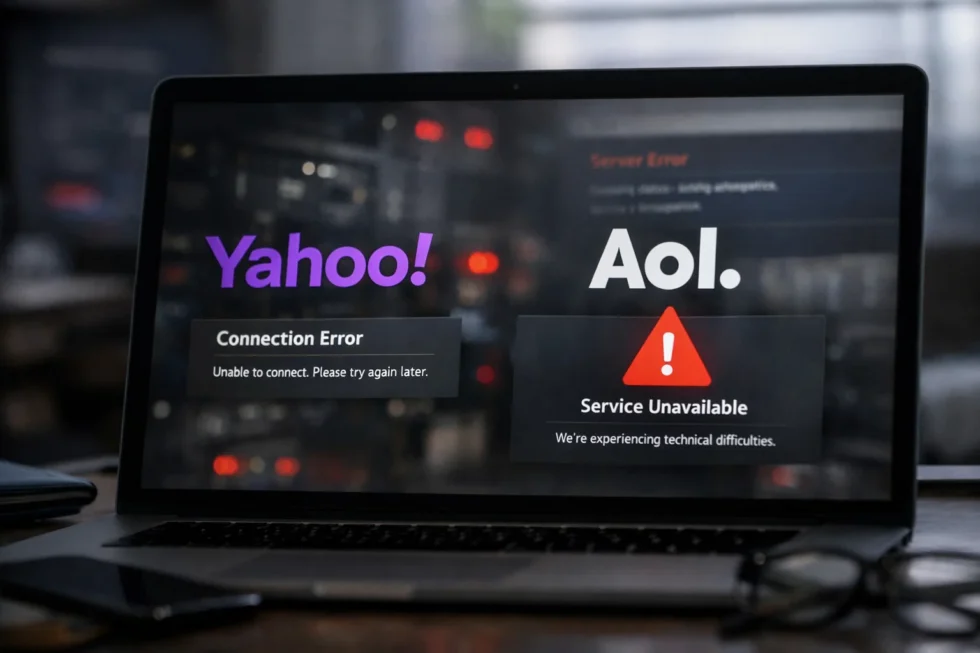
London, 21 January 2026 — Thousands of users across the United Kingdom and the United States reported temporary access issues affecting Yahoo and AOL, including Yahoo Mail UK and Yahoo Finance, after a technical change to Yahoo’s traffic management system caused a brief service disruption. Yahoo confirmed that the issue was resolved within an hour after the update was rolled back, with no indication of a cyberattack or data breach, reports The WP Times.
What happened to Yahoo and AOL services
The outage occurred on Tuesday, 21 January 2026, when users began reporting difficulties accessing Yahoo and AOL web portals. Affected services included email, finance content, search functions and news pages.Users attempting to load pages or log into accounts encountered error messages, most commonly “edge: too many requests”, suggesting server-side traffic overload rather than individual account issues.
When the Yahoo and AOL outage started and ended
Reports of service disruptions followed a clearly defined and relatively brief timeline, pointing to a contained technical incident rather than a prolonged or escalating system failure. According to outage-tracking data and company statements, the first signs of trouble emerged shortly after 9:00 a.m. Eastern Time, when users began reporting difficulties accessing Yahoo and AOL services, including email and financial content.
The volume of reports rose rapidly over the following hour, reaching a peak at around 10:00 a.m. ET, a period that coincided with widespread login failures, page load errors and server-rate limit messages.

By approximately 11:00 a.m. ET, the number of new reports had fallen sharply, indicating that access was being restored for most users. Yahoo later confirmed that the disruption was resolved after the company reversed a recent traffic management system update, with the overall impact lasting less than one hour. The speed at which reports both surged and declined suggests a configuration-related issue rather than a deeper infrastructure failure, and supports the company’s assessment that the incident was limited in scope and duration.
How many users were affected by the outage
The scale of the disruption became clear as user reports surged on the outage-tracking platform Downdetector, which collects real-time data from affected customers. During the peak of the incident, tens of thousands of users reported difficulties accessing Yahoo and AOL services, indicating a widespread impact across multiple regions. According to Downdetector data:
- Approximately 17,000 Yahoo users submitted outage reports by around 10:00 a.m. ET
- Around 7,000 AOL users reported similar access problems during the same period
Downdetector figures are based on voluntary user submissions and are widely regarded as an indicator rather than a precise count. Industry analysts note that such numbers typically represent only a fraction of the total affected user base, suggesting that the real scale of disruption was likely significantly larger. The sharp rise — and subsequent rapid decline — in reports further supports the conclusion that the outage was both widespread and short-lived, consistent with a configuration or traffic management failure rather than a sustained systems breakdown.
What Yahoo and AOL said about the outage
Yahoo acknowledged the disruption and provided a technical explanation in a statement issued to USA TODAY, confirming that the incident was caused by an internal systems update rather than external interference.
“The outage occurred after we rolled out a change to our traffic management system,” a Yahoo spokesperson said. “After reverting the change, Yahoo services have fully recovered, with the impact lasting less than an hour.”
— Yahoo spokesperson, 21 January 2026
The company’s statement emphasised the limited duration of the disruption and indicated that the issue was resolved once the configuration change was rolled back. During the outage, official customer support accounts for both Yahoo and AOL published identical notices on X, stating that the companies were aware some users were experiencing access issues and that engineering teams were actively investigating. No further technical details were provided at the time, and neither company reported evidence of a security breach or loss of user data.
Taken together, the statements suggest a contained operational error rather than a systemic failure, reinforcing Yahoo’s assessment that the incident was short-lived and confined to traffic handling systems.e time, Yahoo Customer Care and AOL Customer Care posted identical updates on X, stating that teams were investigating reports of access issues and would provide updates as more information became available.
Why Yahoo Mail UK and Yahoo Finance were affected
The disruption was linked to infrastructure shared across multiple Yahoo-operated platforms, rather than to any single service or geographic market. Yahoo Mail, Yahoo Finance and AOL services rely on common traffic-routing and load-balancing systems designed to manage large volumes of global user requests. When a configuration change was introduced into this system, it affected how traffic was distributed across servers, leading to access failures for users in several regions, including the United Kingdom.
Because these systems operate at a network level, even a limited update can have wide-ranging consequences when deployed across interconnected platforms. The pattern of failures — simultaneous issues across email, finance and web portals — is consistent with a traffic-handling error rather than isolated service outages. Yahoo said the issue was resolved once the update was reversed. There is no evidence to suggest:
- a security breach
- loss or exposure of user data
- a targeted outage affecting specific countries or user groups
Are Yahoo and AOL still connected
Although AOL was sold in late 2025 to Italian technology firm Bending Spoons, the January outage suggests that parts of Yahoo and AOL’s technical infrastructure remain operationally linked during the transition period. The simultaneous disruption across both platforms indicates that elements such as traffic management, routing or backend services are still shared or coordinated, at least in part. This is not unusual following large technology divestments, where brands may be sold while underlying systems continue to operate jointly until full separation is completed.

The incident highlights how legacy integrations can persist beyond ownership changes, creating the potential for cross-platform impact even after a sale has formally closed.
Key facts at a glance
| Category | Details |
|---|---|
| Date | 21 January 2026 |
| Regions affected | UK, US and other markets |
| Services impacted | Yahoo Mail UK, Yahoo Finance, AOL portals |
| Peak disruption | Around 10:00 a.m. ET |
| Cause | Traffic management system update |
| Duration | Less than one hour |
| Data breach | None reported |
What users should do during similar outages
When large-scale service disruptions occur, users are advised to:
- avoid repeated login attempts
- check official customer care channels for updates
- confirm outages via independent tracking platforms
- wait for confirmation before changing passwords or settings
Short but widespread disruptions highlight the continued reliance on legacy digital platforms for communication, finance tracking and daily news consumption. Even brief outages can affect millions of users simultaneously, particularly when services operate on shared infrastructure.
Read about the life of Westminster and Pimlico district, London and the world. 24/7 news with fresh and useful updates on culture, business, technology and city life: When will fire tv blaster discontinue take effect and why are UK devices being disabled now