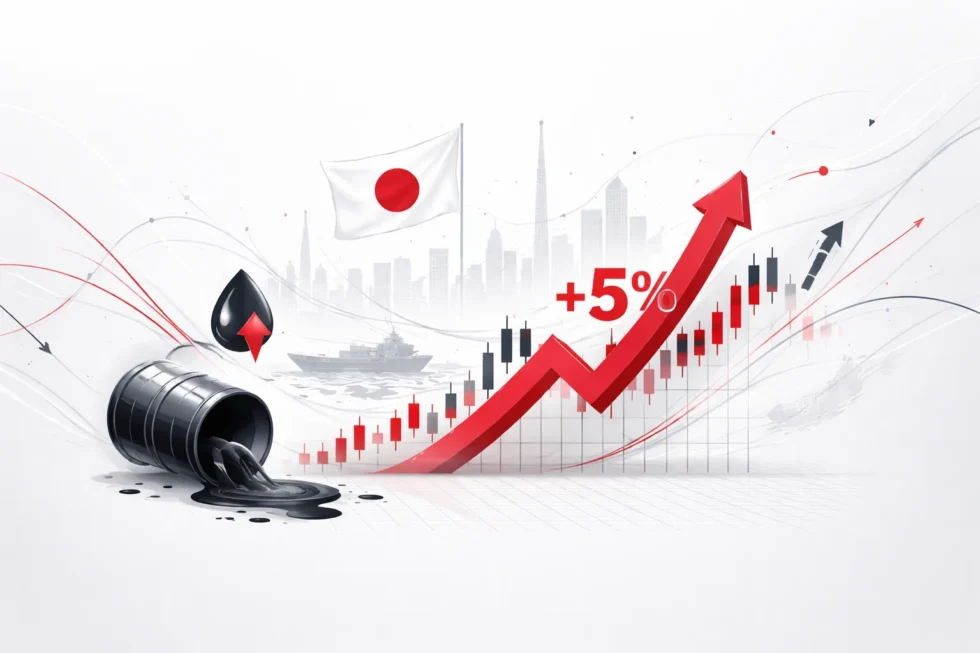
Nikkei 225 opened a decisive upward move across Asia-Pacific markets after a geopolitical reversal triggered a sharp collapse in oil prices, forcing a rapid re-pricing of inflation expectations and accelerating risk appetite across equities, with the Japanese benchmark gaining more than 5% in a synchronised regional rally following a conditional two-week US-Iran ceasefire tied directly to the safe reopening of the Strait of Hormuz — a critical global oil transit corridor that anchors supply expectations and pricing across energy markets, reported The WP Times, citing CNBC and official statements.
The market reaction was immediate, coordinated and technically significant: energy risk premium unwound within hours, volatility compressed across commodities, and equity indices across Asia responded with broad-based buying, led by export-heavy and semiconductor-linked sectors that are structurally sensitive to global liquidity conditions and cost inputs. The Nikkei 225, already positioned near cyclical highs prior to the event, accelerated sharply as the oil shock translated into a forward-looking reduction in input costs for industry, while simultaneously improving the probability of accommodative central bank trajectories globally.
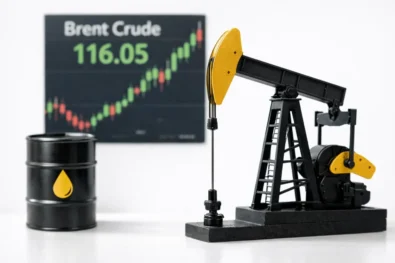
At the centre of the move is oil, not equities. US crude contracts dropped by nearly 15% intraday, while Brent futures declined by over 13%, marking one of the most aggressive short-term repricings in recent months. This was not a technical correction but a geopolitical unwind: markets had priced escalation risk into energy supply expectations, particularly through the Strait of Hormuz, which handles a substantial portion of global oil flows. The conditional ceasefire — explicitly linked to “complete, immediate and safe” reopening of the passage — removed a structural constraint from supply assumptions, forcing rapid liquidation of long oil positions and rebalancing across asset classes.
Asia markets rally mechanics: South Korea leads, semiconductors jump, global spillover
South Korea delivered the strongest regional signal, with the Kospi surging over 6% and technology leaders posting outsized gains. Semiconductor giants recorded sharp increases, reinforcing a broader thesis: lower energy costs reduce operational expenses in high-energy industries such as chip manufacturing, while improved global demand expectations support forward revenue projections. The move was mirrored in smaller-cap indices, indicating breadth rather than concentration.
China’s major indices, including the CSI 300, advanced more moderately but still reflected a coordinated shift in risk appetite. Hong Kong’s Hang Seng Index, resuming trading after a holiday break, aligned with the broader regional trend, confirming that the rally was not isolated but systemic. Australia’s S&P/ASX 200 also moved higher, despite its exposure to commodities, indicating that equity markets prioritised macro stability over short-term resource price declines.
India’s Nifty 50 added more than 3%, supported by similar dynamics: reduced energy import costs and improved macro stability. For India, which remains highly sensitive to oil prices due to its import profile, the drop in crude represents a direct improvement in trade balance expectations and inflation control, reinforcing domestic monetary policy flexibility.
The transmission to US markets, while more muted, remains consistent. Futures tied to major indices moved higher in anticipation of improved global conditions, although the underlying US session showed only marginal gains. This divergence reflects a different starting point: US equities were already trading near elevated levels, with much of the risk premium priced into energy rather than equities themselves.

Oil, central banks and the two-week risk window: what markets price next
From a financial systems perspective, the ceasefire introduces a temporary stabilisation rather than a structural resolution. The two-week timeframe attached to the agreement embeds conditionality into market expectations. This creates a layered pricing environment: immediate relief drives risk-on positioning, but the limited duration of the agreement prevents full re-rating of long-term risk.
The Strait of Hormuz remains the key variable. As a chokepoint through which a significant share of global oil supply passes, its operational status directly influences energy pricing. The requirement for “safe opening” under coordinated military oversight introduces both reassurance and residual uncertainty. Traders must therefore balance short-term supply normalisation against the possibility of renewed disruption beyond the ceasefire window.
Currency markets adjust indirectly. Lower oil prices reduce inflation pressure in importing economies, stabilising exchange rates and supporting capital inflows into equities, while oil-exporting regions may experience short-term revenue compression. This dynamic reinforces capital rotation toward Asia-Pacific markets.
Sector rotation is also evident. Energy stocks face immediate downside pressure as crude prices fall, while sectors dependent on energy inputs — industrials, transportation, technology — outperform. This rotation reflects a classic macro rebalancing following commodity shocks, where cost structures and margin expectations are recalibrated in real time.
The Nikkei 225 rally therefore represents more than a regional reaction; it is a node within a global adjustment process linking geopolitics, commodities, monetary policy and equity valuations. Each component reinforces the others, creating a feedback loop that accelerates market moves in the short term, while leaving medium-term direction contingent on the durability of the ceasefire and the stability of global energy supply.
Read about the life of Westminster and Pimlico district, London and the world. 24/7 news with fresh and useful updates on culture, business, technology and city life: Why is the HSBC share price falling after highs — should investors buy HSBC shares now