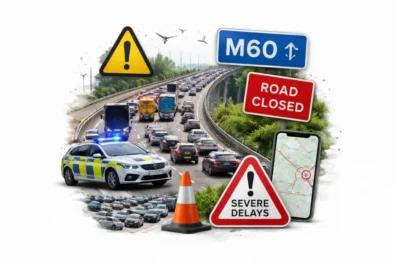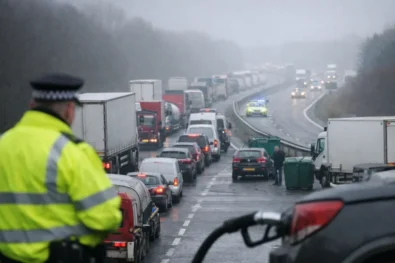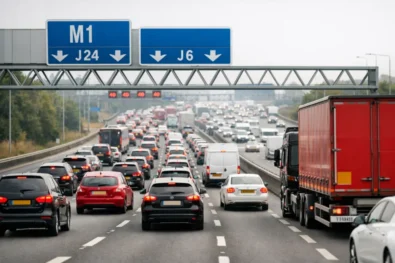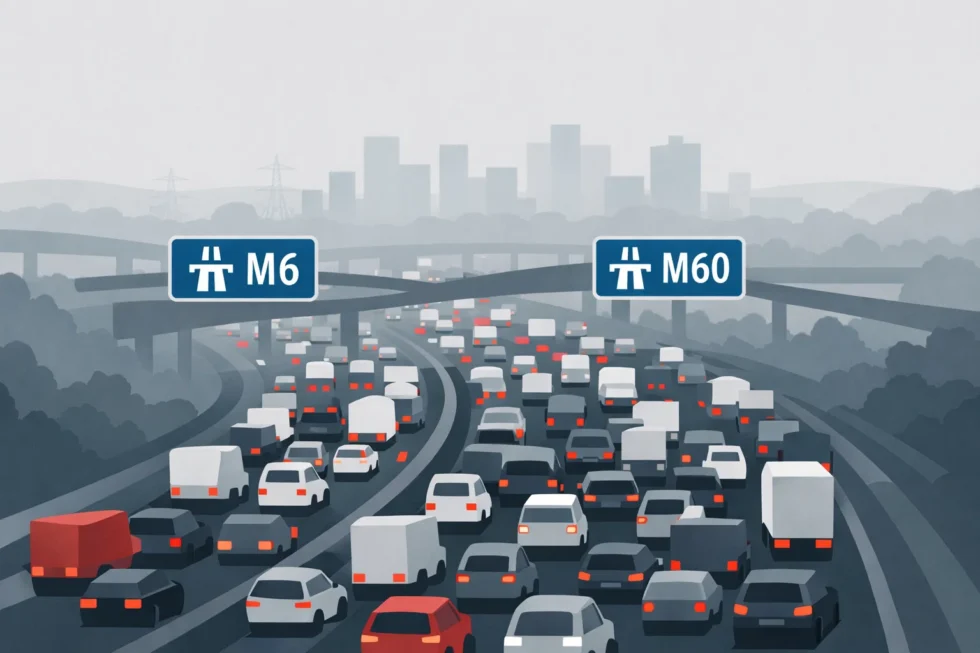
Today, 8 April 2026, by 08:40 BST, M6 and M60 traffic conditions across two of the UK’s most critical motorway corridors — M6 traffic today and M60 traffic delays — remain severely disrupted after two separate but compounding incidents triggered sustained congestion across the North West, with queues stretching for miles and peak-hour delays holding at up to 90 minutes, reports The WP Times, citing live data from National Highways and regional police updates. What began shortly after 06:00 as two isolated events — an overturned heavy goods vehicle on the Thelwall Viaduct and a police-led welfare incident on the M60 near Eccles — has since escalated into a prolonged, system-level disruption, affecting key interlinked routes including the M62 and M61 and placing continued pressure on the wider Greater Manchester motorway network.
M6 traffic today: disruption at Thelwall Viaduct
The primary failure point remains the M6 northbound at the Thelwall Viaduct near Warrington — a critical crossing over the Manchester Ship Canal and one of the UK’s most heavily used freight corridors.
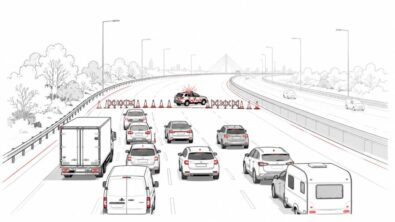
At around 06:00 BST, a heavy goods vehicle overturned across multiple lanes, forcing an immediate closure and halting traffic entirely while emergency services secured the scene and began recovery operations. By 08:40 BST, the situation has only partially stabilised:
- two lanes have reopened
- two lanes remain closed
- effective capacity is reduced by roughly 50%
- queues extend beyond Junction 24, with slow-moving traffic stretching further south
This is not a routine motorway section. The M6 at this point carries sustained long-distance freight flows between the Midlands and Scotland and feeds directly into the M62 Liverpool–Manchester corridor. When capacity is cut here, the network has little ability to absorb the shock. The result is structural rather than temporary congestion: demand has remained at peak levels while throughput has been sharply reduced. Traffic is moving in compressed, stop-start waves, with delays holding at 60 to 90 minutes and spillback already affecting the M62 eastbound before the merge.
M60 traffic delays: Eccles incident under pressure
At the same time, a separate police-led incident on the M60 anticlockwise has placed additional strain on the Greater Manchester orbital route. The disruption is centred between Junction 11 (Eccles) and Junction 10 (Trafford Centre), on the Barton Bridge section — another critical crossing point over the Ship Canal. Police intervention following concerns for an individual’s welfare required controlled traffic management and lane closures. By 08:40 BST:
- two lanes remain shut
- only one lane is running
- queues extend back to Junction 17
Unlike intercity motorways, the M60 operates as a dense urban ring road with constant inflow and outflow at closely spaced junctions. This makes it highly sensitive to disruption. The impact has been immediate:
- speeds have fallen to near walking pace in places
- congestion has spread onto the M61 approach
- local roads around Eccles and Trafford Centre are heavily congested as drivers divert
What drivers should do now
For drivers across the North West, this is not a short-lived delay but a network-level disruption requiring immediate adjustment. Those already on the M6 or M60 should expect prolonged stop-start conditions rather than recovery in the near term. Lane closures remain in place at key pressure points, and traffic flow is being released in waves rather than continuously.
Motorists are advised not to rely on late diversions. By the time vehicles leave the motorway network, surrounding A-roads — particularly around Eccles, Warrington and the Trafford Centre — are already operating under heavy strain, limiting any time advantage. For those yet to travel, delaying departure remains the most effective response. Even a shift of one to two hours is likely to reduce exposure to the peak of disruption more effectively than rerouting. Where travel is essential, planning must be done in advance rather than reactively. The M6 northbound between Junctions 21 and 24 and the M60 anticlockwise between Junctions 10 and 17 remain the most affected sections, and avoidance of these corridors is advised where viable.
Read about the life of Westminster and Pimlico district, London and the world. 24/7 news with fresh and useful updates on culture, business, technology and city life: Fuel prices surge: what is the jet fuel price impact airlines and what happens next for travellers