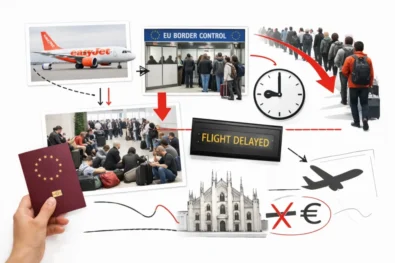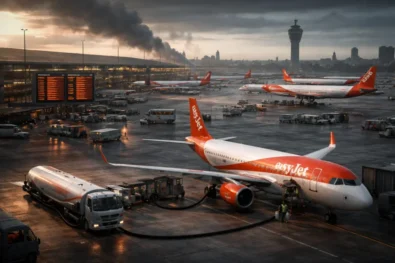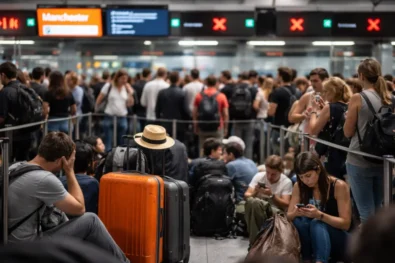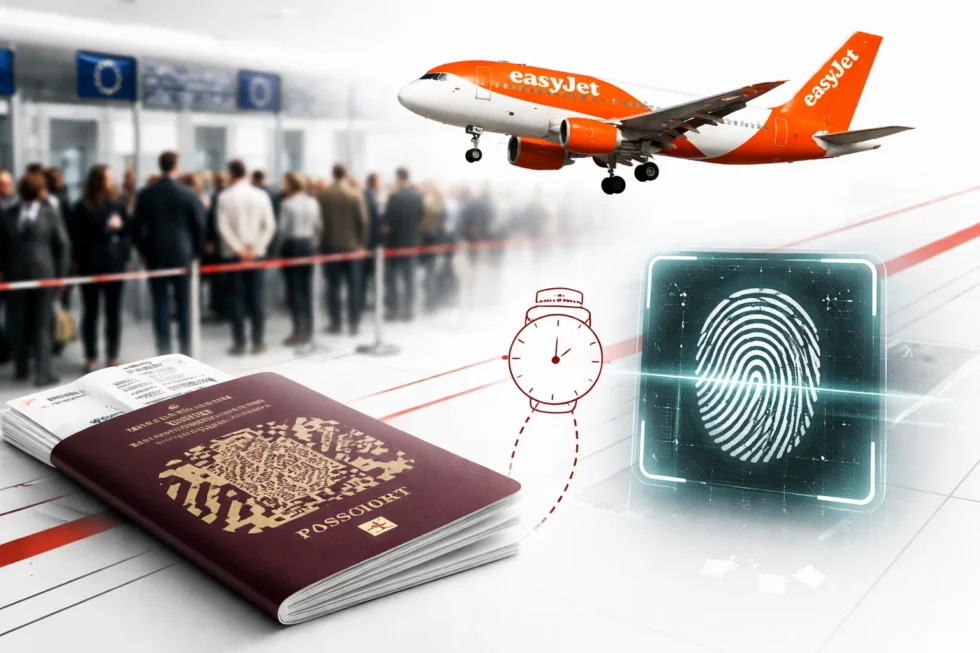
The easyjet passenger alert new warning has shifted from routine travel advice to an operational signal that directly affects whether passengers board their flights at all. EasyJet has warned that travellers delayed at passport control “will not be able to board and will miss your flight”, reflecting mounting disruption across European airports as biometric border checks are rolled out under the EU’s Entry/Exit System. The development underscores a structural change in how passengers move through airports — reported by The WP Times citing Mirror.
The warning follows the phased implementation of the Entry/Exit System (EES), a digital border regime that replaces passport stamping with biometric registration. For non-EU travellers, including UK citizens, this means fingerprint scanning and facial image capture at the point of entry into the Schengen area. While designed to strengthen border security and automate tracking, the system has introduced significant delays at passport control, particularly at high-volume airports. EasyJet’s message emerged in response to real-time passenger complaints. One traveller reported being stuck in a fingerprint queue for over an hour with only minutes remaining before departure. The case illustrates a new type of disruption: passengers arriving within recommended timeframes but unable to reach the gate due to bottlenecks outside airline control.
The airline’s statement — “you will not be able to board and will miss your flight” — reflects standard aviation procedures, but its relevance has intensified. Boarding gates typically close between 20 and 30 minutes before departure. Once closed, passengers are denied boarding regardless of the reason for delay. Under current conditions, the risk has shifted upstream, with passport control now the critical failure point. This creates a layered system of responsibility. Airlines control boarding cut-off times, airports manage security and passenger flow, while governments oversee border checks. The introduction of EES has placed pressure on the final stage of this chain, where delays are both unpredictable and difficult to mitigate.
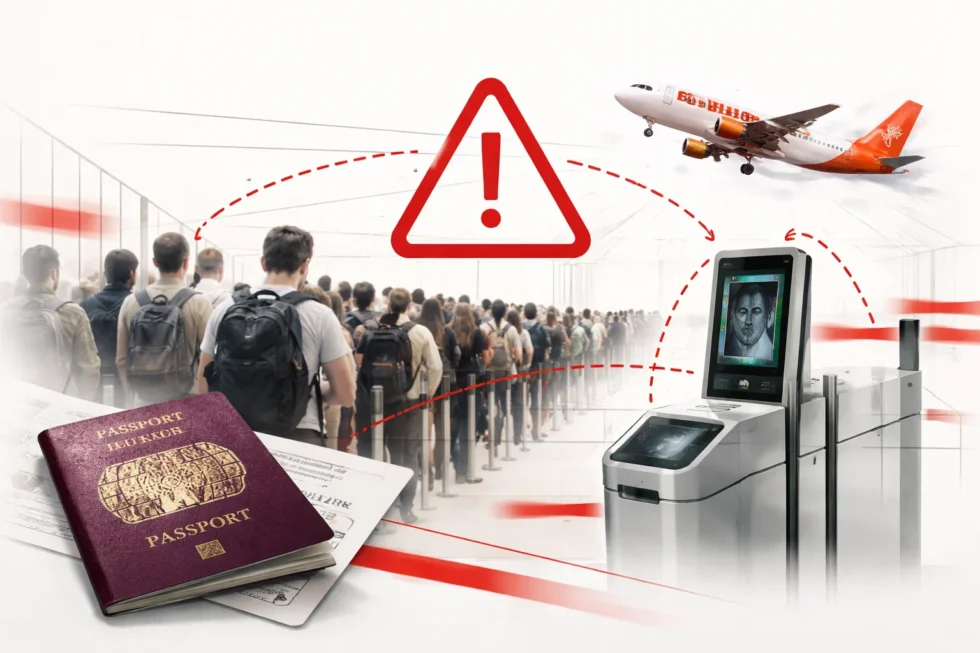
At major European hubs, queues at passport control are now reported to reach two to three hours during peak periods. Airports such as Paris Charles de Gaulle, Amsterdam Schiphol, Barcelona El Prat and Rome Fiumicino have seen the most visible impact. Processing times vary depending on whether passengers are registering biometrics for the first time, as well as staffing levels and technical capacity.
For UK travellers, the change is structural. Following Brexit, they are treated as third-country nationals and must comply with full biometric registration. This includes fingerprint capture, facial recognition and digital recording of entry and exit data. While registration is free and completed at the border, it adds a new layer of processing that did not previously exist. The transition phase has exposed operational limits. Infrastructure is still scaling, passengers are often unfamiliar with procedures, and systems are not yet uniformly deployed across all airports. As a result, queue lengths and waiting times remain inconsistent, even within the same airport.
Passenger behaviour has become a critical factor in managing risk. Traditional guidance — arriving two hours before a short-haul flight — is increasingly insufficient during peak travel periods. Industry bodies now advise travellers to prioritise passport control immediately after clearing security, rather than spending time in retail areas or waiting zones.
Reports from passengers suggest additional complications. These include perceived inconsistencies in queue prioritisation, slow processing for first-time biometric users and unclear instructions in some terminals. The variability reflects a fragmented rollout, where operational practices differ across locations.
EasyJet has responded by issuing practical guidance rather than operational guarantees. Passengers are advised to arrive earlier than usual, proceed through bag drop and security without delay, and move directly to passport control. They are also urged to monitor gate announcements closely and ensure all documentation is prepared in advance. The airline has emphasised that it does not control border operations. This distinction is central to understanding the limits of airline responsibility. While carriers enforce boarding deadlines, delays caused by border checks fall under government jurisdiction.
This distinction becomes particularly relevant in the context of compensation. Under European passenger rights regulations, travellers may be entitled to compensation for delays or cancellations depending on the circumstances. However, missed flights caused by passport control delays occupy a grey area. As these delays are not directly attributable to the airline, compensation may not apply. EasyJet has confirmed that compensation claims related to other disruptions may take up to 28 days to process. For significant delays — typically exceeding five hours — passengers may request refunds, rebooking or accommodation if overnight stays are required. These provisions, however, do not necessarily cover cases where passengers fail to reach the gate in time.
The broader context is one of systemic pressure on European aviation. The post-pandemic recovery has driven strong demand for travel, while new security requirements and staffing constraints have increased operational complexity. The transition to digital border systems adds another layer, combining long-term efficiency goals with short-term disruption. The Entry/Exit System was officially launched in October 2025, with full implementation expected by April 2026. During this period, passengers may encounter a mix of procedures, depending on the airport and their travel history. Some undergo full biometric registration, while others experience partial or hybrid checks.
This inconsistency is a key factor behind current delays. Without uniform processes, airports struggle to manage passenger flow effectively, leading to unpredictable waiting times.
The language used in the easyjet passenger alert new message reflects a shift in communication strategy. Rather than advising passengers to allow extra time, the airline is now explicitly warning of the consequences of delay. The phrase “you will not board and will miss your flight” signals a move towards operational clarity, even at the cost of blunt messaging. For passengers, the implications are immediate. Airport timing strategies must adapt to a system where border control, rather than security or boarding logistics, is the primary constraint. The risk is no longer hypothetical. It is embedded in the process itself.
Read about the life of Westminster and Pimlico district, London and the world. 24/7 news with fresh and useful updates on culture, business, technology and city life: Fuel prices surge: what is the jet fuel price impact airlines and what happens next for travellers