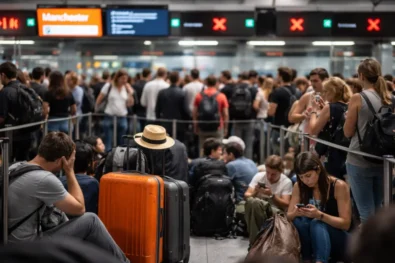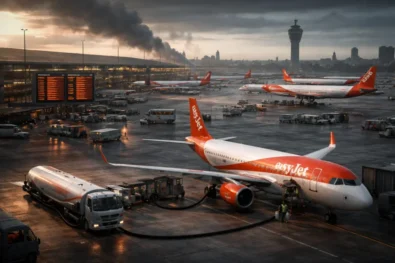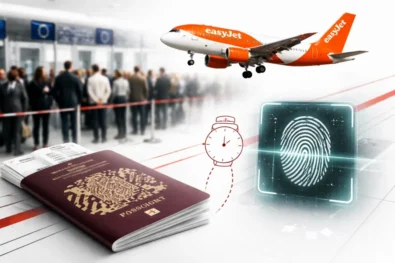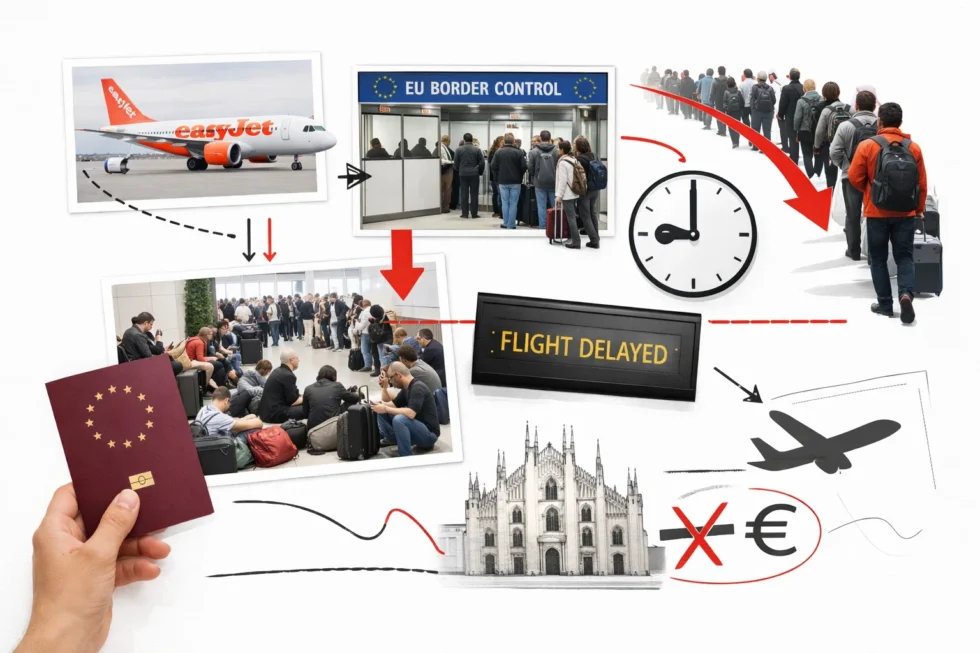
EasyJet EU border delays are forcing passengers to miss flights and incur significant costs as the European Union’s new Entry Exit System (EES) triggers severe congestion at passport control, with more than 100 travellers left behind at Milan Linate Airport despite arriving hours early and airlines unable to hold departures indefinitely. The disruption, centred on biometric checks including facial scans and fingerprints, has exposed operational gaps between airlines and border authorities, as flights depart on schedule while queues extend for hours, leaving passengers stranded across Europe, The WP Times reports.
The situation escalated over the weekend as the EES became fully operational, creating bottlenecks at key departure points for UK-bound travellers classified as third-country nationals after Brexit, with reports of passengers fainting, vomiting and missing flights despite arriving up to three hours in advance, while airlines warned the delays were outside their control but acknowledged the scale of disruption affecting schedules, staffing limits and turnaround times.
Why EES border checks are slowing airports across Europe
The core issue lies in the implementation of the European Union Entry Exit System (EES), which replaces manual passport stamping with biometric registration. Every traveller entering or leaving the Schengen zone must now complete facial recognition and fingerprint verification, significantly increasing processing time per passenger. At Milan Linate Airport, this shift created a structural bottleneck. Instead of fast manual checks, passengers were funnelled through limited biometric stations, often with only a small number of officers and machines operational. This mismatch between passenger volume and processing capacity led to queues stretching for hours.
The disruption is not isolated. Airport and airline associations across Europe have reported similar patterns, particularly during peak travel windows, where waiting times have reached two to three hours. The system also requires data validation on exit, adding further complexity even for travellers who already registered biometrics on entry.
What happened on the EasyJet Milan–Manchester flight
The incident involving EasyJet flight EJU5420 highlights how operational limits intersect with border delays. Of approximately 156 booked passengers, only a small fraction managed to board before departure, leaving more than 100 behind.
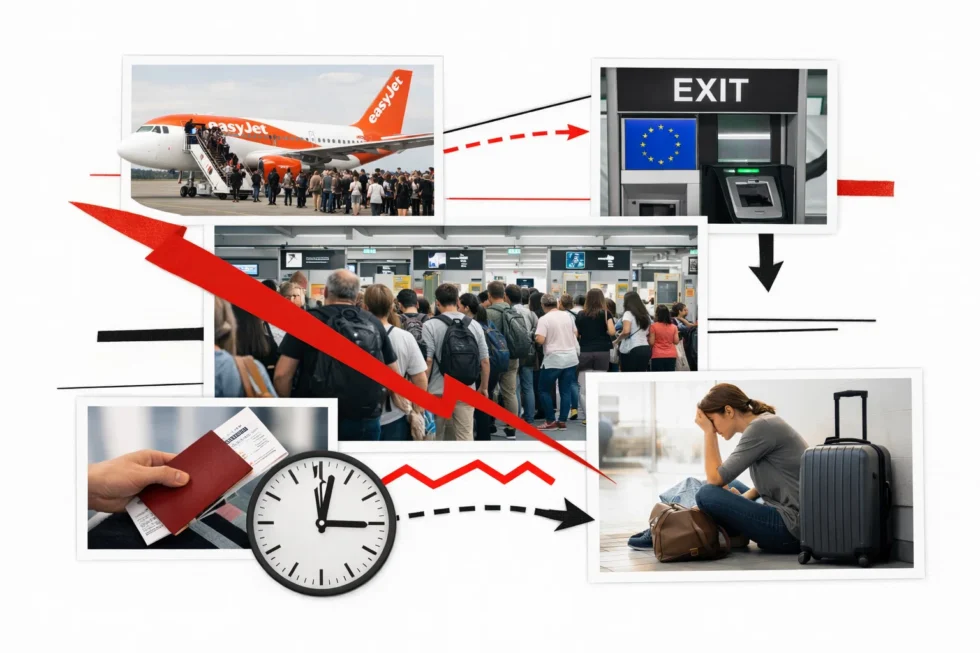
The flight was reportedly held for nearly an hour, but airline crews are bound by strict duty-time regulations, meaning further delays risk cancelling the flight entirely. As a result, the aircraft departed while passengers were still stuck in passport control queues. Key breakdown of the situation:
| Factor | Impact on passengers |
|---|---|
| Long biometric checks | Queue times exceeded 2–3 hours |
| Limited border staff | Slow processing speed |
| Gate assignment delays | Passengers blocked from early clearance |
| Crew duty limits | Flight could not wait indefinitely |
| Rebooking constraints | High costs and limited availability |
Passengers described being unable to pass through control even when queues were short initially, due to procedural restrictions such as waiting for gate allocation before processing could begin.
Passenger accounts highlight systemic failure
First-hand accounts indicate the issue was not simply high demand, but a breakdown in coordination between airport operations and border control enforcement.
“People were vomiting, people were almost passing out,” said one passenger describing conditions inside the terminal (passenger account, Milan Linate, April 2026). Others reported being denied access to passport control despite arriving early, while passengers on different flights were processed faster.
Another traveller described the situation as “absolute carnage”, with families stranded and forced to rebook complex return journeys via other European cities. Costs escalated quickly, with some passengers spending over £1,000–£1,800 to return to the UK via alternative routes such as Luxembourg. In several cases, passengers were classified as “no-shows” despite being physically present in the airport but unable to clear border control in time.
How the new EU system changes travel for UK passengers
The EES fundamentally alters how UK travellers move through European borders following Brexit. As non-EU nationals, Britons are now subject to full biometric registration on entry and exit. Key changes include:
- Mandatory fingerprint and facial scan collection
- Data storage for up to three years
- Additional verification on departure
- Longer processing time per passenger
Children under 11 are exempt from fingerprinting but may still undergo facial recognition checks. The system is designed to improve border security and track overstays, but its rollout phase is exposing operational weaknesses. Airlines and airport bodies have warned that without greater flexibility—such as the ability to suspend the system during peak congestion—the situation could worsen during the summer travel season.
EasyJet has apologised to affected passengers but maintains that border control operations fall outside airline responsibility. The carrier said it had attempted to mitigate disruption by holding flights where possible and offering free transfers to alternative departures.
“We continue to urge border authorities to ensure they make full and effective use of the permitted flexibilities,” an airline spokesperson said (EasyJet statement, April 2026).
However, industry groups argue that current rules are too rigid. Previously, authorities could suspend EES entirely during excessive delays. Under the new framework, only partial suspension is allowed, limiting the ability to respond dynamically to congestion. Airport associations are now calling for urgent adjustments before peak travel demand intensifies.
What travellers should do now to reduce the risk of missing flights
The disruption shows that airport timing assumptions that worked before the EU’s new Entry Exit System may no longer be reliable, particularly on UK-bound departures from Schengen airports where biometric checks are now adding extra pressure to already tight boarding windows. For passengers, the practical consequence is clear: arriving at the airport at what was once considered a sensible time may no longer be enough if passport control slows sharply, gate information is released late, or border staff process travellers manually rather than through faster automated channels.
Travellers should now build more time into every stage of the journey, not only check-in and security but also the final border-control segment, which has become the main point of failure in a growing number of cases. That means arriving at least three to four hours before departure where EES checks may apply, confirming in advance whether biometric registration will be required on the route, tracking live airport information where available, avoiding tight onward connections, and keeping enough financial flexibility for unexpected hotel, rebooking or ground transport costs. Even with those precautions, the risk cannot be removed entirely while airports and border authorities continue adjusting to the new system.
Read about the life of Westminster and Pimlico district, London and the world. 24/7 news with fresh and useful updates on culture, business, technology and city life: Lufthansa strike Germany flights: Hundreds of cancellations hit Frankfurt and Munich as unions escalate dispute