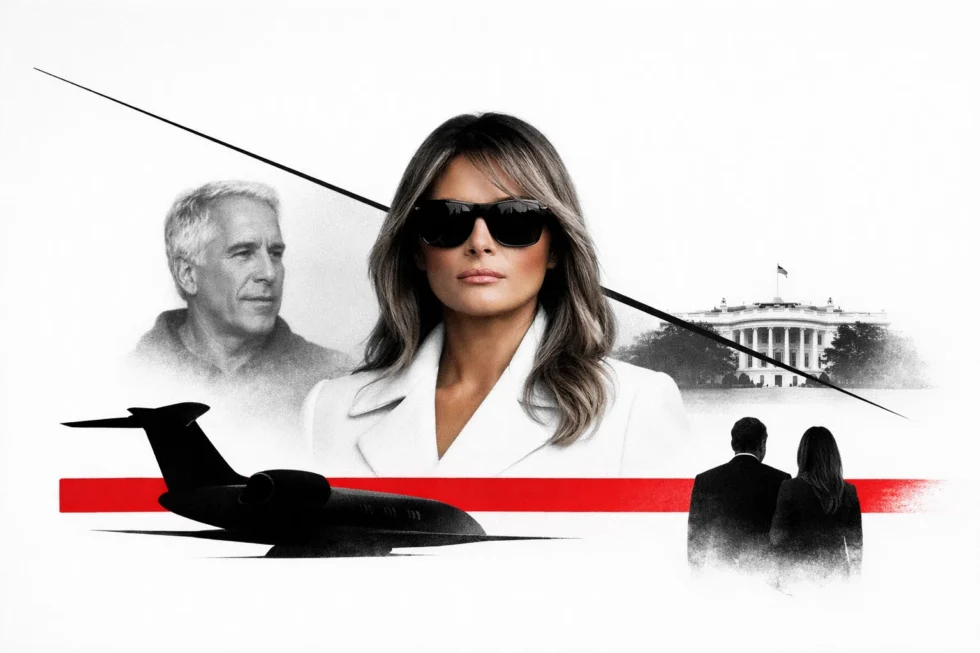
Melania Trump moved abruptly into the centre of a renewed US political storm on Thursday, delivering an unscheduled White House statement in which she firmly denied any relationship with Jeffrey Epstein, said she had never been his friend, had no knowledge of his crimes and had only ever “crossed paths” with him within overlapping elite social circles in New York and Palm Beach (Melania Trump, prepared White House statement, White House foyer, 9 April 2026). The intervention immediately drew scrutiny not only for its substance but for its timing, coming without a clearly identified trigger, without advance public briefing and without any single new allegation being formally set out beforehand, leaving reporters and political observers asking why such a direct rebuttal had been issued at that specific moment. Reuters, AP and The Guardian all reported that the address was unusual in both tone and timing; The WP Times reports this citing BBC News, The Guardian, Reuters and Associated Press.
The central question in Washington on Friday was not simply what Melania Trump said, but why she chose to say it now. In her prepared remarks, the first lady rejected claims linking her not only to Epstein but also to Ghislaine Maxwell, said she was “not Epstein’s victim” and denied the long-circulating suggestion that Epstein had introduced her to Donald Trump (Melania Trump, prepared White House statement, 9 April 2026). At the same time, she called for Congress to hold public hearings for Epstein’s victims so they could testify under oath and have their accounts entered into the Congressional Record (Melania Trump, prepared White House statement, 9 April 2026). That moved the event beyond a personal denial and into a broader political demand for public testimony.
That combination is what has kept the episode politically sensitive rather than neatly resolved. On one side, her language was categorical. Reuters reported that she said she had “never had a relationship” with Epstein (Melania Trump, quoted by Reuters, 9 April 2026), while Associated Press reported that she described accusations linking her to him as “unfounded and baseless lies” and “mean-spirited attempts to defame” her reputation (Melania Trump, quoted by AP, 9 April 2026). On the other side, the statement did not emerge in a vacuum. AP, Reuters and The Guardian all tied the speech to renewed attention around historical material connected to the Epstein case, including a 2002 email exchange involving Maxwell and photographs placing Melania Trump in the same social orbit as Epstein and Maxwell in the early 2000s.
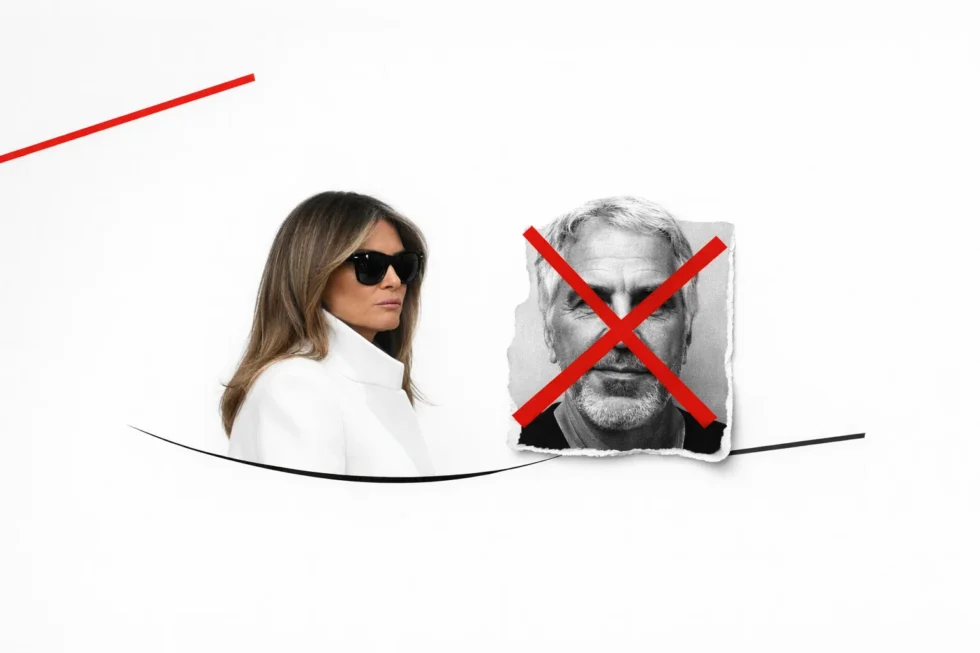
The first lady’s defence rested heavily on distinction. She did not deny that there had been some overlap in elite social settings. Instead, she argued that such encounters were incidental, superficial and socially unremarkable. The Guardian reported that she said being invited to some of the same parties was unsurprising because “overlapping in social circles is common in New York City and Palm Beach” (Melania Trump, quoted by The Guardian, 9 April 2026). Reuters similarly reported that she described her email exchange with Maxwell as “casual correspondence” and rejected any suggestion that it demonstrated friendship or deeper association (Melania Trump, quoted by Reuters, 9 April 2026).
That distinction matters politically because the language of “crossing paths” is narrower than the language of total non-contact. It is an attempt to draw a sharp line between moving within the same wealthy social world and being knowingly tied to wrongdoing. Whether that line holds may become more important as attention returns to historical photographs, guest lists, emails and social records from the late 1990s and early 2000s, when Epstein maintained access to influential figures across politics, business, media and celebrity circles. That is an inference from the current reporting rather than a separately established finding, but it is consistent with how Reuters, AP and The Guardian frame the significance of the overlap issue.
There is also the issue of timing, which remains murky. The Guardian’s live coverage said even well-sourced reporters were struggling to understand what had prompted the statement. Fox News senior White House correspondent Jacqui Heinrich said: “We’ve been trying to understand why she made it today, if there was something that she is reacting to that might already be in the news … or if there’s a story that’s yet to come out” (Jacqui Heinrich, Fox News, quoted by The Guardian live blog, 10 April 2026, 12:39 CEST). Reuters added another layer by reporting that Melania Trump’s adviser said she spoke out because “the lies must stop” (Melania Trump adviser, quoted by Reuters, 9 April 2026). Reuters also reported separately that Donald Trump later said he did not “know anything about” the statement in advance (Donald Trump, quoted by Reuters from remarks to MS Now, 9 April 2026), adding to the impression of either limited coordination or conflicting explanations around the event.
The political fallout widened further after survivors criticised the first lady’s appeal for public testimony. A group of Epstein survivors said she was “shifting the burden onto survivors under politicized conditions to protect those with power” and added that “asking more of them now is a deflection of responsibility, not justice” (joint statement from a group of Epstein survivors, cited by The Guardian live blog, 10 April 2026, 12:23 CEST). The same statement argued that attention should instead focus on withheld files and the exposure of survivors’ identities. That response complicated any attempt to frame Melania Trump’s remarks as a straightforward act of victim advocacy.
For readers searching the basic facts behind the row, several points are clear from the reporting. Melania Trump was born in Slovenia on 26 April 1970 and is 55 as of 10 April 2026, while Donald Trump, born on 14 June 1946, is 79. Reuters and The Guardian both reported that Melania Trump repeated her longstanding claim that she met Donald Trump independently at a New York party in 1998, not through Epstein. Reuters also reported in her full remarks that she said she first encountered Epstein in 2000 and had never travelled on his plane or visited his island.
| Fact | What is established |
|---|---|
| Who is Melania Trump? | First Lady of the United States, born in Slovenia on 26 April 1970 |
| How old is Melania Trump? | 55 as of 10 April 2026 |
| How old is Donald Trump? | 79 as of 10 April 2026 |
| What did she deny? | Friendship, relationship or involvement with Jeffrey Epstein and Ghislaine Maxwell |
| What did she acknowledge? | Some overlap in social circles in New York and Palm Beach |
| What did she ask for? | Public congressional hearings for Epstein’s victims |
The political sensitivity is obvious. Epstein remains one of the most toxic names in US public life because any revived scrutiny of his network has the capacity to draw prominent figures back into public questioning, regardless of whether there is evidence of criminal involvement by them. In that context, Melania Trump’s intervention was not merely a personal denial. It reopened a politically fraught subject at the White House, and did so at a moment when the administration had little obvious interest in giving the Epstein story fresh visibility. AP explicitly noted that her remarks drew attention back to a subject the administration had been trying to put behind it.
What can safely be said at this stage is narrower than some of the speculation now circulating online. There is confirmed reporting that Melania Trump denied any relationship with Epstein, denied that he introduced her to Donald Trump, denied knowledge of his crimes and called for victims to testify publicly. There is also confirmed reporting that historical material — including photographs and a 2002 email exchange — helped revive scrutiny around her statement. What remains unclear is whether the speech was purely pre-emptive damage control, a reaction to a broader new wave of insinuations, or a response to something more specific still not fully visible in public reporting.
Read about the life of Westminster and Pimlico district, London and the world. 24/7 news with fresh and useful updates on culture, business, technology and city life: Shadow Fleet And Warship In Channel: What Changed After UK Authorised Ship Seizures