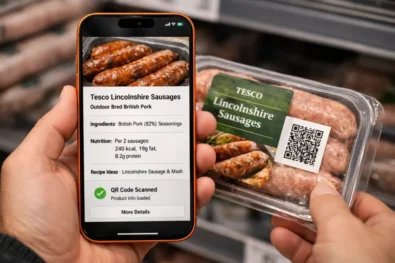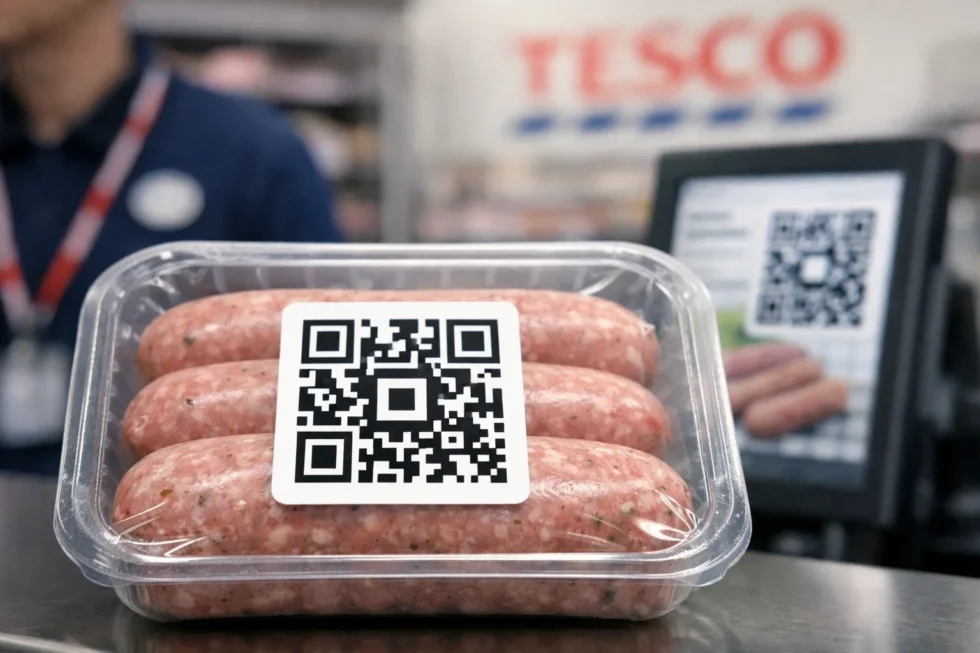
Tesco QR codes were rolled out on 17 April 2026 across UK stores as the retailer began replacing traditional barcodes on selected own-brand products, starting with 13 fresh sausage lines — including pork sausages, chipolatas, Cumberland and Lincolnshire varieties — in what it describes as a UK retail “first”. The Tesco QR codes system enables shoppers to scan packs with a smartphone to access live product data in real time, including full nutritional breakdowns, allergens, country of origin and batch-level traceability, while allowing Tesco to identify, isolate and block specific production batches at checkout and run targeted recalls instead of withdrawing entire product ranges; The WP Times reports, citing industry briefings released.
The rollout marks a structural shift from static packaging to dynamic, updateable product identity, aligning with the global GS1 UK “Sunrise 2027” programme, which is driving adoption of QR-based standards across retail supply chains. Tesco states the system is designed to improve traceability, food safety response times and stock accuracy, while reducing unnecessary food waste and maintaining existing checkout processes, where QR codes still function alongside scanners without slowing transactions.
The key change lies in how product information is stored and delivered. Traditional barcodes encode a fixed numeric identifier linked to a database entry, meaning any update — such as ingredient corrections or allergen warnings — requires physical packaging changes. QR codes, by contrast, act as digital gateways, linking directly to cloud-based datasets that can be updated instantly without altering the printed label. For consumers, the physical shopping experience remains unchanged, but the informational layer becomes significantly more detailed and responsive. By scanning Tesco QR codes, shoppers can access:
- full nutritional values, including salt, fat and additives
- clearly structured allergen disclosures in line with UK regulations
- sourcing details, including origin of meat and ingredients
- batch-specific traceability data linked to production runs
- recipe suggestions and product usage ideas
- optional promotional or brand content tied to the item
This shift reduces reliance on small-print labels and enables post-production corrections, which is particularly relevant for allergen safety and regulatory compliance.
Operationally, the system introduces a higher level of precision in stock control and recall management. Under barcode-based systems, a safety issue — for example, contamination or labelling error — typically results in entire product lines being removed from sale, even if only a limited batch is affected. Tesco QR codes allow the retailer to isolate impacted units at batch level.
| Function | Traditional barcodes | Tesco QR codes |
|---|---|---|
| Identification | Product type only | Product + batch-level data |
| Recall scope | Entire product line | Specific batches only |
| Waste impact | High (broad removal) | Reduced (targeted action) |
| Checkout control | Passive | Active blocking of affected items |
| Stock visibility | Periodic updates | Near real-time tracking |
This means affected products can be automatically flagged and prevented from sale at checkout, while unaffected stock remains available — a model that reduces disruption to both supply chains and consumers. The rollout is part of a wider industry transition coordinated by GS1, the global standards organisation responsible for barcodes. The “Sunrise 2027” framework sets a target for retailers and manufacturers to adopt 2D codes such as QRacross packaging, driven by regulatory pressure and consumer demand for transparency. Key drivers behind this transition include:
- stricter allergen labelling and compliance requirements
- demand for full end-to-end supply chain visibility
- pressure to reduce food waste across retail systems
- integration with digital tools, apps and mobile ecosystems
- faster and more precise recall capabilities
Tesco’s early deployment places it among the first major UK supermarkets to implement QR codes at scale in everyday grocery categories, rather than limited pilot environments. Company and industry statements underline the strategic nature of the move. Tesco described the change as “almost invisible at checkout but significant for retail infrastructure”, pointing to improvements in stock control and waste reduction (Tesco, UK statement, April 2026). GS1 representatives characterised the rollout as a “major step towards a connected retail system”, emphasising interoperability between retailers, suppliers and regulators.
The initial focus on sausage products reflects a controlled pilot phase within fresh food categories, where traceability and safety risks are higher. Expansion is expected across additional own-brand ranges as suppliers adapt packaging and backend systems to support QR integration. Future applications linked to Tesco QR codes could extend beyond current functionality, including:
- personalised nutrition tracking linked to purchase history
- integration with loyalty programmes and digital receipts
- automated alerts for recalled items already purchased
- household-level food waste monitoring tools
- enhanced supply chain analytics for retailers and suppliers
The shift indicates a broader transformation in retail, where products are no longer static physical items but carry continuously updateable digital identities. As the 2027 deadline approaches, Tesco’s rollout signals the beginning of a wider move across the UK grocery sector towards data-driven, fully traceable retail systems.
Read about the life of Westminster and Pimlico district, London and the world. 24/7 news with fresh and useful updates on culture, business, technology and city life: RSV vaccine pregnancy rollout shows how timing and coverage cut infant hospital risk across England