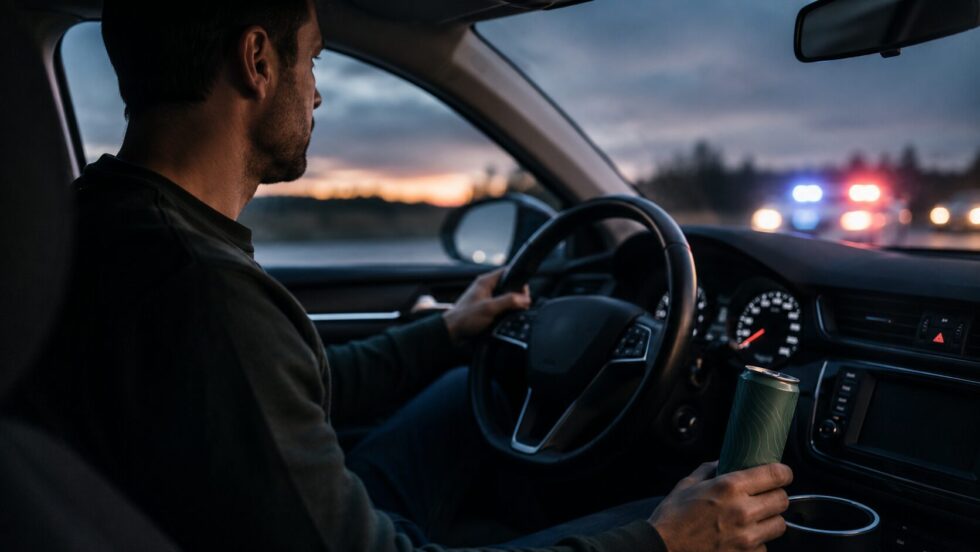
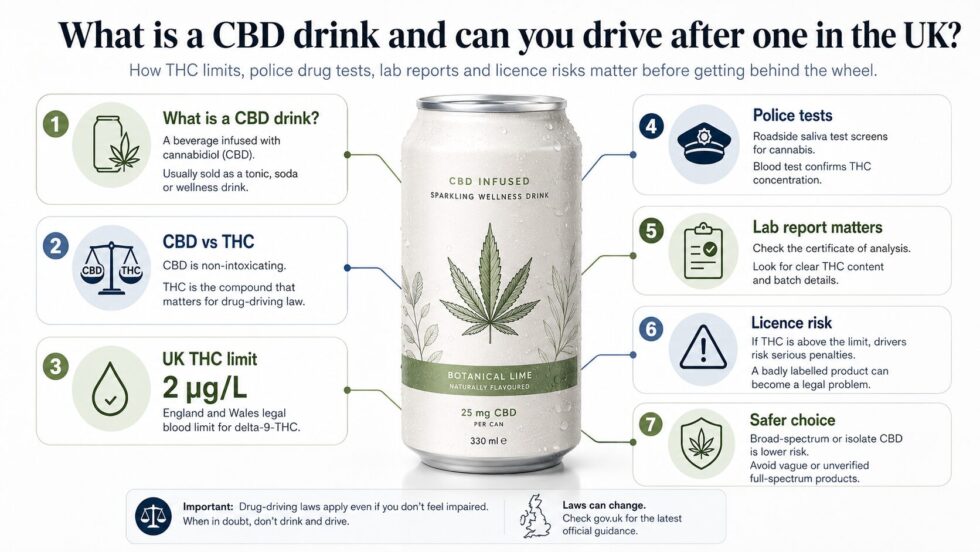
A CBD drink is a beverage infused with cannabidiol, a non-intoxicating compound found in the cannabis plant. It is usually sold as a wellness alternative to alcohol — in the form of a tonic, sparkling drink, soda or functional drink — and is marketed for relaxation rather than intoxication. But for drivers, the important question is not only what CBD is. It is whether the drink contains any THC, the controlled cannabis compound that UK drug-driving law actually tests.
CBD drink before driving is no longer a niche wellness question in Britain. It has become a practical legal issue for motorists who choose a cannabidiol tonic instead of alcohol after work, then realise they still need to get behind the wheel. The WP Times reports that UK law draws a sharp and unforgiving line: CBD itself is not the substance targeted by drug-driving rules, but THC is. In England and Wales, the legal blood limit for delta-9-THC is just 2 micrograms per litre of blood, a threshold so low that the decisive issue is not the branding on the can, but whether the product can prove what it contains. That is the core of the risk. A properly manufactured and independently tested CBD drink should not put a driver anywhere near the THC limit, because cannabidiol is non-intoxicating and is not listed among the controlled drugs with specified driving limits. But the protection does not come from the word CBD, premium wellness packaging or a retailer’s promise. It comes from evidence: a current certificate of analysis, transparent ingredients and proof that the drink contains no undeclared or excessive THC. Full-spectrum extracts, weak batch control, imported products and vague labelling can turn a fashionable alcohol alternative into a legal gamble. Police do not test lifestyle claims. They test substances in the body — and at 2 µg/L, the margin for careless assumptions is almost non-existent.
THC: the compound that actually matters
THC is the part of the cannabis plant that matters most for drivers. Its full name is delta-9-tetrahydrocannabinol, and it is the intoxicating compound associated with cannabis use. Under UK drug-driving law, THC is treated as a specified controlled drug, which means it has a fixed legal blood limit for motorists. In England and Wales, that limit is extremely low: 2 micrograms per litre of blood, or 2 µg/L. The editorial team reports that this is not a casual safety guideline, but the figure around which the legal risk is built. This is the point many CBD drink consumers misunderstand. The law does not ask whether a driver felt high, looked impaired or believed they were safe behind the wheel. Drug-driving rules operate on what lawyers describe as strict liability. In practical terms, if a blood test shows THC above the legal limit, the offence can be made out even if the person felt normal, drove normally and had no intention of breaking the law. The legal threshold is not behaviour. It is the number in the blood test.
That makes the position very different from the way many people think about alcohol or visible impairment. With THC, the danger for a CBD drink consumer is not necessarily intoxication in the obvious sense. It is the possibility that a product contains more THC than expected, that the batch was poorly controlled, or that a full-spectrum extract leaves a measurable trace in the body. Once the result crosses 2 µg/L, the argument that the drink was bought legally or marketed as CBD may offer little comfort. The consequences are serious. A drug-driving conviction can bring a minimum 12-month driving ban, an unlimited fine and a criminal record. In more serious cases, there can also be a prison sentence. The offence can remain on a driving record for years, increase insurance costs sharply and create major problems for anyone whose job depends on driving. For professional drivers, sales workers, carers, delivery staff and people who rely on a car for daily life, the impact can be far bigger than one night out.
So the real legal question is not whether it is legal to drive after CBD. CBD itself is not the target of the offence. The sharper question is whether the CBD drink could introduce enough THC into the body to create a detectable and legally relevant result. That is why the quality of the product, the type of extract, the certificate of analysis and the credibility of the brand matter more than the wellness message on the label.
Where the THC risk actually comes from
The THC risk in a CBD drink does not begin with cannabidiol itself. It begins with the quality of the product, the type of extract used and the reliability of the laboratory evidence behind the label. In the UK, CBD food products are regulated under the novel foods framework, while controlled cannabinoids such as THC remain the legal issue that matters for drivers. The Food Standards Agency says CBD products on the market must not be incorrectly labelled, unsafe or regarded as controlled substances. That is the key distinction for motorists: a CBD drink may be sold as a wellness product, but if it contains undeclared or excessive THC, the road-traffic consequences are no longer theoretical.
The technical threshold is narrow. UK regulatory guidance has generally treated the controlled cannabinoid issue around the 1 mg per container concept, while more recent expert advice has also focused on much smaller limits per serving for controlled cannabinoids. The Advisory Council on the Misuse of Drugs has warned that consumer CBD products can contain controlled phytocannabinoids as unavoidable traces, but at recommended levels these are highly unlikely to produce harmful effects. For a driver, however, the central question is not only whether the product is harmful. It is whether it could contribute to a detectable THC result in blood against the 2 µg/L drug-driving limit in England and Wales.
This is why the safe answer is not simply CBD is legal. The safe answer is: genuine, compliant, properly tested CBD with no meaningful THC should not create a drug-driving problem. A poorly labelled, poorly tested or full-spectrum product is a different matter. The Government Chemist has described the presence of controlled cannabinoids in CBD products as a known risk and has noted that interpreting controlled-drug thresholds in CBD products is technically difficult. That is an important expert warning, because it means the consumer cannot rely only on branding, packaging or the word natural.
Three categories of risk deserve particular attention.
First, full-spectrum CBD products carry more legal sensitivity than isolate or broad-spectrum products. Full-spectrum formulations are designed to preserve a wider range of cannabis plant compounds, and that can include trace THC. Broad-spectrum and isolate products are usually formulated to remove THC entirely or as close to entirely as possible. For a regular driver, the cautious choice is therefore not the most fashionable extract. It is the one with the clearest evidence that THC has been removed and tested.
Second, mislabelled or poorly controlled products remain the real hazard. Academic testing of over-the-counter CBD products in the UK has found that quality can be substandard and that some products contain controlled cannabinoids such as THC or CBN. Earlier market testing also found a major mismatch between label claims and actual CBD content, with some products containing detectable THC despite being sold to ordinary consumers. This is where a lifestyle product becomes a legal problem. A driver is not tested on what the label promised. A driver is tested on what is in the body. Third, heavy or repeated use can make a marginal product more complicated. THC is fat-soluble, and its clearance varies between people. A single compliant CBD drink with no meaningful THC should not be treated like a cannabis product. But repeated use of full-spectrum products, especially if their THC content is unclear, creates a different risk profile. The danger is not that CBD suddenly becomes intoxicating. It is that repeated exposure to trace THC from an unreliable product may become detectable.
How the police actually test for it
The enforcement process is built around THC, not CBD. Police can carry out roadside screening if they suspect drug-driving, if a driver has committed a traffic offence or if there has been a collision. British Transport Police states that officers can test for cannabis and cocaine at the roadside and can screen for other drugs at a police station. In practice, cannabis screening means THC. A roadside test does not look for CBD, and a genuinely THC-free CBD drink gives that test nothing relevant to detect.
A roadside test is not the same as a conviction. It is a screening stage that can lead to arrest and further evidential testing. The decisive stage is usually a blood test taken after arrest, because the legal offence in England and Wales is built around the specified blood concentration. GOV.UK lists the limit for delta-9-tetrahydrocannabinol, cannabis THC, at 2 micrograms per litre of blood. That is the figure that matters.
There is another legal route too. A driver can also face action if police believe they are unfit through drugs, where the issue is impairment rather than only a fixed blood number. That matters because even a legal product could still be relevant if it makes someone drowsy, slowed or unsafe behind the wheel. CBD itself is not treated like THC, but drivers still have a general responsibility not to drive when their ability is affected by any substance. The practical takeaway is simple. The system is designed to catch THC and impairment. A genuine THC-free CBD drink should not trigger the THC route. The exposure comes from products that contain more THC than the consumer expects, from weak documentation, from unclear full-spectrum formulations and from assuming that a wellness label is the same as legal proof.
How long should a driver wait after a CBD drink
This is the question many motorists ask, but it is often the wrong starting point. For a compliant CBD drink with zero or only legally insignificant trace THC, there should be no meaningful THC clearance window to calculate. The issue is not whether to wait two hours, six hours or until the next morning. The issue is whether the drink contained THC in the first place.
The Government has said it cannot provide simple dosage guidance for drug-driving limits because people metabolise substances differently and many variables affect blood concentration. That caution is especially relevant to THC-containing products. It means no serious article should promise a universal safe waiting time for THC exposure. Biology, dose, frequency, body composition, product strength and timing all matter.
For ordinary CBD drinks, the safer rule is upstream rather than downstream. Do not try to manage risk after drinking an unknown product. Manage it before buying. Choose a broad-spectrum or isolate product, check the certificate of analysis, confirm THC content and avoid vague full-spectrum products if you need to drive.
If a product makes you feel sleepy, light-headed, slow or unusual in any way, do not drive. That advice is not because CBD is automatically illegal behind the wheel. It is because road safety law is not only about chemistry. It is also about whether a driver is fit to control a vehicle.
CBD drinks and driving: the risk picture at a glance
| Factor | Lower-risk scenario | Higher-risk scenario |
|---|---|---|
| Product type | Broad-spectrum or isolate CBD | Full-spectrum CBD with retained trace THC |
| THC evidence | Current certificate of analysis confirms THC is absent or within compliant trace limits | No certificate, vague claim or old lab report |
| Retail source | Traceable brand, reputable retailer, product linked to the FSA public list where relevant | Unknown online seller, imported drink or product not clearly traceable |
| Consumption pattern | One drink used as directed | Repeated full-spectrum use over a short period |
| What police test | THC and impairment, not CBD itself | THC above the legal limit or signs of impairment |
| Legal exposure | Minimal if the product is genuinely THC-free and the driver is fit | Serious if blood THC exceeds 2 µg/L |
How to protect your licence
The most practical protection is to treat CBD drinks like any product that can carry legal consequences if badly made. Do not buy only on taste, design or influencer marketing. Buy on evidence. A serious CBD brand should be able to show what is in the product, who tested it and when that batch was tested.
Drivers should choose broad-spectrum or isolate CBD if they want the lowest THC risk. They should avoid full-spectrum CBD before driving unless the lab report is current, clear and specific. The certificate of analysis should show THC, not only CBD. It should also be linked to the batch or product being sold, not to a generic marketing claim.
Keep the packaging and any QR-code lab report if you regularly use CBD and drive. This does not create immunity from the law, but it supports the factual explanation that the product was sold and consumed as a compliant CBD product rather than as a THC product. If stopped, calm evidence is more useful than a verbal argument about wellness. The strongest checklist is short:
- Choose broad-spectrum or isolate rather than full-spectrum if you drive regularly.
- Check the certificate of analysis before buying.
- Confirm the THC result, not only the CBD amount.
- Buy from a traceable UK retailer or established brand.
- Avoid products with vague wording such as hemp extract without clear cannabinoid testing.
- Do not stack several full-spectrum products before driving.
- Do not drive if you feel drowsy, slowed or impaired for any reason.
- Keep the packaging or lab-report link if you rely on the product often.
Questions and answers
Can you legally drive after a CBD drink in the UK
Yes, in ordinary circumstances, if the drink is a genuine compliant CBD product and the driver is not impaired. CBD itself is not the substance targeted by the UK drug-driving limit. The legal danger is THC.
Does a roadside drug test detect CBD
No. Roadside drug screening is designed to detect drugs such as cannabis THC and cocaine. CBD is not what the cannabis roadside test is looking for.
What is the THC driving limit in England and Wales
The specified legal limit for delta-9-THC is 2 micrograms per litre of blood. That is a very low threshold and it does not require the prosecution to prove that the driver felt high.
Could a CBD drink make someone fail a drug-driving test
A properly made THC-free or compliant trace-only CBD drink should not. The risk comes from full-spectrum products, poor labelling, contamination, unreliable imports or products containing more THC than the consumer expects.
Is full-spectrum CBD risky for drivers
It is the more cautious category because full-spectrum products may retain trace THC. That does not mean every full-spectrum product will cause a problem, but it does mean drivers should demand stronger lab evidence before using it.
How long should you wait before driving after a CBD drink
For a compliant THC-free CBD drink, the waiting-time question is usually not meaningful because there should be no relevant THC to clear. If the product contains THC or may contain THC, there is no universal safe waiting time.
What should be checked before buying a CBD drin
The key document is a certificate of analysis. It should show CBD content, THC content, the testing laboratory, the date of testing and ideally the batch number. If a brand cannot provide that, a driver should not trust the product with their licence.
What happens if THC is found above the limit
A driver can face a drug-driving conviction, a minimum 12-month driving ban, an unlimited fine, a criminal record and higher insurance costs. The consequences can be especially serious for anyone who drives for work.
CBD is not the problem. Unverified THC is.
The legal position is clear. A genuine CBD drink should not, by itself, create a drug-driving problem in the UK. Cannabidiol is not the substance police are looking for in cannabis roadside screening, and it is not the compound with a specified drug-driving blood limit. The problem is THC. That is the intoxicating cannabis compound. That is what the law controls behind the wheel. And that is where a badly labelled, poorly tested or full-spectrum product can put a driver in real trouble.
For motorists, the safest conclusion is not simply CBD is legal. The sharper question is whether this exact drink can prove what it contains. A broad-spectrum or isolate CBD drink with a current certificate of analysis is one thing. An unverified full-spectrum drink from an unknown seller is another. One is a documented consumer product. The other may be a legal risk dressed up as wellness.
The rule for drivers is simple:
Do not trust the word CBD on the can. Trust only the evidence behind it.
Before driving, a consumer should know whether the drink is THC-free or only trace-level compliant, whether the lab report is current, whether the batch can be matched to the product, and whether the brand is traceable. If the company cannot clearly show the THC content, the driver is being asked to gamble with their licence.
That matters because the law does not care about branding. A label may promise calm, balance, focus or a cleaner alternative to alcohol, but police do not test lifestyle language. They test substances in the body. If THC is found above the legal limit, the argument that the product was sold as CBD may not be enough to prevent serious consequences. This is the uncomfortable truth behind the CBD drinks boom. Many products are legitimate, non-intoxicating and low-risk for drivers. But the market also contains vague labels, full-spectrum extracts, imported products and brands that rely more on mood than evidence. For anyone who needs to drive, that difference matters. The practical verdict is therefore reassuring but conditional. If the CBD drink is genuine, properly tested and THC-free or compliant at trace level, it should not be treated as a threat to a driving licence. If the THC content is unclear, the risk changes completely. The issue is not the wellness trend. It is the chemistry in the can. This article provides general information about UK road-traffic and food regulation. It is not legal advice. Anyone facing a drug-driving allegation, using prescribed medical cannabis or dealing with a specific legal case should speak to a qualified solicitor or appropriate medical professional.
Read about the life of Westminster and Pimlico district, London and the world. 24/7 news with fresh and useful updates on culture, business, technology and city life: Why are vitamin D users in the UK warned to stop supplements when these symptoms appear