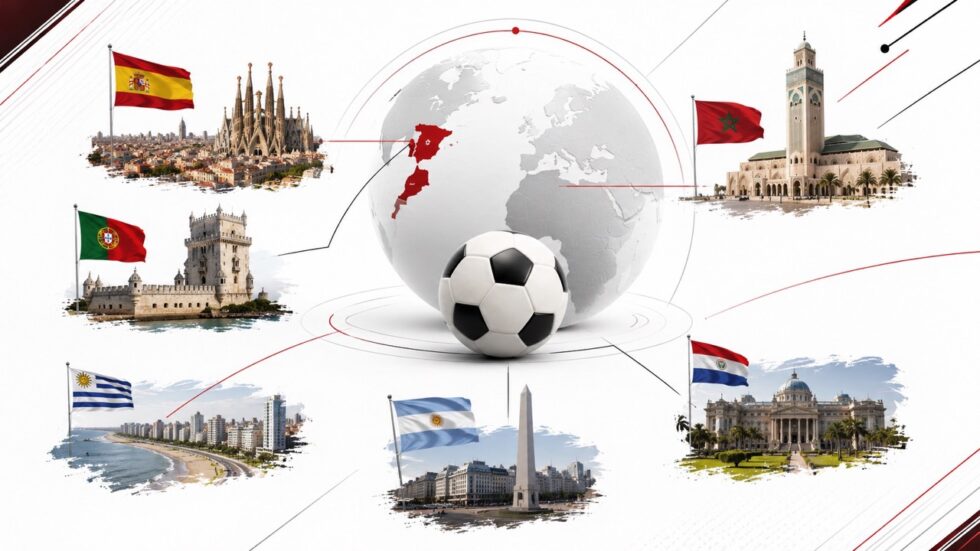
World Cup 2030 will be staged mainly in Spain, Portugal and Morocco, with three centenary matches in Uruguay, Argentina and Paraguay before the tournament moves fully to Europe and North Africa. For supporters asking where is the next world cup 2030 or where is the 2030 world cup, the answer is unusual but clear: FIFA has created a six-country anniversary edition to mark 100 years since the first tournament was played in Uruguay in 1930, The WP Times reports.
The 2030 edition will be the first men’s World Cup spread across six countries and three continents, but the practical hosting centre will be Spain, Portugal and Morocco. Uruguay, Argentina and Paraguay will each stage one opening match as part of the centenary tribute before the rest of the 48-team competition continues across the main host nations. The final stadium, full match calendar, ticket dates and exact city allocation still need final confirmation from FIFA. That makes the tournament already historic, but also logistically complex for fans, teams, broadcasters and national associations.
Where is the World Cup 2030 taking place
World Cup 2030 is taking place mainly in Spain, Portugal and Morocco, with the tournament’s core schedule expected across major cities in those three countries. Spain brings the largest football infrastructure in the bid, Portugal adds established elite venues in Lisbon and Porto, and Morocco gives the tournament a major North African base. This combination creates a compact Mediterranean tournament after the symbolic opening matches in South America. For UK fans, the main phase should be far easier to follow than the 2026 World Cup in Canada, Mexico and the United States because most fixtures will be in close European and North African time zones.
The South American part is not a normal co-hosting model. Uruguay, Argentina and Paraguay are included because FIFA wants the 2030 tournament to begin where World Cup history began. Uruguay hosted and won the first edition in 1930, Argentina were the runners-up in that first final, and Paraguay has historical importance because Asunción is linked to CONMEBOL’s institutional base. Each of the three South American countries will stage one centenary match, after which the competition will shift back across the Atlantic. That structure is the reason many fans searching where is the 2030 world cup are seeing six countries in the answer rather than three.
| Country | Role in World Cup 2030 | Main reason |
|---|---|---|
| Spain | Main host | Largest European base of the tournament |
| Portugal | Main host | Major football venues and close travel links |
| Morocco | Main host | North African host and major tournament partner |
| Uruguay | Centenary match | Hosted and won the first World Cup in 1930 |
| Argentina | Centenary match | Finalist in the first World Cup final |
| Paraguay | Centenary match | Historic CONMEBOL connection |
Why World Cup 2030 is being played across six countries
World Cup 2030 is being played across six countries because FIFA has combined a modern joint bid with the centenary of the tournament. Spain, Portugal and Morocco provide the main operational structure for a 48-team World Cup, while Uruguay, Argentina and Paraguay provide the historical opening. It is a political, sporting and symbolic compromise that allows FIFA to honour South America without placing the entire expanded tournament there. The format also gives Europe, Africa and South America all a visible role in the 100-year anniversary edition.
The decision also fits the wider World Cup hosting sequence. World Cup 2026 is being staged in North America, world cup 2030 goes to Europe, Africa and South America, and World Cup 2034 has been awarded to Saudi Arabia. That means the tournament will move through several regions in less than a decade. Supporters may see this as a celebration of global football, but it also raises questions about travel, cost, environmental impact and tournament scale. The 2030 edition will therefore be watched not only as a football event, but also as a test of how far FIFA can stretch the World Cup model.
What British fans need to know
For British fans, the most important point is that the main World Cup 2030 host countries are close enough for realistic travel. Spain and Portugal are short-haul destinations from the UK, with strong air links, large hotel markets and familiar routes for football supporters. Morocco will require more planning, but it is also well connected to European travel networks and has experience hosting major football events. If England, Scotland, Wales or Northern Ireland qualify, the group-stage draw will be crucial because travel demands could vary sharply by country and city.
The centenary matches in South America are different. A team drawn into one of those opening fixtures could face long-haul travel before returning to the main tournament zone. Fans following that team would need to plan for higher costs, longer flights and a more complicated schedule. That is why the final FIFA match calendar will matter so much. Until the exact fixtures are published, supporters should treat early travel plans with caution.
When is World Cup 2030 and how many matches will be played
World Cup 2030 is expected to be played in the traditional summer window, with the tournament running across June and July. FIFA’s expanded 48-team model means the competition is expected to follow the 104-match structure introduced for the 2026 World Cup. That is a huge increase from the old 32-team format and creates a longer, more demanding event for host cities. It also gives broadcasters more matchdays, more prime-time slots and more commercial value.
The tournament schedule must solve three major problems. First, it has to give proper importance to the centenary matches in Uruguay, Argentina and Paraguay. Second, it has to move the competition smoothly into Spain, Portugal and Morocco. Third, it has to work for global television audiences without damaging player preparation or supporter access. For viewers in Britain, the Spain-Portugal-Morocco phase should be far more convenient than matches played deep into the night in other time zones.
The final match calendar will also affect qualification and preparation. Host countries normally receive automatic qualification, and the six-country 2030 model makes that question especially important. Spain, Portugal, Morocco, Uruguay, Argentina and Paraguay are all part of the confirmed hosting plan. Other national teams will have to qualify through their confederation routes. For European sides, including England and Scotland, that means the road to World Cup 2030 will still be shaped by UEFA qualification.
World Cup 2030 host cities and final venue
The confirmed countries are known, but the full list of World Cup 2030 host cities and stadiums is still the key missing detail for fans. Spain has obvious candidates such as Madrid and Barcelona, Portugal has Lisbon and Porto, and Morocco has major stadium ambitions, especially around Casablanca. The final venue has not yet been formally confirmed by FIFA. That means any claim about the final should be treated carefully until the official decision is announced.
Madrid’s Santiago Bernabéu is expected to be one of the strongest candidates because of its status, redevelopment and history. Barcelona’s Camp Nou also has the scale and global recognition to be part of the biggest matches if its redevelopment timeline fits FIFA requirements. Morocco may push strongly for a showpiece fixture because the bid is not only European but also African. Portugal’s role will likely be important in the group stage and knockout rounds, even if the final race is dominated by Spain and Morocco.
The stadium decision will shape the fan experience. A compact schedule across Iberia and Morocco could work well if transport links, ticketing, fan zones and accommodation are coordinated properly. A scattered schedule would create more pressure on flights, hotels and domestic rail systems. Supporters should therefore wait for FIFA’s official city list and match allocation before making expensive plans. World Cup 2030 is already confirmed in location, but not yet fully confirmed in practical fan detail.
World Cup 2034 already has its host after World Cup 2030
The next two World Cups after 2026 are already known. World Cup 2030 will be hosted by Spain, Portugal and Morocco, with centenary matches in Uruguay, Argentina and Paraguay. World Cup 2034 will be hosted by Saudi Arabia. That creates a clear long-term map for FIFA’s biggest tournament and gives national associations, broadcasters and sponsors years to prepare.
The 2034 tournament will be very different from World Cup 2030. Saudi Arabia is set to stage the competition as a single-country host, unlike the six-country 2030 model. Its plans include major stadiums across several cities and large-scale infrastructure projects. The decision will bring renewed debate about climate, calendar timing, human rights, fan access and the future of mega-event hosting. But for fans now asking where is the next world cup 2030, the immediate answer remains Spain, Portugal and Morocco, with the tournament opening symbolically in South America.
World Cup 2030 questions and answers
Where is the next World Cup 2030?
The next World Cup 2030 is mainly in Spain, Portugal and Morocco. Uruguay, Argentina and Paraguay will each stage one centenary match at the start of the tournament.
Where is the 2030 World Cup final?
The World Cup 2030 final venue has not yet been officially confirmed by FIFA. Major candidates are expected to come from the main host countries, especially Spain and Morocco.
Why are there six World Cup 2030 host countries?
There are six host countries because FIFA is marking the 100th anniversary of the first World Cup. Spain, Portugal and Morocco are the main hosts, while Uruguay, Argentina and Paraguay host centenary matches.
Is World Cup 2030 in Europe or Africa?
World Cup 2030 is in both Europe and Africa, with Spain and Portugal in Europe and Morocco in North Africa. It also begins with three matches in South America.
Who hosts World Cup 2034?
World Cup 2034 will be hosted by Saudi Arabia. The decision was confirmed after Saudi Arabia became the sole candidate for that edition.
Read about the life of Westminster and Pimlico district, London and the world. 24/7 news with fresh and useful updates on culture, business, technology and city life: How India’s record Test win in afg vs ind exposed Afghanistan’s red-ball gap in New Chandigarh heat