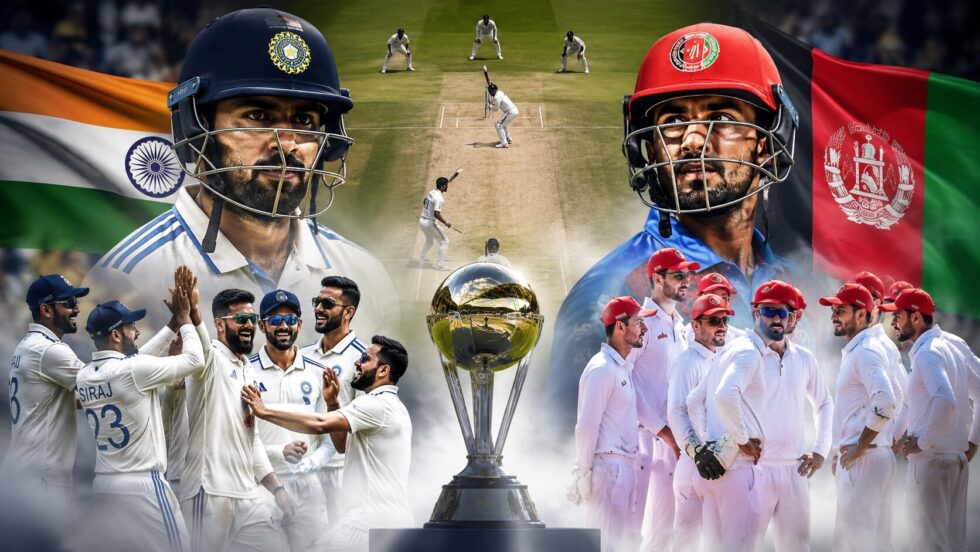
India turned a one-off Test into a statement of depth, control and red-ball superiority by beating Afghanistan by an innings and 300 runs in New Chandigarh on Monday, 8 June 2026, the biggest victory margin in India’s Test history. The match was effectively decided by India’s first-innings 564-8 declared, built on centuries from Shubman Gill and KL Rahul, before debutant left-arm spinner Manav Suthar dismantled Afghanistan’s first innings and gave the hosts a result that The WP Times reports as both a record win and a warning about the gulf between the sides in long-form cricket.
Afghanistan were bowled out for 152 and then, after being asked to follow on, collapsed again for 112 as India closed the match inside three days at the Maharaja Yadavindra Singh Stadium. Suthar’s 6-33 in the first innings made him only the fifth Indian bowler to take a five-wicket haul on Test debut, while Washington Sundar’s 4-36 and Kuldeep Yadav’s 3-30 finished the second innings with clinical efficiency.
afg vs ind scorecard: India’s batting platform left Afghanistan chasing the match from day one
India’s control started with the toss and never really loosened. Gill, now leading a side being carefully refreshed, made 126, while Rahul added exactly 100 at the top of the order to give India the kind of base that turns a one-off Test into a pressure examination for the touring side. Sai Sudharsan’s 81 and useful lower-order runs allowed India to declare at 564-8, a total that gave their bowlers freedom to attack without scoreboard anxiety. Afghanistan’s Mohammad Saleem took 6-140, a demanding but valuable return in extreme conditions, yet his effort was buried beneath the weight of India’s total.
The scale of the innings mattered because Afghanistan were not merely chasing runs; they were chasing time, discipline and method. Once India had crossed 500, every Afghan batter entered with the match already tilted towards survival rather than construction. Rahmat Shah’s 60 in the first innings was therefore more than a personal half-century; it was the only passage in which Afghanistan showed the patience required for Test cricket. But the innings lacked enough support around him, and once Suthar removed Rahmat, the resistance lost its centre.
| Match detail | Figure |
|---|---|
| Venue | New Chandigarh / Mullanpur |
| Dates | 6–8 June 2026 |
| India | 564-8 declared |
| Afghanistan first innings | 152 |
| Afghanistan second innings | 112 |
| Result | India won by an innings and 300 runs |
| Player of the Match | Manav Suthar |
| India’s previous biggest innings win | Innings and 272 runs v West Indies, 2018 |
Manav Suthar debut: why the six-for changed the match and India’s spin conversation
Manav Suthar’s debut was the defining cricket story of the match because it was not built only on helpful conditions. Reports from the game noted that the surface had flattened for others, yet Suthar found turn, drift and enough control to make Afghanistan defend and attack on his terms. His 6-33 in the first innings made him the first Indian since Ravichandran Ashwin in 2011 to take a five-wicket haul on Test debut, according to the ICC.
The detail that will please India most is that Suthar’s wickets came through more than one method. He struck early, challenged the outside and inside edges, and produced the key ball to Rahmat Shah, turning one from around the leg-stump line to beat the sweep and hit the stumps. That wicket mattered because Rahmat was Afghanistan’s most settled batter and had already passed fifty. By the time Suthar completed the six-for, Afghanistan had been pushed into a follow-on scenario from which there was almost no realistic route back.
Suthar finished with seven wickets in the match and was named Player of the Match. Reuters reported that he called the debut “on top of the world” and spoke about patience and consistency as the essential skills in Test cricket, which was exactly what separated the two teams across three days.
What India learned from Suthar, Sundar and Kuldeep
India’s second-innings bowling was as important as Suthar’s first-innings burst because it showed variety. Afghanistan tried to disrupt Suthar by using their feet and looking for boundaries, especially through Sediqullah Atal, who made 42. That forced India to use Washington Sundar and Kuldeep Yadav differently. Sundar’s 4-36 came through drift, lines outside off stump and pressure on attacking strokes, while Kuldeep picked up 3-30 and ended the match with two wickets in two balls.
For India, that is a useful selection message. This was not a full-strength bowling attack built around Jasprit Bumrah and Ravindra Jadeja; both had been rested before the Test as India managed workloads and tested options. Yet the replacement and rotation players produced a record win. That does not automatically settle India’s long-term Test combination, but it gives the selectors evidence that Suthar can be more than a squad name.
Afghanistan’s red-ball problem: effort was visible, but Test method was missing
Afghanistan did not lose simply because India had more famous players. They lost because the demands of Test cricket repeatedly exposed gaps in shot selection, defensive judgement and innings management. In the first innings, Rahmat Shah showed what was required: absorb pressure, leave well, defend straight and punish the loose ball. Around him, however, too many dismissals came from strokes that belonged to a shorter format or to a situation Afghanistan were not actually in.
The second innings was more revealing. Afghanistan began with greater intent and moved to 74-1, but then lost their structure and were bowled out for 112. The collapse from that position showed how quickly pressure can compound in Test cricket when a side does not have enough batters capable of resetting the tempo. Hashmatullah Shahidi’s team were also fighting heat, scoreboard pressure and an Indian attack rotating spin angles, but the main issue was still control over risk.
“A complete win, ticked all the boxes so very happy,” Gill said after registering his 11th Test hundred and leading India to their record margin.
That quote captures India’s view of the match, but Afghanistan’s lesson is sharper. A one-off Test against India is a brutal assignment because there is no second match to correct tactical errors. For a developing red-ball side, the format requires not only talent but repetition. Afghanistan have elite white-ball cricketers and a strong global identity in limited-overs cricket, but Test cricket asks different questions: how to bat through two sessions, how to build pressure without wickets, how to protect a tail, and how to survive when the ball is turning but the field is attacking.
Key Afghanistan concerns after New Chandigarh
Afghanistan’s biggest issue was not one individual failure. It was the lack of collective batting time across both innings. Their first innings lasted only long enough for Rahmat’s resistance to stand out, while the second innings showed that aggression alone cannot solve scoreboard pressure after a follow-on.
Important concerns:
- Too many batters were drawn into cross-batted or aerial strokes before the innings had stabilised.
- The middle order did not build a partnership around Rahmat Shah in the first innings.
- The second innings started with intent but lacked a defensive plan once India changed spin angles.
- Saleem’s six-wicket haul was a positive, but Afghanistan still conceded 564.
- The team need more regular long-form cricket if they are to close the gap against established Test nations.
Why India’s biggest Test win did not change the World Test Championship table
One important detail for readers following the wider Test landscape is that this result did not affect the World Test Championship standings. The match was a one-off Test outside the WTC cycle, which means India gained a historic result but no WTC points. That distinction matters because a record win can look like a major table event, yet the official championship race remains unchanged.
For India, the value was still significant. Gill made another captain’s hundred, Rahul delivered at the top of the order, Sudharsan added substance, and three spinners shared the workload in a way that points towards depth. For Afghanistan, the result was painful but instructive, especially before the limited-overs leg of the tour. The two sides were scheduled to move into a three-match ODI series after the Test, giving Afghanistan a format in which they are more experienced and more dangerous.
The record itself is also historically important. India’s previous biggest Test win by an innings was against West Indies in Rajkot in 2018, by an innings and 272 runs. The New Chandigarh result surpassed that by 28 runs, placing the Afghanistan Test at the top of India’s list of dominant red-ball victories.
afg vs ind verdict: a record win for India, a red-ball audit for Afghanistan
The match will be remembered first for Manav Suthar, because debut six-wicket hauls rarely arrive with such authority. It will also be remembered as a Shubman Gill captaincy win: bat first, bat big, enforce the follow-on, and trust spin to finish the job. India did not need a fourth innings, did not need a rescue act, and did not allow Afghanistan to take the contest deep enough for uncertainty.
For Afghanistan, the fair reading is not humiliation alone. They were outplayed by a side with far greater Test experience, deeper domestic structures and more red-ball specialists. Saleem’s six wickets, Rahmat’s first-innings 60 and Atal’s second-innings 42 were credible individual notes, but Test cricket does not reward isolated moments for long. The challenge now is converting those fragments into sessions, then into days, and eventually into matches.
For India, the result offers something more immediate: confidence in bench strength. A debutant spinner won Player of the Match, a refreshed batting order made runs, and the attack adapted when Afghanistan tried to counterpunch. That is why the record margin matters. It was not just a large win; it was a clean, structured, low-drama Test performance from a team already looking beyond one fixture.
FAQ: afg vs ind, India’s record Test win and Manav Suthar’s debut
What was the result of the afg vs ind Test match?
India beat Afghanistan by an innings and 300 runs in the one-off Test at New Chandigarh. India declared on 564-8 after centuries from Shubman Gill and KL Rahul, then bowled Afghanistan out for 152 and 112. The result became India’s biggest win by an innings in Test cricket. It surpassed India’s previous record victory by an innings and 272 runs against West Indies in Rajkot in 2018.
Who was the Player of the Match in India vs Afghanistan Test?
Manav Suthar was named Player of the Match after taking seven wickets on his Test debut. The left-arm spinner claimed 6-33 in Afghanistan’s first innings and added another wicket in the second. His first-innings six-for put India in complete control of the match. It also made him only the fifth Indian bowler to take a five-wicket haul on Test debut.
Why was Manav Suthar’s debut so important?
Suthar’s debut mattered because he did not merely collect wickets at the end of an already broken innings. He removed key batters, including Rahmat Shah, who was Afghanistan’s most settled player in the first innings. His control, drift and turn gave India the breakthrough spell that forced Afghanistan into a follow-on. For India, it was also a major sign that their spin depth remains strong beyond the established senior names.
How many runs did Shubman Gill score against Afghanistan?
Shubman Gill scored 126 in India’s first innings. It was a captain’s innings because it gave India the platform to bat Afghanistan out of the match early. Gill’s hundred came alongside KL Rahul’s 100 and helped India reach 564-8 declared. After the win, Gill described it as a complete performance in which India had “ticked all the boxes”.
What did KL Rahul score in the afg vs ind Test?
KL Rahul scored exactly 100 in India’s first innings. His century at the top of the order gave India control before the middle order and lower order extended the total. In a one-off Test, that kind of first-innings score was decisive because Afghanistan were immediately placed under scoreboard pressure. Rahul’s innings also helped India protect their bowlers from having to chase the game later.
How did Afghanistan bat in the Test match?
Afghanistan struggled badly across both innings. Rahmat Shah made 60 in the first innings and Sediqullah Atal scored 42 in the second, but there was not enough support around them. Afghanistan were bowled out for 152, then collapsed again for 112 after following on. Their biggest problem was not effort, but the lack of sustained Test-match batting partnerships.
Did Afghanistan have any positives from the match?
Yes, but they were limited. Mohammad Saleem took 6-140 in India’s first innings, which was a strong individual bowling performance in difficult conditions. Rahmat Shah also showed patience and technique with his first-innings half-century. Sediqullah Atal’s 42 in the second innings showed some attacking intent. However, those moments were not enough to stop India from controlling every major phase of the Test.
Why did India enforce the follow-on?
India enforced the follow-on because they had a huge first-innings lead after bowling Afghanistan out for 152. With Afghanistan trailing by more than 400 runs, India had the chance to finish the match quickly without batting again. The decision worked because Afghanistan were dismissed for 112 in their second innings. India completed the win inside three days.
Did the afg vs ind result affect the World Test Championship table?
No, the result did not affect the World Test Championship standings. The match was a one-off Test outside the WTC cycle, so India did not receive WTC points for the victory. That does not reduce the sporting importance of the win, but it means the championship table remained unchanged. The value for India was mainly historical, tactical and selection-related.
What happens next after India’s Test win over Afghanistan?
After the one-off Test, India and Afghanistan were scheduled to move into a three-match ODI series starting on 13 June. That format should suit Afghanistan more than Test cricket because they have more experience and stronger global results in white-ball cricket. For India, the ODI series gives another chance to test squad depth. For Afghanistan, it is an opportunity to respond quickly after a heavy red-ball defeat.
Read about the life of Westminster and Pimlico district, London and the world. 24/7 news with fresh and useful updates on culture, business, technology and city life: Emma Raducanu and Katie Boulter turn Queen’s tennis into Britain’s first serious Wimbledon test