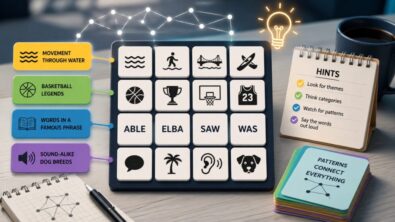
12 July 2026 — Connections hint searches are likely to rise sharply as Sunday’s New York Times puzzle presents players with 16 deceptively simple words that must be divided into four precise groups: reproductive parts of fruit, fruit-flavoured sweets, verbs from a familiar college-life slogan and fragments hidden at the beginning of US capital names. Puzzle No. 1,127 has been rated at the difficult end of the scale by some daily solvers because several words appear capable of belonging to more than one group, particularly PIP, PIT, STONE, PHO and NERD.
The complete NYT Connections answers for Sunday are PIP, PIT, SEED and STONE; DOT, NERD, RUNT and SPREE; PARTY, SLEEP, STUDY and REPEAT; and DEN, MAD, PHO and SAC. Readers looking for help without immediately revealing the grid can begin with the spoiler-free clues below before moving through the category names and full solutions, The WP Times reports after checking the published puzzle guides for 12 July.
Connections hint today: spoiler-free clues for Sunday’s puzzle
Today’s Connections board contains the following words:
| Word | Word | Word | Word |
|---|---|---|---|
| SPREE | STUDY | DEN | SLEEP |
| NERD | MAD | PARTY | PIT |
| SAC | SEED | DOT | REPEAT |
| PHO | STONE | RUNT | PIP |
The most useful approach is not to begin by selecting the first apparently obvious group. Instead, players should identify the words with the narrowest possible meanings and test whether the remaining entries form clean sets of four.
Here are four Connections hints that reveal the idea behind each colour without giving away every answer:
- Yellow hint: Think about what may be found inside a peach, cherry, apple or similar fruit.
- Green hint: Look beyond ordinary dictionary meanings and consider small branded sweets.
- Blue hint: Four verbs belong to a familiar phrase describing the repetitive rhythm of student life.
- Purple hint: Four short entries can be expanded into the names of American state capitals.
A one-word clue for each group is:
- Yellow: STONE
- Green: NERD
- Blue: SLEEP
- Purple: MAD
The yellow and blue sets may become visible relatively quickly, but the green and purple categories are designed to exploit ambiguity. PHO looks like the Vietnamese noodle soup, for example, while MAD appears to be an adjective and DEN an ordinary room or animal shelter. Their role becomes clear only when each is treated as the opening sound or spelling of a longer place name.
What are today’s NYT Connections categories
The four category titles for Sunday, 12 July, are:
| Colour | Category |
|---|---|
| Yellow | Reproductive part of fruit |
| Green | Bit of fruit-flavoured candy |
| Blue | Verbs in a college-life slogan |
| Purple | Starts of US capitals |
The official colour system moves broadly from the most accessible group, yellow, through green and blue to the wordplay-heavy purple category. That order should not be interpreted as an absolute measure of how every player will experience the board. Someone familiar with American confectionery may identify the green group before recognising the fruit terms, while players outside the United States may find the capital-name construction particularly demanding.
The puzzle’s main difficulty comes from deliberate overlap. SEED is the clearest yellow entry, but PIT and STONE can describe places, objects or actions. DOT is an everyday noun and verb, while NERD is more readily understood as a description of a person than as the name of a sweet. PARTY, STUDY and SLEEP appear naturally connected to university life, but the final word requires players to recognise the slogan-like structure rather than a formal category.
Connections answers today for July 12, 2026
Spoiler warning: the full NYT Connections answers appear below.
Yellow Connections answer: reproductive parts of fruit
The yellow group is:
- PIP
- PIT
- SEED
- STONE
All four words can refer to the seed or seed-containing reproductive structure found inside fruit.
SEED is the broad biological term and the most direct route into the category. A PIP is commonly used in British English for a small seed found in fruit such as an apple or orange. PIT is the usual American term for the hard central part of fruits including peaches and cherries, while STONE is the familiar British term used for fruits such as plums, apricots and nectarines.
The category is effective because the words are related but not perfectly interchangeable in every context. A strawberry carries seeds on its outer surface, an apple contains pips, and a peach has a stone or pit. Connections requires the broader shared relationship rather than identical usage.
STONE may initially distract players because it can mean a rock, a unit of weight or a verb. PIT can describe a hollow or an arena, and PIP may suggest a mark on a playing card or die. Once SEED is identified, however, the intended group becomes substantially easier to verify.
Green Connections answer: bits of fruit-flavoured candy
The green group is:
- DOT
- NERD
- RUNT
- SPREE
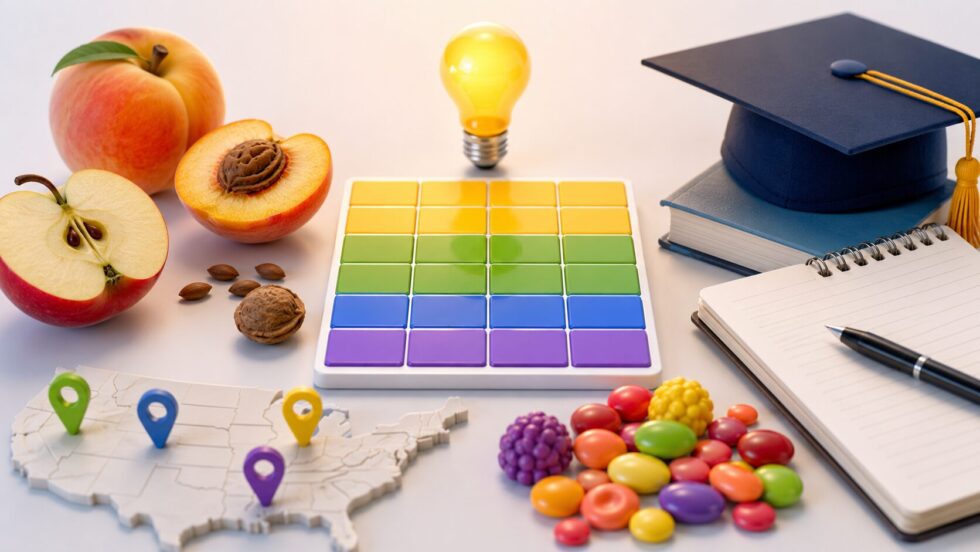
Each word becomes the singular form of a fruit-flavoured confectionery name: Dots, Nerds, Runts and Spree.
This may be the hardest category for British readers because the shared link depends on knowledge of American sweet brands rather than a conventional vocabulary relationship. The entries are presented in the singular, disguising names normally encountered in plural or branded form.
Nerds are small, brightly coloured crunchy sweets sold in several fruit flavours. Dots are gumdrop-style sweets, while Runts are hard candies traditionally shaped like pieces of fruit. Spree is another fruit-flavoured sweet brand. The singular wording is essential to the misdirection: DOT, NERD and RUNT all have common meanings unrelated to confectionery, and SPREE usually describes a period of excessive or uninhibited activity.
The group becomes easier once two branded terms are recognised. NERD and RUNT should prompt players to consider plural forms, after which DOT and SPREE can be tested against the same pattern.
Blue Connections answer: verbs in a college-life slogan
The blue group is:
- PARTY
- SLEEP
- STUDY
- REPEAT
These verbs form the familiar university-life sequence “study, sleep, party, repeat”, although the precise order may vary when the phrase is used informally.
Unlike the green set, the blue group does not depend on a technical definition. Its connection is cultural and phrase-based. Each entry describes an activity associated with the repetitive cycle of student life: attending classes or revising, resting, socialising and then beginning the routine again.
STUDY, SLEEP and PARTY provide the strongest initial cluster, but players may hesitate over REPEAT because it describes the continuation of the cycle rather than a separate college activity. That hesitation is part of the design. Connections frequently includes categories built around slogans, quotations, compound expressions or familiar sequences rather than four words that share the same grammatical or factual definition.
The group is also a potential trap because PARTY might appear to belong beside SPREE, while SLEEP could be linked loosely with DEN. Players should therefore avoid submitting a group based only on tone or association. All four words must support one exact connection.
Purple Connections answer: beginnings of US state capitals
The purple group is:
- DEN
- MAD
- PHO
- SAC
Each word forms the beginning of a US state capital:
- DEN — Denver, Colorado
- MAD — Madison, Wisconsin
- PHO — Phoenix, Arizona
- SAC — Sacramento, California
This is the puzzle’s principal wordplay category. The entries are not abbreviations normally used for the cities; they are simply their opening three letters. That distinction matters because players looking for airport codes, state abbreviations or conventional nicknames may miss the pattern.
PHO is especially effective as misdirection because it is widely recognised as the name of a Vietnamese noodle soup. SAC may suggest a bag or biological structure, DEN is an ordinary room or animal shelter, and MAD reads naturally as an adjective. None initially appears geographical.
The capital connection may emerge only after the other three groups have been removed. Once the remaining words are DEN, MAD, PHO and SAC, expanding them to Denver, Madison, Phoenix and Sacramento reveals the intended relationship.
The category has also been described as “city syllables” or “starts of US capitals” in published guides. “Starts of US capitals” is the more precise explanation because the entries are linked by their initial letters rather than necessarily by a consistent linguistic definition of a syllable.
Why today’s Connections puzzle is unusually difficult
Sunday’s puzzle has been assessed as particularly challenging because its surface vocabulary encourages several false groupings.
One published solver described the game as a five-out-of-five challenge, while another guide summarised the categories as vital parts of plants, singular confections, a campus motto and city syllables. Those descriptions reflect the same answer structure but also show why the puzzle can feel harder than an ordinary vocabulary test: two of the groups depend on cultural or orthographic knowledge rather than direct semantic similarity.
Potential traps include:
| Misleading combination | Why it appears plausible | Why it fails |
|---|---|---|
| PARTY, SPREE, MAD, RUNT | All may suggest uncontrolled behaviour | They do not share one exact definition |
| DEN, PIT, SAC, STONE | All may describe spaces or physical containers | The relationship is too loose |
| DOT, PIP, SEED, STONE | Small marks or small objects | DOT belongs to the confectionery set |
| PHO, NERD, RUNT, SPREE | Several look like food or brand names | PHO begins PHOENIX and is not in the sweet group |
| STUDY, SLEEP, REPEAT, NERD | All can be associated with academic life | NERD is part of the sweets category |
The safest solving strategy is to demand precision. Connections is not asking whether four words can be connected in some imaginative way. It is asking for the unique classification that allows every word on the board to be placed once and only once.
How to solve NYT Connections without losing four lives
Connections gives players 16 words and asks them to produce four groups of four. A submitted group must be exact. When a selection contains three correct entries and one wrong answer, the game may indicate that the player is “one away”, but the attempt still counts as a mistake. Four mistakes end the game.
A practical method is:
- Find the most specific pair first.
In this puzzle, SEED and STONE strongly suggest fruit, while STUDY and SLEEP suggest a repeated student-life phrase. - Look for hidden formats.
Ask whether the words are shortened names, brand names, prefixes, homophones or parts of expressions. - Check every member before submitting.
A loose thematic relationship is not enough. The category must explain all four words equally well. - Leave ambiguous words temporarily unassigned.
PHO, MAD, PIT and SPREE each support several possible interpretations. Removing clearer groups makes their real purpose easier to see. - Use the shuffle function.
Rearranging the grid can break visual associations created by the original placement and reveal combinations that were previously overlooked.
The New York Times publishes a new Connections puzzle daily, with the board becoming available according to the player’s local time. The objective is to complete all four groups before making four mistakes.
Connections: Sports Edition hints for July 12, 2026
The regular NYT Connections puzzle should not be confused with Connections: Sports Edition, which has a separate board and separate answers.
Sports Edition puzzle No. 657 was published for Sunday, 12 July, and was assessed at a relatively accessible two out of five for difficulty. Its four one-word hints were:
- Yellow: CUP
- Green: SQUEEZE
- Blue: TOWEL
- Purple: KOOZIE
Connections: Sports Edition answers for puzzle No. 657
| Colour | Category | Answers |
|---|---|---|
| Yellow | Award | CUP, MEDAL, PLAQUE, TROPHY |
| Green | Baseball tactics | DELAYED STEAL, HIT AND RUN, SACRIFICE, SQUEEZE |
| Blue | Used during a timeout | CHAIR, DRY ERASE BOARD, TOWEL, WATER BOTTLE |
| Purple | Homophones of Celtics greats | ALAN, BURRED, KOOZIE, PERISH |
The purple group uses sound-alike versions of surnames associated with leading figures in Boston Celtics history. The joke depends on hearing the entries rather than reading them literally, making it the most wordplay-heavy category in the sports puzzle.
Connections: Sports Edition follows the same fundamental structure as the main game: 16 entries must be divided into four groups, each containing four connected items. It is produced as a sports-focused daily puzzle and uses categories drawn from teams, athletes, tactics, equipment and sporting language.
NYT Connections answers for Sunday, July 12, at a glance
For readers who need only the completed grid, today’s answers are:
- Yellow — Reproductive part of fruit: PIP, PIT, SEED, STONE
- Green — Bit of fruit-flavoured candy: DOT, NERD, RUNT, SPREE
- Blue — Verbs in a college-life slogan: PARTY, SLEEP, STUDY, REPEAT
- Purple — Starts of US capitals: DEN, MAD, PHO, SAC
The green and purple categories provide the decisive challenge. The first requires players to convert ordinary singular nouns into American sweet names, while the second requires each three-letter word to be expanded into a state capital. Once those mechanisms are recognised, the apparently disconnected board resolves into four exact groups.
Materials used: The New York Times Games, The Athletic, TechRadar, Yahoo, Parade, NME, Forbes.
Read about the life of Westminster and Pimlico district, London and the world. 24/7 news with fresh and useful updates on culture, business, technology and city life: Why did Donald Trump reverse course at the NATO summit after attacking allies, Spain and Iran