
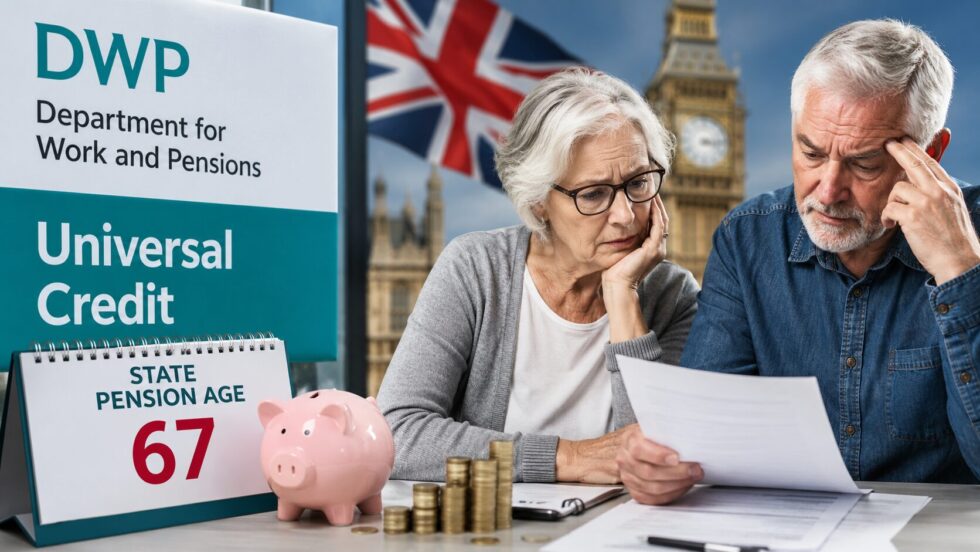
12 July 2026 — 66-year-olds Universal Credit payments could be increased for people forced to wait longer for their State Pension, after MPs warned that the phased rise in pension age from 66 to 67 risks leaving older claimants in poverty. The House of Commons Work and Pensions Committee wants ministers to introduce a temporary higher Universal Credit rate during the final year before State Pension age, when a single claimant may currently have to survive on a standard allowance of £424.90 a month despite deteriorating health, limited job prospects and the loss of immediate access to Pension Credit, The WP Times reports.
The proposal is not yet government policy and no higher payment has been approved. It is a formal recommendation made as the State Pension age rises gradually between April 2026 and April 2028. People born between 6 April 1960 and 5 March 1961 must now wait between one and 11 months beyond their 66th birthday, depending on their date of birth, while those born from 6 March 1961 generally reach State Pension age at 67. MPs say the delay will be hardest for people who cannot continue working because of poor health, caring responsibilities, redundancy or decades spent in physically demanding jobs.
Why MPs want more Universal Credit for 66-year-olds
The Work and Pensions Committee says the benefits system does not adequately recognise the circumstances of people in the final year before State Pension age.
At 66, many claimants are still legally treated as working-age adults even when their chances of returning to employment are substantially lower than those of younger workers. They may be expected to rely on Universal Credit until reaching their individual pension date, while Pension Credit remains unavailable. MPs want the Government to consult on a higher Universal Credit rate for all eligible claimants during that final year. Their preferred short-term approach is to use the existing Universal Credit system because payments could be delivered through an established benefit rather than requiring ministers to design a separate scheme. The committee has not recommended a precise increase. It has instead asked ministers to determine how much additional support is needed and how it should interact with earnings, disability elements, housing costs and other benefits.
The central argument is that the State Pension age rise does not affect every 66-year-old equally. People with substantial occupational pensions or savings may be able to bridge the gap. Those with low lifetime earnings, poor health or no private pension may have no comparable protection. The committee warned that some people will spend the additional months using savings intended for retirement, borrowing money or cutting essential spending while they wait for their State Pension to begin.
What MPs are proposing
The recommendation would not give every 66-year-old an automatic payment. Universal Credit is means-tested, so entitlement would continue to depend on household income, savings, a partner’s earnings and other financial circumstances. The proposed change would instead increase the amount available to people who already qualify for Universal Credit and are within a year of State Pension age. Ministers could choose to:
- raise the standard Universal Credit allowance for eligible pre-pensioners;
- create a separate age-related Universal Credit element;
- introduce a bridging payment between working age and pension age;
- target additional support at people unable to work;
- or expand existing health and disability-related payments.
The committee supports a broad increase for eligible claimants because it believes this would reduce poverty more effectively than a narrowly targeted scheme requiring additional medical or employment assessments.
How much Universal Credit can a 66-year-old receive in 2026?
From April 2026, the monthly Universal Credit standard allowance is £424.90 for a single claimant aged 25 or over. For a couple where one or both partners are aged 25 or over, the joint monthly standard allowance is £666.97. These figures are the basic starting rates. A claimant may receive additional amounts for eligible rent, children, caring responsibilities or limited capability for work. The final award can also be reduced by earnings, pension income, savings, benefit deductions or sanctions.
| Universal Credit standard allowance | Monthly rate from April 2026 |
|---|---|
| Single claimant under 25 | £338.58 |
| Single claimant aged 25 or over | £424.90 |
| Couple, both under 25 | £528.34 |
| Couple, one or both aged 25 or over | £666.97 |
A single 66-year-old receiving only the standard allowance would have £5,098.80 across 12 months before deductions. That is not necessarily the claimant’s total support. Housing costs or disability-related elements can increase the award, while earnings and other income can reduce it. Nevertheless, MPs argue that the basic rate is too low for people who have little realistic prospect of returning to sustained employment before reaching pension age.
The contrast with Pension Credit is one of the committee’s main concerns. In 2026-27, Pension Credit can bring a qualifying single pensioner’s weekly income up to £238, equivalent to about £1,031 a month on average. The standard minimum guarantee for a qualifying couple is £363.25 a week.
When does the State Pension age rise from 66 to 67
The State Pension age is not changing for everyone on a single date. The increase began in April 2026 and will be completed by April 2028. During that period, the exact pension date depends on a person’s date of birth. People born between 6 April 1960 and 5 March 1961 reach State Pension age at 66 plus a specified number of months. People born between 6 March 1961 and 5 April 1977 generally reach State Pension age at 67 under the current timetable.
| Date of birth | State Pension age |
|---|---|
| 6 April to 5 May 1960 | 66 years and 1 month |
| 6 May to 5 June 1960 | 66 years and 2 months |
| 6 June to 5 July 1960 | 66 years and 3 months |
| 6 July to 5 August 1960 | 66 years and 4 months |
| 6 August to 5 September 1960 | 66 years and 5 months |
| 6 September to 5 October 1960 | 66 years and 6 months |
| 6 October to 5 November 1960 | 66 years and 7 months |
| 6 November to 5 December 1960 | 66 years and 8 months |
| 6 December 1960 to 5 January 1961 | 66 years and 9 months |
| 6 January to 5 February 1961 | 66 years and 10 months |
| 6 February to 5 March 1961 | 66 years and 11 months |
| 6 March 1961 to 5 April 1977 | 67 |
A person born on 20 July 1960, for example, would not reach State Pension age on their 66th birthday. They would normally have to wait until they were 66 years and four months old.
Someone born on 20 February 1961 would wait until 66 years and 11 months. A person born on or after 6 March 1961 would generally wait until 67. The Government’s State Pension age calculator also shows when an individual becomes eligible for Pension Credit and, in England, age-linked free bus travel.
Who could be hit hardest by the longer pension wait
The financial effect is expected to be greatest among people who cannot simply extend their careers by another year. Older employees in office-based or professional jobs may be able to reduce their hours, work remotely or remain employed until 67. They may also have workplace pensions, investments or savings available before the State Pension begins.
That flexibility is less common in physically demanding sectors. A construction worker, cleaner, warehouse employee, driver, factory worker or care worker may reach 66 with health problems caused or aggravated by decades of manual work. The groups most exposed include:
- people with long-term health conditions;
- workers leaving manual or physically demanding occupations;
- unpaid carers;
- people made redundant in their mid-60s;
- older jobseekers facing age discrimination;
- renters with high housing costs;
- people with little or no occupational pension;
- and claimants living in areas with fewer suitable vacancies.
The committee says later working can benefit health when it is voluntary and supported by suitable employment. Continuing because a person cannot afford to stop is different, particularly where the work is physically demanding or health is already declining.
A delayed State Pension therefore creates more than an administrative gap. For some people, it means choosing between work they are no longer physically able to perform and months of living on a lower working-age benefit.
Why the State Pension age rise could increase poverty
The committee says evidence from the previous pension-age increase shows that financial harm is not theoretical. When the State Pension age previously moved from 65 to 66, absolute poverty among 65-year-olds more than doubled, according to evidence cited by MPs. The increase to 67 may reproduce that effect among people aged 66, particularly those who leave work before reaching their new pension date. A person who cannot work may face several simultaneous losses:
- no salary;
- no State Pension;
- no Pension Credit;
- delayed eligibility for some age-linked concessions;
- pressure to draw private pension savings early;
- and possible reliance on Universal Credit.
Drawing down retirement savings during this gap can also reduce the money available later in retirement. A temporary income problem can therefore have consequences extending well beyond the additional months before State Pension age. The committee has also highlighted inequalities in healthy life expectancy. People living in deprived areas are more likely to experience poor health earlier while having fewer employment opportunities and lower private pension wealth. They may wait just as long for the State Pension as people in wealthier areas but receive it for fewer years because average life expectancy and healthy life expectancy are lower.
Why getting another job at 66 may not solve the problem
The Universal Credit system is based partly on the expectation that working-age claimants should seek work where they are able to do so. MPs accept that a higher allowance could raise questions about whether financial support discourages employment. They argue, however, that this concern is limited for claimants within months of State Pension age.
Universal Credit remains far below normal employment income. An increase would be unlikely to persuade somebody in secure, suitable work to leave their job. The more significant problem is that many older claimants are already outside the labour market for reasons that a benefits condition cannot reverse. They may have:
- health restrictions;
- caring responsibilities;
- limited digital skills;
- no recent recruitment experience;
- a need for reduced or flexible hours;
- or a work history concentrated in jobs they can no longer perform.
Employers may also be reluctant to recruit and train applicants who are close to retirement, particularly where workplace adjustments are needed. Work and Pensions Committee chair Debbie Abrahams said people approaching pension age should not be forced to choose between continuing to work in poor health and remaining in poverty until their State Pension starts. She said older claimants face greater barriers because of ill-health, age discrimination and limited opportunities to retrain.
Which benefits can 66-year-olds claim before State Pension age?
People below their individual State Pension age may be able to claim several forms of support, depending on their circumstances.
Universal Credit
Universal Credit supports people on a low income or out of work. It can include payments for living costs, rent, children, caring duties and limited capability for work.
Eligibility depends on household circumstances. A partner’s earnings, savings or pension income can reduce or eliminate an award.
Personal Independence Payment
Personal Independence Payment can help people with the additional costs of a long-term health condition or disability.
PIP is not means-tested. Eligibility is based on the effect of a condition on daily living and mobility rather than on income or the diagnosis alone.
New Style Employment and Support Allowance
New Style Employment and Support Allowance may be available to people whose health limits their ability to work and who have paid sufficient National Insurance contributions.
It can sometimes be claimed alongside Universal Credit, although the ESA payment is usually taken into account when calculating Universal Credit.
Carer support
A person providing regular care may qualify for Carer’s Allowance or the carer element of Universal Credit, subject to the relevant conditions.
Council Tax Reduction and housing support
Low-income households may qualify for Council Tax Reduction through their local authority. Universal Credit may also include help with eligible rent, although it does not necessarily cover the full amount charged by a landlord.
Pension Credit
Pension Credit cannot normally be claimed until a person reaches the relevant qualifying age. This is central to the current dispute. A 66-year-old may have stopped working and have the same basic living needs as a pensioner but remain excluded from pensioner-level means-tested support for several more months.
Does the pension-age change also delay a free bus pass?
In England, eligibility for the national older person’s bus pass is linked to State Pension age.
This means people affected by the phased rise to 67 may also have to wait longer for free bus travel. They do not automatically qualify when they turn 66 if their individual State Pension age falls later.
The rules differ across the UK.
| Area | General qualifying rule |
|---|---|
| England outside London | State Pension age |
| London | Local travel from 60 under separate London rules |
| Wales | From age 60 |
| Scotland | From age 60 |
| Northern Ireland | From age 60 under separate rules |
The bus-pass change is not a separate DWP reduction. It follows because the English eligibility age is connected to State Pension age.
Has the DWP approved the Universal Credit increase
No additional Universal Credit rate for 66-year-olds has been confirmed. The Work and Pensions Committee has made a recommendation. The Department for Work and Pensions must now respond and decide whether to consult on the proposal, introduce another form of support or reject the change. The DWP said it welcomed the inquiry and would consider the committee’s report and recommendations. It also said that, as of February 2026, people aged 65 or 66 represented only 0.02% of the Universal Credit caseload.
That proportion could rise as more people pass their 66th birthday without immediately reaching State Pension age. Before introducing a higher payment, ministers would need to decide:
- the amount of the increase;
- which claimants would qualify;
- whether payment would be automatic;
- whether working claimants would be included;
- how savings and household income would be treated;
- how the payment would interact with disability benefits;
- and when the new rate would begin.
There is therefore no application process for a special 66-year-old Universal Credit increase at present.
What should people approaching 66 check now
People approaching 66 should first confirm their exact State Pension age rather than assuming their pension will begin on their birthday. They should also check:
- their State Pension forecast;
- their National Insurance record;
- the date on which they can claim Pension Credit;
- workplace and private pension options;
- possible Universal Credit eligibility;
- entitlement to disability or carer support;
- and their free bus pass qualifying date.
The State Pension is not normally paid simply because a person reaches the relevant age. The Pension Service usually contacts people before their qualifying date, but a claim still needs to be made.
Anyone considering drawing a private pension early should examine the long-term effect on retirement income. Taking money sooner may help bridge the gap but can leave less available later and may affect means-tested benefits.
What happens next for 66-year-olds on Universal Credit
The Government is expected to issue a formal response to the committee’s report. It could introduce a temporary Universal Credit increase before the State Pension age reaches 67 for all affected groups in April 2028. It could also propose a narrower payment for people with health conditions or no realistic prospect of work.
The committee’s recommendation is deliberately focused on the immediate transition. MPs argue that waiting for a wider review of pension policy would leave the first affected birth cohorts without additional protection.
The core policy question is now clear: whether somebody aged 66 and unable to work should remain on the same basic Universal Credit rate as a much younger claimant while being denied access to the State Pension and Pension Credit. Without additional support, the pension-age rise will save public pension expenditure partly by extending the period in which some older people depend on lower working-age benefits. Ministers must decide whether the existing system provides an adequate bridge to retirement or whether the rise to 67 requires a distinct level of protection for people who have reached the end of their working lives but not yet reached their official pension date.
Materials used: House of Commons Work and Pensions Committee, Department for Work and Pensions, GOV.UK benefit rates, GOV.UK State Pension age timetable, Department for Transport and House of Commons Library.
Read about the life of Westminster and Pimlico district, London and the world. 24/7 news with fresh and useful updates on culture, business, technology and city life: The Hidden Labour Market Keeping London's Grandest