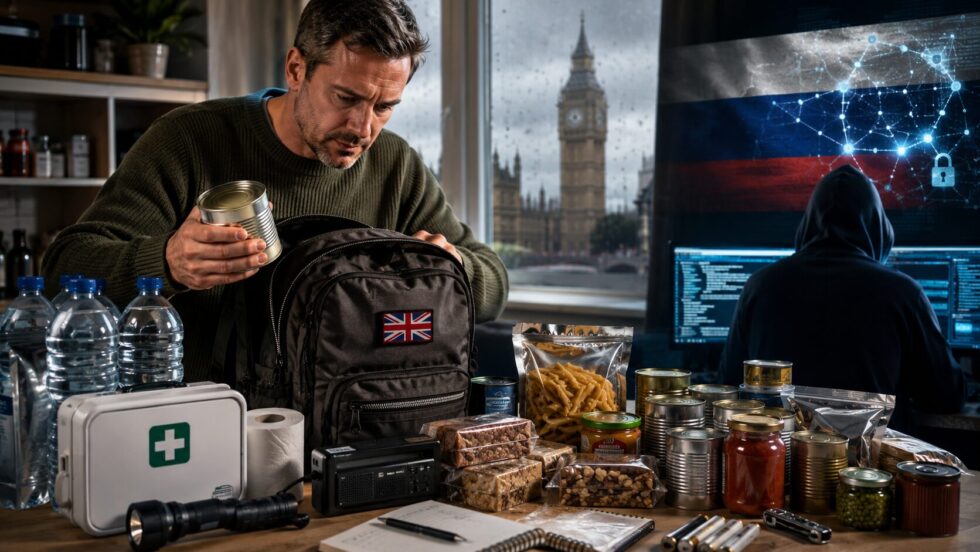
Stockpile food preparations are moving closer to the centre of Britain’s national resilience policy after the Government announced a new public campaign covering cyber-attacks, extreme weather and prolonged disruption to essential services. The initiative, due to launch later in 2026, will advise households on practical measures for emergencies that could interrupt electricity, drinking water, mobile communications or access to local shops. However, ministers have not announced that a Russian cyber-attack is imminent, nor have they yet published a compulsory shopping list or a fixed national stockpiling requirement, The WP Times reports.
The announcement was made on 14 July as the Cabinet Office published an updated National Risk Register containing seven additional risks. These include cyber-attacks on water systems, data infrastructure and police systems, as well as a broader “digital resilience failure” scenario based partly on lessons from the worldwide CrowdStrike outage of July 2024. The Government says the register is a planning document rather than a forecast: it identifies events for which authorities should prepare, not events that ministers believe will necessarily happen.
Why is the UK discussing stockpile food guidance now
The immediate policy announcement concerns a national resilience campaign intended to help the public prepare for several types of disruption. Cyber-attacks are one part of that programme, alongside floods, heat, storms, power cuts, water outages, infrastructure failures and other national emergencies. Darren Jones, the Chief Secretary to the Prime Minister, told Parliament that Britain must continue assessing risks as climate conditions, artificial intelligence and hostile-state capabilities develop. He said cyber incidents could affect access to “power, water, or phone signal” and argued that households taking limited preparatory action could allow emergency services to concentrate on people who need the greatest assistance.
The Government’s official statement does not say that every household must immediately buy large quantities of food. It says the forthcoming campaign will encourage “simple” and “small but important” measures, building on the existing Prepare website.
That distinction matters. The phrase stockpile food in case of Russian cyber attack has appeared prominently in newspaper coverage, but the official announcement is broader. It connects public preparedness with cyber-attacks generally, severe weather and other emergencies. Russia is identified separately by the Armed Forces Minister as a direct security threat to the UK, while recent official warnings have described Russian intelligence-linked cyber activity against critical infrastructure.
Is the warning specifically about Russia
Russia forms an important part of the security context, but the household resilience campaign is not limited to a single country or attack scenario. Louise Sandher-Jones, the Armed Forces Minister, said Russia was “not only a threat to NATO’s eastern flank” but a direct threat to the British homeland. Her comments accompanied plans for a major home-defence exercise and the revision of classified government crisis documents.
One day before the resilience announcement, the National Cyber Security Centre joined agencies from 12 countries in warning critical sectors about activity attributed to Centre 16 of Russia’s Federal Security Service. The NCSC said the group had been exploiting weakly protected routers and network equipment while targeting communications, energy, defence, financial services, healthcare and government networks internationally.
The NCSC also said Britain and its partners had attributed an attempted December 2025 attack on Poland’s energy grid to the Russian group. According to the agency, a successful operation could have disrupted electricity for approximately 500,000 civilians.
These warnings explain why Russia is prominent in the political discussion. They do not establish that a specific Russian operation against British food shops, water systems or the electricity network is under way.
What should households include in a UK emergency food stockpile
Britain already has official household preparedness guidance, and the new campaign will expand upon it. The existing Prepare service advises people to consider supplies for an emergency lasting several days, particularly where power or water is unavailable, residents are told to remain indoors, or evacuation becomes necessary. The guidance does not impose one universal quantity because households differ in size, age, health, dietary requirements and access to storage. Instead, people are advised to build a practical emergency kit gradually rather than panic-buying everything at once.
| Emergency item | Existing UK guidance | Why it could matter |
|---|---|---|
| Drinking water | Keep bottled water appropriate to the household’s needs | A cyber incident or infrastructure failure could affect pumping, treatment or distribution |
| Ready-to-eat food | Choose non-perishable products requiring little or no cooking | Electricity or gas may be unavailable and shops may temporarily close |
| Essential medication | Maintain enough required medicine for several days | Pharmacies, transport or digital prescription systems could be disrupted |
| Torch | Use a battery-powered or wind-up torch | Safer and more useful than candles during a power cut |
| Portable power bank | Keep it charged for mobile devices | Phone charging may be difficult during an electricity outage |
| Radio | Battery-powered or wind-up models can receive official updates | Mobile networks and internet services may be unreliable |
| First-aid supplies | Keep dressings, plasters, antiseptic and basic equipment | Minor injuries may need to be managed while services are under pressure |
| Hygiene products | Hand sanitiser and wet wipes are recommended | Running water may be restricted |
| Paper information | Record important numbers, medicines and insurance details | Cloud services, mobile phones or online accounts may be unavailable |
| Pet and baby supplies | Include food, formula, nappies and necessary medication | Emergency planning should cover every dependent household member |
Official guidance recommends a minimum of approximately 2.5 to 3 litres of drinking water per person per day for survival, citing World Health Organization guidance. It notes that up to 10 litres per person per day provides greater capacity for cooking and basic hygiene. More may be needed for babies, medical devices and pets.
The Government has not said that every household will be instructed to store exactly 72 hours of supplies. Several European countries and the European Union have used a three-day benchmark, but the present UK guidance refers more generally to emergencies lasting “a few days”. The final content of the new campaign may provide further detail when it is launched.
Which foods are most useful during a power cut
The most practical products are those that remain safe without refrigeration and can be eaten without an oven, hob or microwave. Suitable choices can include tinned vegetables, fruit, beans, fish or meat; long-life milk; crackers; cereal bars; nut butter; dried fruit; nuts; and other foods compatible with the household’s dietary and medical needs. A manual tin opener is essential when canned products are included. Households should also avoid buying unfamiliar food that nobody normally eats. A rotating supply is more economical: products can be consumed before their use-by or best-before dates and replaced during ordinary shopping.
Food safety becomes particularly important when refrigeration stops. Fridges and freezers should be kept closed as much as possible, and food that may no longer be safe should not be eaten merely to avoid waste. The purpose of an emergency reserve is to provide an alternative, not to encourage risky consumption.
Should people panic-buy food and bottled water
No. Existing government guidance expressly suggests building supplies over time rather than purchasing an entire emergency kit at once. Panic-buying can empty local shelves, place pressure on household budgets and make essential products harder to obtain for elderly, disabled or medically vulnerable people. A measured approach might involve adding one or two suitable items during normal weekly shopping, checking expiry dates periodically and storing supplies somewhere accessible during darkness.
The objective is household continuity for a limited period, not indefinite self-sufficiency.
How could a cyber-attack interrupt food, water and power
A major cyber incident does not have to destroy physical infrastructure to cause widespread disruption. Modern utility systems, payment services, warehouses, logistics networks and communications platforms depend on interconnected digital systems. An attack could prevent staff from accessing operational controls, disrupt billing or customer databases, disable communication between sites, lock organisations out of essential software, or force operators to shut systems down while an intrusion is investigated. In the water sector, the risks could involve treatment, monitoring, pumping or distribution systems. In energy, disruption could affect control networks, service management or communications. Food availability could be affected indirectly if card payments fail, warehouses cannot process orders, delivery routes are interrupted or shops are unable to operate electronic tills.
The Government’s Cyber Security and Resilience policy material has previously warned that the most serious attacks can contribute to unsafe water, unavailable electricity, inaccessible medical records and businesses being unable to use their systems.
This does not mean a single attack would necessarily disable every service simultaneously. National resilience planning considers cascading risks because difficulties in one sector may create problems elsewhere. A power outage can affect mobile networks; a communications failure can delay deliveries; and payment disruption can prevent customers from buying available goods.
What is “digital resilience failure”
Digital resilience failure is one of the new scenarios added to the National Risk Register. It covers major disruption arising from dependence on widely used digital technology, even when the cause is not a hostile cyber-attack.
The Government points to the July 2024 CrowdStrike incident as an example. A defective software update affected millions of Windows devices around the world, disrupting airlines, healthcare, broadcasters and businesses. The event demonstrated that a technical failure at one widely used provider could produce consequences across multiple countries and industries.
Including this category alongside cyber-attacks recognises that households can experience similar practical consequences whether disruption is caused by hostile activity, human error, software failure or an infrastructure accident.
What new risks have been added to the National Risk Register
The July 2026 update added seven risks, including interference in Britain’s democratic processes and cyber-attacks affecting data infrastructure, water infrastructure and police systems. It also added digital resilience failure, reflecting the potential for a large-scale technological outage. The complete register now contains 95 assessed risks, according to the Government’s accompanying reporting.
At the same time, disruption to Russian gas supplies was removed as a standalone risk. The Cabinet Office said this reflected Britain’s reduced reliance on Russian gas rather than any broader reduction in tensions with Moscow. The National Risk Register is the public version of the classified National Security Risk Assessment. It is used by government departments, local responders, infrastructure operators and other organisations to inform emergency planning.
| Updated risk area | Potential public consequence |
|---|---|
| Cyber-attack on water infrastructure | Loss or restriction of drinking-water services |
| Cyber-attack on data infrastructure | Failure of digital services used across sectors |
| Cyber-attack on police systems | Reduced access to operational information and communications |
| Digital resilience failure | Widespread disruption caused by technology breakdown |
| Democratic interference | Attempts to influence or undermine political processes |
| Severe weather and climate-related disruption | Flooding, heat, transport failure and pressure on utilities |
| Hybrid hostile activity | Combined cyber, information, sabotage or other coercive operations |
The presence of a risk in the register does not reveal intelligence about an impending incident. The Government describes the document as a preparedness tool and explicitly says it should not be read as a prediction.
What is Operation Albiston Shadow
Operation ALBISTON SHADOW will be a multi-day national home-defence exercise held in 2027. Ministers and hundreds of officials from government and the public sector are expected to participate. The detailed scenario will remain classified, but the exercise is designed to test Britain’s response to hybrid attacks. Such operations can combine cyber activity, sabotage, disinformation, interference, economic pressure and conventional military threats.
The drill will complement NATO’s CMX27 crisis-management exercise and is intended to test whether Britain can coordinate effectively with allies and across domestic institutions. The Cabinet Office describes it as the largest UK home-defence exercise in decades.
It will test government decision-making rather than stage a public military mobilisation. The exercise is separate from the household preparedness campaign, although both form part of the same effort to improve national resilience.
Why are Britain’s “war books” being rewritten
The Government is also updating classified crisis plans commonly known as the “War Books”. These documents set out how departments should continue operating and coordinate their response during severe threats to the country. The plans were last comprehensively updated in 2004. Since then, dependence on cloud services, mobile communications, digital payments, satellite systems and complex international supply chains has increased significantly. Cyber operations and online information manipulation have also become more prominent elements of hostile-state activity.
Updating the documents is therefore intended to reflect the structure of a modern crisis rather than simply reproduce Cold War civil-defence arrangements.
What should people do before the new campaign launches
Households do not need to wait for the later campaign to take sensible, low-cost measures. Current official advice already recommends preparing for power cuts, water outages, flooding and other temporary disruption.
Practical household checklist
- Store a modest rotating supply of drinking water and food that does not require cooking.
- Keep essential prescription medicines available and order repeat prescriptions responsibly.
- Charge one or more power banks and test them regularly.
- Obtain a battery-powered or wind-up torch and radio.
- Write emergency contacts, medical information and utility numbers on paper.
- Know how to turn off water, gas and electricity safely.
- Register for utility Priority Services where a household member qualifies.
- Discuss emergency arrangements with children and vulnerable relatives.
- Check official flood, weather and local emergency alerts.
- Keep baby, disability-related and pet supplies in the household plan.
People should also understand that online rumours may circulate during a cyber incident. Information should be checked against the Government, emergency services, local authorities, utility providers and established broadcasters. Unexpected messages requesting passwords, payments or software installation should be treated with suspicion, particularly during periods of public anxiety.
Has the Government ordered Britons to prepare for war
No formal order to prepare for war has been issued.
The Government is strengthening planning for a broad range of emergencies while explicitly acknowledging that Russia presents a direct threat to UK security. Ministers are preparing exercises for severe hybrid scenarios, but the public campaign is framed around general resilience rather than an announcement that conflict is expected. The most accurate interpretation is that Britain wants households, public bodies and infrastructure operators to be less vulnerable if services are temporarily interrupted—whether by hostile cyber activity, severe weather, technological failure or another emergency.
For families, that means maintaining enough basic food, water, medicine, light and communication equipment to cope for several days. For the state, it means testing crisis structures, updating classified plans and strengthening the organisations responsible for electricity, water, communications, policing and other essential services. The policy is preventive. Its central message is not that a Russian cyber-attack is certain, but that modest preparation before any crisis can reduce disruption if one occurs.
Read about the life of Westminster and Pimlico district, London and the world. 24/7 news with fresh and useful updates on culture, business, technology and city life: When will England get a bank holiday if they win the World Cup, and will Friday 24 July be confirmed
Materials used: UK Cabinet Office, GOV.UK Prepare, National Cyber Security Centre, The Guardian, National Risk Register reporting.