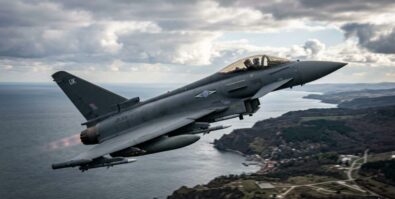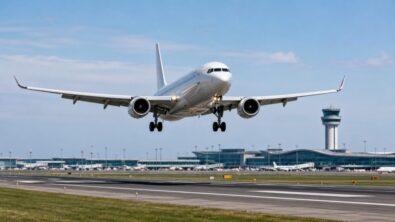
RAF Typhoon Qatar Airways intercept: Two Royal Air Force fighter jets were scrambled from RAF Coningsby on Friday, 24 July 2026, after UK authorities received a reported threat concerning Qatar Airways flight QR23 from Doha to Manchester. The Eurofighter Typhoons intercepted the passenger aircraft over central England and accompanied it for part of its approach before the flight landed safely at Manchester Airport at about 19:45 BST. Police later said there had been no danger to the passengers or crew and identified a 14-year-old boy from the Bolton area, who was not on board, in connection with what officers described as a hoax threat, The WP Times reports.
The incident initially appeared to be an unexplained RAF Quick Reaction Alert after the Ministry of Defence said only that the airliner had been “causing concern to civil authorities”. Early aviation reports suggested controllers might temporarily have lost radio contact with the aircraft, but the subsequent police account provided a more specific explanation: National Air Traffic Services alerted officers at about 18:00 after a threat was made against the Manchester-bound flight. The RAF, airport authorities and civilian security agencies responded under precautionary procedures, while Qatar Airways said normal operations continued on board and the aircraft was at no point in danger.
What Happened During the RAF Typhoon Qatar Airways Intercept
Qatar Airways flight QR23 was nearing the end of its journey from Hamad International Airport in Doha when the security notification reached British authorities. The flight operates directly to Manchester Airport, where it was scheduled to arrive at Terminal 2 at approximately 19:45 BST.
The alert was escalated through the United Kingdom’s air-security system and a Quick Reaction Alert, commonly known as a QRA, was ordered. Two RAF Typhoon jets were launched from RAF Coningsby in Lincolnshire, one of the principal bases responsible for protecting UK airspace.
Open-source flight tracking cited by aviation publications placed the interception near Nottingham, after the Qatar Airways aircraft had entered central England. The Typhoons then remained close to the passenger jet as it continued north-west towards Manchester. Tracking reports identified the military aircraft by the call signs RIGID 11 and RIGID 12, although the Ministry of Defence did not publish those operational details in its initial statement.
The Qatar Airways aircraft continued to its intended destination rather than diverting to another airport. It landed safely at Manchester shortly before 20:00, close to its scheduled arrival time. Passengers and crew disembarked without incident, and police said there was ultimately no threat to anyone on board.
Confirmed Timeline of the Qatar Airways QR23 Incident
| Time and stage | Confirmed development |
|---|---|
| Friday afternoon, 24 July | Flight QR23 travelled from Doha to Manchester on its scheduled route |
| About 18:00 BST | National Air Traffic Services reported a threat concerning the aircraft to police |
| Early evening | The RAF activated a Quick Reaction Alert from RAF Coningsby |
| Over central England | Two Eurofighter Typhoons intercepted the passenger aircraft near Nottingham |
| Approximately 19:45 BST | QR23 landed safely at Manchester Airport |
| After landing | Passengers and crew disembarked normally, with police confirming that no genuine threat existed |
| Saturday, 25 July | Police said a 14-year-old boy from Bolton, who had not been aboard the flight, was assisting the investigation |
Why Were RAF Typhoons Launched After the Qatar Airways Threat?
The RAF does not need to establish that a threat is genuine before launching fighter aircraft. A QRA exists precisely because potentially serious incidents must be investigated rapidly while an airliner remains in flight.
The Ministry of Defence’s first public explanation was deliberately limited. An RAF spokesperson confirmed that a Quick Reaction Alert had been launched for a Qatar Airways flight “causing concern to civil authorities”, adding that the incident had been resolved and the airliner had landed safely.
That wording did not identify whether the concern involved communications, an onboard emergency, suspicious behaviour or an external security report. The lack of detail led several aviation outlets to suggest that flight QR23 had stopped responding to air traffic control. Such an event can trigger an interception because controllers must determine whether the silence is caused by a radio fault, an incorrect frequency, crew workload or a more serious security problem.
However, the later police statement materially changed the picture. Officers said the response began after National Air Traffic Services reported that a threat had been made against the Qatar Airways aircraft. A boy aged 14 from the Bolton area was subsequently identified and was assisting investigators. Police stressed that he had not been travelling on the plane.
The evidence publicly available therefore supports a security-warning response rather than a confirmed onboard communications failure. It remains possible that air traffic control experienced operational difficulties while the alert was being handled, but no official source has established a radio failure as the cause of the RAF deployment.
What Did Qatar Airways Say About Flight QR23
Qatar Airways confirmed that the aircraft had received a military escort after UK authorities issued a security notification.
The airline described the escort as a precautionary measure carried out in accordance with standard procedures. It said the aircraft was not in danger, normal cabin operations continued throughout the incident and everyone on board left the flight safely after landing. The carrier also thanked passengers for their understanding and said the safety and security of customers and crew remained its highest priority. That statement is significant because it indicates that the crew did not need to conduct an emergency descent, divert to a military-controlled airfield or prepare passengers for an abnormal landing. The flight remained on course for Manchester and completed its journey at the airport and terminal for which it had originally been scheduled.
There were also no reports of the airport being closed for a prolonged period. That distinguishes the 2026 event from the more disruptive interception of another Qatar Airways QR23 service in August 2014, when a threat made on board prompted an RAF escort, an arrest after landing and a temporary suspension of Manchester Airport operations.
What Is an RAF Quick Reaction Alert
Quick Reaction Alert is the RAF’s permanent system for responding to unidentified, unresponsive or potentially threatening aircraft approaching or operating within British-controlled airspace. Typhoon crews, engineers and ground personnel remain available around the clock. When military commanders receive an alert from civilian air traffic authorities or the national air-defence network, pilots can be ordered to launch within minutes.
In mainland Britain, RAF Coningsby in Lincolnshire and RAF Lossiemouth in Scotland carry the principal QRA responsibility. Their locations allow fighter aircraft to respond to incidents affecting the southern and northern parts of UK airspace. A QRA launch does not itself mean that an aircraft has been hijacked or that a terrorist attack is under way. Typhoons may be scrambled because:
- an aircraft cannot be identified;
- pilots fail to respond to air traffic control;
- a plane deviates unexpectedly from its cleared route;
- authorities receive information about a possible threat;
- a foreign military aircraft approaches monitored UK airspace;
- civilian agencies request visual identification or assistance.
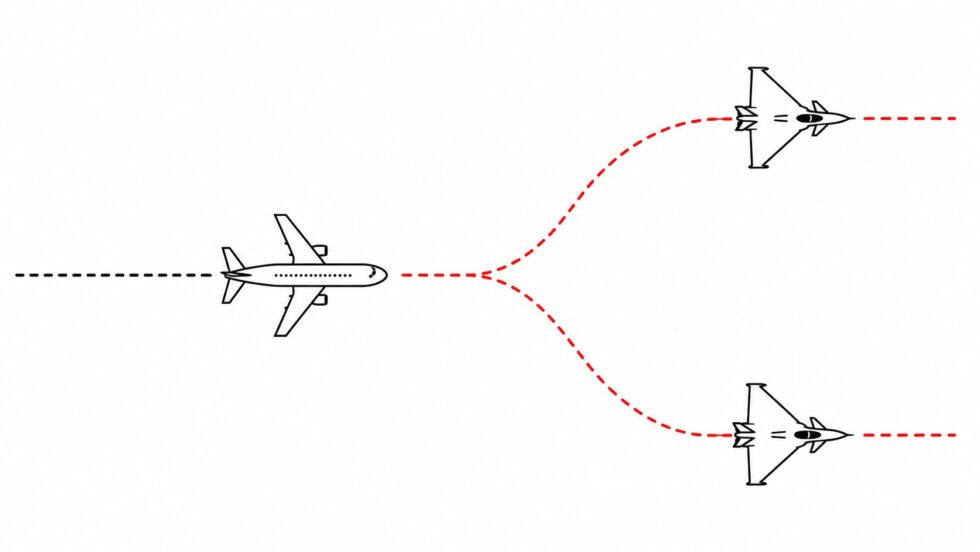
The pilots can approach the aircraft, identify it visually, inspect its exterior and attempt to communicate using internationally recognised radio frequencies, lights or hand signals. They may then escort it towards an airport, accompany it through controlled airspace or return to base once the concern has been resolved.
How Do Eurofighter Typhoon Jets Intercept a Passenger Aircraft
The Eurofighter Typhoon is considerably faster and more manoeuvrable than a commercial airliner. RAF Typhoon FGR4 aircraft can reach supersonic speeds, allowing them to close rapidly on an aircraft requiring investigation.
During a civilian interception, the fighters generally approach in a controlled manner rather than appearing suddenly directly in front of the airliner. One aircraft may position itself where the passenger jet’s pilots can see it, while the second maintains cover or observes the aircraft from another position. The fighter crew can check whether the airliner appears physically damaged, whether its cockpit is occupied and whether it is following the expected route. The pilots may also relay information to ground controllers and command authorities.
The Typhoons involved in the Qatar Airways response were not reported to have caused a sonic boom. This suggests that either supersonic flight was unnecessary or that any acceleration took place away from populated areas. Open-source tracking indicated that the jets used a transponder code associated with NATO air-policing operations. Military aircraft are sometimes visible to passengers during such operations, but the presence of a fighter beside an airliner does not necessarily mean the flight is in immediate danger. Its principal role is to give authorities direct visual contact and ensure that a potentially serious situation remains under control.
What Have Police Said About the Alleged Hoax Threat
Police said the initial notification came from National Air Traffic Services at approximately 18:00 on Friday. The report concerned a threat against the Qatar Airways aircraft as it travelled towards Manchester.
A 14-year-old boy from the Bolton area was later identified. Officers said the boy had not been on board the aircraft and was assisting with their enquiries. No arrest or charge had been publicly announced at the time of reporting.
Chief Inspector Gary Homa, from the policing operation at Manchester Airport, said reports of this type were treated extremely seriously because public safety remained the priority. Police also warned that hoax threats can divert emergency personnel, disrupt transport operations and create unnecessary fear among passengers, crew members and the wider public. Officers said they would investigate such incidents thoroughly and take action where criminal offences had been committed.
The identification of a person outside the aircraft is an important element of the investigation. It indicates that the alert was not necessarily generated by anyone travelling on QR23 and helps explain why normal operations could continue inside the cabin while authorities assessed the report from the ground.
Was Qatar Airways Flight QR23 Ever in Danger
Based on the statements released by the airline and police, there is no evidence that the aircraft, passengers or crew were in actual danger.
The plane remained airborne under normal control, continued towards Manchester and landed safely. Qatar Airways said normal operations continued on board, while police said no threat was found to passengers or crew. The RAF response should therefore be understood as a precaution taken while the credibility of the reported threat remained unknown. Security agencies cannot assume that a warning is false before it has been investigated. The purpose of launching the Typhoons was to maintain immediate oversight of the aircraft and provide authorities with options if the situation deteriorated.
That distinction matters. A military interception is evidence that officials considered the report serious enough to require a rapid response; it is not evidence that the aircraft had been seized, damaged or placed in immediate peril.
Has Qatar Airways Flight QR23 Been Intercepted Before
The same flight number was involved in a separate security incident on 5 August 2014.
On that occasion, Qatar Airways flight QR23 was operated by an Airbus A330 travelling from Doha to Manchester with 269 passengers and 13 crew members. RAF Typhoons escorted the aircraft after its pilot reported information about a possible explosive device. The plane landed safely, and police arrested a passenger on suspicion of making a hoax bomb threat. Manchester Airport suspended arrivals and departures for approximately 25 minutes while the incident was brought under control.
There is no known connection between the two incidents beyond the airline, route and flight number. The 2014 threat originated from somebody on board, whereas the boy identified in the 2026 investigation was not travelling on the aircraft.
What Happens Next in the RAF Jet Intercept Investigation
Greater Manchester Police will now seek to establish how the threat was communicated, who received it, whether anyone else was involved and what offence may have been committed.
Investigators are likely to review call records, digital communications and information supplied by National Air Traffic Services, Qatar Airways and airport security teams. Because the person identified is 14, any further action would be handled under the legal protections and procedures applying to children. The Ministry of Defence may also conduct a routine operational review of the QRA launch. Such assessments examine how quickly information was passed between civilian and military authorities, how the fighters were tasked and when the escort was judged no longer necessary. For passengers, however, the immediate outcome is clear: flight QR23 landed at its intended destination, nobody aboard was harmed and Manchester Airport continued operating.
The incident demonstrates why even an apparently false warning can produce a large and highly visible security response. Until authorities can establish that a threat is not credible, a passenger aircraft carrying hundreds of people must be treated as a potential emergency — and the RAF’s Quick Reaction Alert system is designed to act before uncertainty becomes danger.
Read about the life of Westminster and Pimlico district, London and the world. 24/7 news with fresh and useful updates on culture, business, technology and city life: Will Elon Musk’s Tesla Tiny House Really Reach the UK – or Is It Just Another Vision