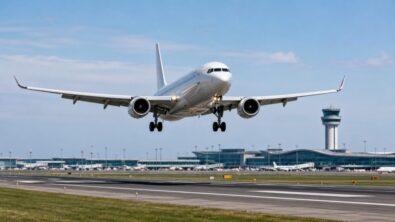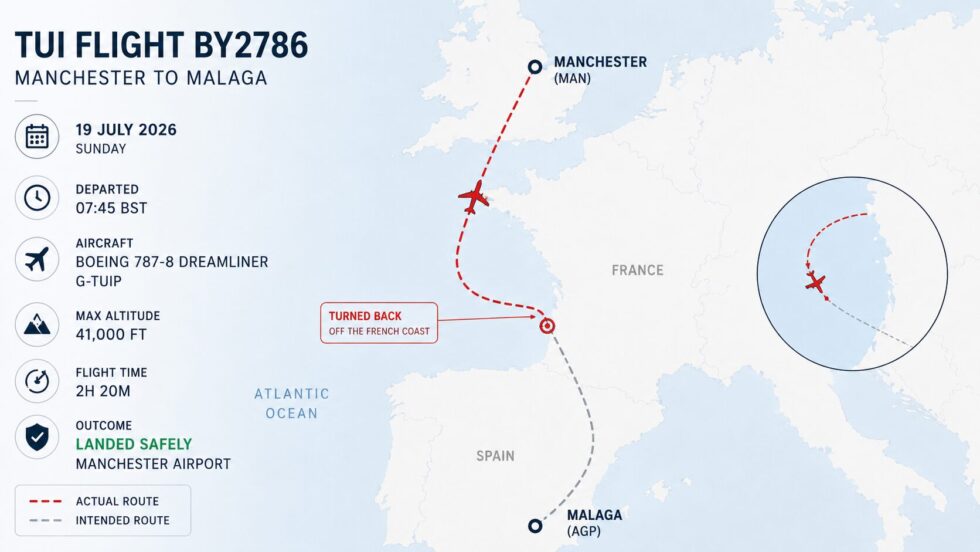
Sunday, 19 July 2026 — A TUI Airways flight carrying holidaymakers from Manchester to Malaga returned to its departure airport after turning around near the western coast of France. The Boeing 787-8 Dreamliner operating the route took off on Sunday morning, climbed to cruising altitude and travelled south across the English Channel before abandoning the journey to Spain. The aircraft landed safely back at Manchester Airport, while the precise reason for the TUI flight BY2786 mid-air turnaround had not been publicly confirmed by the airline, The WP Times reports.
Flight-tracking records identify the aircraft as G-TUIP and show BY2786, also used operationally as TOM2786, departing Manchester for Malaga before being diverted back to Manchester. No injuries, emergency evacuation or abnormal landing were reported. An aviation report suggested that a suspected technical issue may have prompted the precautionary return, but TUI had not confirmed a technical fault or provided a detailed public explanation at the time this article was prepared.
What happened to TUI flight BY2786 from Manchester to Malaga
TUI flight BY2786 was scheduled to operate from Manchester Airport to Malaga Airport on Sunday morning. The route is a regular leisure service linking northern England with the Costa del Sol and normally takes approximately three hours. TUI’s own route information describes the average Manchester-to-Malaga journey as around three hours, although conditions can alter the precise duration.
According to the initial aviation report, the Boeing 787-8 departed from Manchester’s runway 05L at approximately 7.45am BST. Flight-tracking data records a departure shortly after 7am against a scheduled time of 6.40am, suggesting that different services may record runway, airborne and gate times differently. The important confirmed sequence is that the aircraft left Manchester, proceeded south and later returned to the same airport instead of reaching Malaga. The aircraft was reported to have climbed to approximately 41,000 feet before the crew changed course while flying over the Atlantic near France. It then travelled north towards Britain and landed safely at Manchester Airport roughly two hours and 20 minutes after its initial departure. The Dreamliner taxied normally after landing, allowing passengers to leave through the terminal rather than through an emergency evacuation.
TUI flight BY2786: confirmed details
| Detail | Confirmed information |
|---|---|
| Date | Sunday, 19 July 2026 |
| Airline | TUI Airways |
| Flight number | BY2786, also TOM2786 |
| Planned route | Manchester to Malaga |
| Departure airport | Manchester Airport |
| Destination | Malaga Airport |
| Aircraft type | Boeing 787-8 Dreamliner |
| Registration | G-TUIP |
| Reported departure | Sunday morning |
| Turnaround area | Near the western coast of France |
| Final airport | Manchester Airport |
| Outcome | Landed safely |
| Confirmed cause | Not publicly established |
FlightRadar24 listed the original operation as having been diverted to Manchester and subsequently showed a later replacement or rescheduled operation involving another TUI aircraft. This indicates that the airline was attempting to recover the service, although passengers should rely on direct communications from TUI for their individual departure arrangements.
Why did the TUI Boeing 787 turn back
The exact cause remains unconfirmed.
AIRLIVE reported that operational indications suggested a possible technical issue, but the site did not cite a detailed statement from TUI or an aviation authority confirming which aircraft system may have been affected. That distinction is important: a suspected technical problem is not the same as a confirmed mechanical failure. Pilots may turn an aircraft back for a range of reasons. These can include a cockpit warning, an issue with a non-critical aircraft system, a cabin problem, a medical incident, operational restrictions or a fault that can be assessed more effectively at the airline’s engineering base. A return to the departure airport does not necessarily mean that the aircraft was in immediate danger. Airlines and flight crews regularly make precautionary decisions when continuing to the destination would create unnecessary operational risk or leave the aircraft at an airport without the required engineering support.
In the case of BY2786, no public report indicated a mayday call, runway closure, emergency evacuation or serious injury. The aircraft completed a controlled return and landed normally. Until TUI provides an explanation, it would be inaccurate to claim that the aircraft suffered an engine failure, cabin-pressure emergency or any other specific defect. No reliable public source reviewed for this article established such a cause.
What is known about the Boeing 787-8 G-TUIP
The aircraft involved was a Boeing 787-8 Dreamliner registered G-TUIP and operated by TUI Airways. Flight records connect the registration with the disrupted Manchester-to-Malaga service on 19 July. The Boeing 787 is a twin-engine widebody aircraft principally designed for long-distance operations, although TUI also uses Dreamliners on selected high-demand European holiday routes. The larger cabin allows the airline to carry more passengers than would typically travel on a narrowbody Boeing 737 or Airbus A320-family aircraft.
AIRLIVE described G-TUIP as approximately 12 years old. Aircraft age on its own does not establish the cause of an operational event. Commercial aircraft remain subject to scheduled maintenance, regulatory oversight and technical inspections throughout their working lives.TUI promotes Dreamliner operations as part of its long-haul programme, while the airline also operates from Manchester to destinations across Spain and other holiday markets.
How were passengers affected by the Manchester return
Passengers who had expected to arrive in Malaga during the late morning instead found themselves back at their original departure airport after spending more than two hours in the air. The immediate disruption would have included uncertainty over replacement travel, baggage arrangements, airport transfers and the start of package holidays. Travellers with car-hire bookings, independent accommodation or onward transport in Spain may also have needed to contact providers about their delayed arrival.A third-party flight-status platform initially listed BY2786 as cancelled. FlightRadar24, however, later displayed an estimated replacement departure from Manchester involving a Boeing 737-800. Because live flight-status platforms can update at different times and may use different classifications, passengers should treat their TUI booking messages and airport information as the primary source. Affected travellers should retain:
- their booking confirmation;
- boarding passes;
- messages received from TUI;
- evidence of the original and revised departure times;
- hotel or transfer confirmations;
- itemised receipts for reasonable expenses;
- details of the time at which they ultimately reached Malaga.
These records may be needed when seeking reimbursement or making a compensation claim.
Was the Malaga-to-Manchester return service also disrupted
The outbound aircraft would ordinarily have continued from Malaga back to Manchester after its turnaround in Spain. Because G-TUIP did not reach Malaga, the later return service faced a shortage of its scheduled aircraft.Published timetable information for the reverse TOM2787 service shows a typical Malaga departure at approximately 12.50pm local time and arrival in Manchester at about 2.50pm BST, although individual dates and schedules can change.
When an outbound aircraft returns to Britain, the airline may have to find a substitute aircraft for passengers waiting at the destination. That process can require a replacement crew, a new airport slot, additional ground handling and the transfer of baggage and catering arrangements. Crew duty-time limits can create further delays even when another aircraft is available. Airlines must ensure that pilots and cabin crew do not exceed regulated working periods, meaning a replacement crew may also be required. Passengers waiting in Malaga should monitor the TUI app, airport screens and direct airline messages rather than relying on the original schedule.
What rights do passengers have after the BY2786 disruption
Because the flight departed from Manchester, passenger rights are governed by the UK’s retained air-passenger legislation, commonly known as UK261. The precise entitlement depends on how TUI classified the disruption, when passengers were eventually transported to Malaga, and what caused the original return. If a flight is cancelled, passengers are generally entitled to choose between reimbursement of the unused ticket and rerouting to their destination. Rerouting should be offered at the earliest reasonable opportunity or at a later date that suits the passenger, subject to availability and the applicable conditions.
Where passengers face a significant delay, the airline may also have a duty to provide care. Depending on the waiting time and circumstances, this can include reasonable food and refreshments, communications and hotel accommodation when an overnight stay becomes necessary. When the airline cannot supply assistance directly, passengers may purchase reasonable necessities themselves and seek reimbursement later. They should avoid excessive spending and keep itemised receipts.
What passengers should do
- Check whether TUI has classed the flight as delayed, cancelled or replaced.
- Obtain written confirmation of the revised travel arrangements.
- Ask when checked baggage will be returned or transferred.
- Keep every email, text message and app notification.
- Retain receipts for reasonable food, transport and accommodation.
- Record the final arrival time at the destination.
- Submit any claim directly to TUI Airways.
- Ask the airline to explain the cause if compensation is refused.
The UK Civil Aviation Authority advises passengers to contact the airline directly when seeking costs or compensation.
Could BY2786 passengers receive compensation
Compensation is possible, but it cannot yet be confirmed. Under UK rules, passengers may be entitled to fixed compensation when their flight reaches its destination at least three hours late or is cancelled at short notice, provided the disruption was within the airline’s control. The amount depends on the distance of the journey and the length of the delay. The Manchester-to-Malaga route covers approximately 1,864 kilometres. Third-party schedule records place the normal journey at about two hours and 55 minutes. An airline does not usually have to pay fixed compensation when a delay or cancellation results from extraordinary circumstances outside its control, such as severe weather, air traffic restrictions or certain external security events.
A technical issue does not automatically remove the airline’s responsibility. Whether a particular fault qualifies as an extraordinary circumstance depends on its origin and the specific evidence available to the carrier.
Passengers will therefore need to know:
- what caused the return;
- whether the flight was formally cancelled;
- whether replacement transport was provided;
- when they ultimately reached Malaga;
- whether TUI considers the event to have been outside its control.
The CAA states that passengers may be entitled to compensation only in qualifying circumstances and advises them to submit a claim with full flight and booking details.
What should a claim to TUI include
A claim should be factual and concise.сPassengers should provide their full name, booking reference, flight number BY2786, travel date, original Manchester departure time and eventual arrival time in Malaga. They should also include copies of airline communications and receipts for any reasonable expenses. It is important to distinguish between reimbursement and compensation.сReimbursement relates to money spent because the airline did not provide required care, such as reasonable meals, transport or accommodation. Compensation is a separate fixed payment that may be due when a qualifying delay or cancellation was within the airline’s responsibility.
Passengers whose claims are rejected should ask TUI to provide the precise reason and explain whether it is relying on extraordinary circumstances. If the dispute cannot be resolved directly, an approved alternative dispute-resolution provider may be able to review the case independently.
Has TUI issued an official explanation
No detailed public explanation from TUI had been identified by the time this report was completed. The available evidence confirms the route, aircraft, return to Manchester and safe landing. It does not establish the precise technical or operational reason that prompted the crew’s decision.
The absence of an immediate explanation is not necessarily unusual. Airlines may need to review flight-deck reports, aircraft maintenance data and engineering inspections before issuing a detailed account. For that reason, the incident should be described carefully.
What is confirmed
TUI flight BY2786 departed Manchester for Malaga, turned back near France and landed safely at Manchester Airport.
What remains unconfirmed
The precise cause, the number of passengers aboard, whether a specific aircraft system was affected and the final arrangements made for every traveller.
The aircraft would normally undergo an engineering assessment before returning to passenger service. That examination may involve reviewing cockpit alerts, maintenance records and data recorded during the flight. A precautionary return can be resolved quickly when engineers identify and rectify a minor issue. In other cases, an aircraft may remain grounded while further checks or replacement parts are required. TUI would also need to manage passengers from the original service and those due to travel back from Malaga. FlightRadar24’s later listing of another aircraft against the route suggests an operational recovery plan was being arranged, but individual travellers should continue to follow direct instructions from the airline. The central facts remain clear: flight BY2786 did not complete its original journey to Spain, the crew brought the Boeing 787 safely back to Manchester and no confirmed explanation for the turnaround had been made public.
This article was prepared using materials published by AIRLIVE, FlightRadar24, TUI Airways, independent flight-status services and official passenger-rights guidance from the UK Civil Aviation Authority.
Read about the life of Westminster and Pimlico district, London and the world. 24/7 news with fresh and useful updates on culture, business, technology and city life: Why was flight FR4007 diverted to Paris, and what has Ryanair confirmed