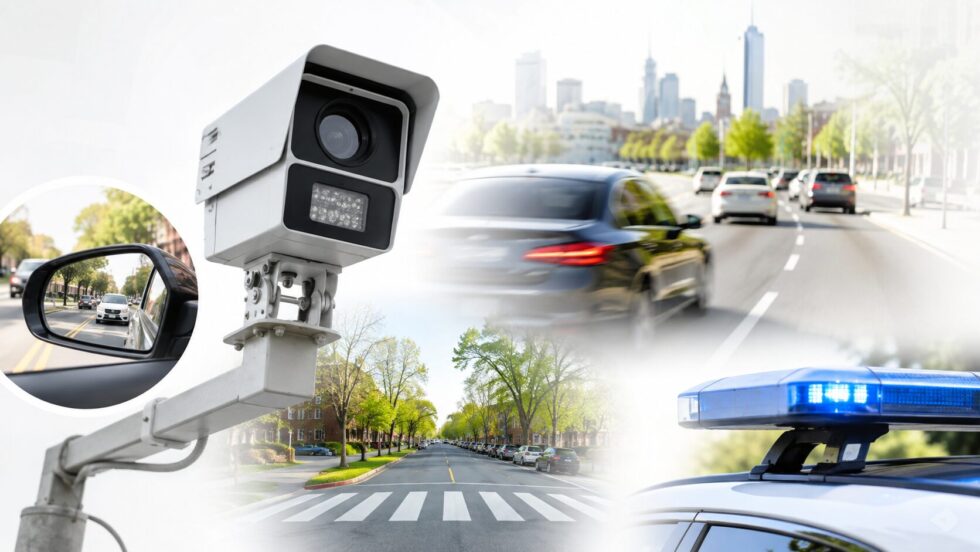
Traffic enforcement camera coverage is being extended along Route 13 in Philadelphia after 10 new automated speed cameras were installed between the 3400 block of Ridge Avenue and the junction of 60th Street and Baltimore Avenue. The equipment covers a long urban corridor through Strawberry Mansion, Brewerytown, West Philadelphia and University City, with motorists expected to receive warnings before financial penalties begin. Drivers recorded travelling at least 11mph above the posted limit could face a $100 citation once enforcement starts, The WP Times reports.
Philadelphia officials have tentatively scheduled the start of a 60-day warning period for mid-to-late August 2026. During that introductory phase, registered vehicle owners caught exceeding the enforcement threshold should receive warning notices rather than fines. The precise launch date had not been formally confirmed when the cameras were announced, meaning drivers should follow posted roadside signs and updates from the Philadelphia Parking Authority rather than assume that enforcement remains inactive throughout August.
Where the New Route 13 Traffic Enforcement Cameras Have Been Installed
The latest Route 13 installation consists of 10 traffic enforcement camera units covering the section from the 3400 block of Ridge Avenue to 60th Street and Baltimore Avenue. This is not a short enforcement zone concentrated around a single junction. It passes through several densely populated neighbourhoods containing homes, shops, schools, pedestrian crossings and public transport connections.
The reported corridor runs through:
- Strawberry Mansion;
- Brewerytown;
- West Philadelphia;
- University City;
- the Ridge Avenue section beginning around the 3400 block;
- the western end near 60th Street and Baltimore Avenue.
The equipment expands automated enforcement into areas where residents regularly share the road with through traffic. That distinction matters because Route 13 is not used only by people making local journeys. It functions as a wider arterial route while also passing directly through residential communities, creating repeated points of conflict between faster vehicles, pedestrians, cyclists and people entering or leaving parked cars.
Officials have not yet published a detailed public list identifying the precise position of every one of the 10 new cameras. Until that information is formally released, motorists should not interpret the two reported endpoints as the only places where speeds are being measured. Automated camera systems can monitor traffic at multiple points along a designated corridor, and each enforcement location should be marked by signs. The route announcement also requires some geographical distinction. Philadelphia already introduced automated enforcement on a separate Route 13 section in the north-east of the city, principally along Frankford Avenue between Morrell Avenue and Levick Street. That earlier scheme began issuing warnings in April 2026 before financial enforcement started on 26 June. The newly announced installation extends camera coverage into Ridge Avenue, Brewerytown, West Philadelphia and University City rather than merely adding more equipment to the existing Frankford Avenue section.
When the Route 13 Speed Camera Warning Period Will Begin
The warning period for the 10 newly installed traffic enforcement cameras is tentatively expected to begin in mid-to-late August 2026. Officials have said it will run for 60 days before citations carrying fines are issued.
A warning period is designed to change driving behaviour before monetary enforcement begins. Cameras can record vehicles exceeding the relevant threshold, but the registered owner receives an educational notice rather than a bill during the introductory stage. The notice provides an opportunity to understand where the system operates and how the vehicle was detected. The expected timetable is:
| Stage | Expected position |
|---|---|
| Camera installation | Completed along the announced corridor |
| Warning-period launch | Tentatively mid-to-late August 2026 |
| Duration of warning period | 60 days |
| Financial enforcement | Expected after the full warning period |
| Confirmed fine mentioned for the new section | $100 from 11mph above the limit |
Because the opening date remains tentative, calculating a fixed enforcement date by adding 60 days to an assumed August launch would be unreliable. If warnings began on different dates at different locations, the transition to fines could also depend on official activation notices.
Drivers should therefore look for three forms of confirmation: signs installed beside the road, notices from the Philadelphia Parking Authority and an official announcement stating when the warning phase ends. The physical presence of a camera does not by itself prove that fines have started, but it does show that motorists should immediately follow the posted speed limit. Philadelphia has used the same adjustment model elsewhere. A 60-day warning period was introduced on the north-eastern Route 13 corridor in April before fines began in June. Broad Street also received an advance warning phase when automated speed enforcement was launched there.
How the Route 13 Traffic Enforcement Camera Fine Will Work
Drivers recorded travelling 11mph or more above the posted speed limit on the newly announced Route 13 section are expected to receive a $100 citation after the warning period. A vehicle travelling exactly 10mph above the limit would therefore remain below the reported camera threshold, although it could still be stopped and cited by a police officer for speeding.
The threshold is based on the speed recorded by the enforcement equipment, not the driver’s estimate from a dashboard display. Motorists should not treat the 11mph trigger as an additional permitted allowance. The legal speed remains the number shown on the roadside sign.
For example:
| Posted limit | Reported camera threshold begins at |
|---|---|
| 20mph | 31mph |
| 25mph | 36mph |
| 30mph | 41mph |
| 35mph | 46mph |
These examples illustrate the reported 11mph threshold but do not establish the speed limit at every point on Route 13. Limits may vary as the road passes through different neighbourhoods, junction layouts or safety zones. The roadside sign at the location remains decisive.
Reports announcing the new western section specifically identified a $100 penalty for motorists travelling 11mph above the posted limit. Philadelphia’s established automated speed enforcement framework on other corridors uses escalating penalties for more serious violations: $100 for 11–19mph above the limit, $125 for 20–29mph above and $150 for 30mph or more above. The city has also said that automated citations issued under the programme do not add points to a driver’s licence. However, motorists should rely on the final Route 13 enforcement notice for confirmation of the full penalty scale applying to these 10 new cameras.
Why Philadelphia Is Expanding Automated Speed Enforcement
The immediate policy argument is road safety. Philadelphia officials say speed cameras have sharply reduced extreme speeding on Roosevelt Boulevard, the first major city corridor to receive the technology. The Philadelphia Parking Authority and city government have repeatedly cited a 95% decline in speeding violations on Roosevelt Boulevard following the introduction of automated enforcement. The city has also reported that crashes involving pedestrians on the boulevard fell by 50% after the camera programme was established.
Those figures explain why the programme has moved beyond its original corridor. Roosevelt Boulevard demonstrated whether automated enforcement could operate on a large urban road. Broad Street followed, and Route 13 was subsequently identified as another priority because of its pattern of speeding, serious injuries and pedestrian collisions. A city analysis of potential expansion corridors confirmed that State Route 13 and State Route 611 remained among the highest priorities for camera enforcement when assessed against updated crash and vehicle-speed data. The selection was therefore based on recorded safety risks rather than simply traffic volume or the potential number of tickets.
The latest Route 13 extension also reflects the character of the communities along the road. Residents interviewed after the camera installation raised concerns about speeding near homes and places where children cross.
Natalya Vinokuroba, a West Philadelphia resident, said the neighbourhood contained many children and expressed hope that enforcement would deter motorists from driving too fast. Referring to the effect of cameras on Roosevelt Boulevard, she said the previous conditions there had been “a nightmare” and believed the Route 13 system could produce a similar improvement.
Alex Bolanos, another West Philadelphia resident, said he had initially seen workers installing an enforcement sign and had asked whether the road would become photo-enforced. According to his account, workers confirmed that automated enforcement was being introduced. His reaction illustrates a central feature of the rollout: the signs are intended to ensure drivers know the cameras are operating rather than creating a concealed enforcement system.
What a Traffic Enforcement Camera Records
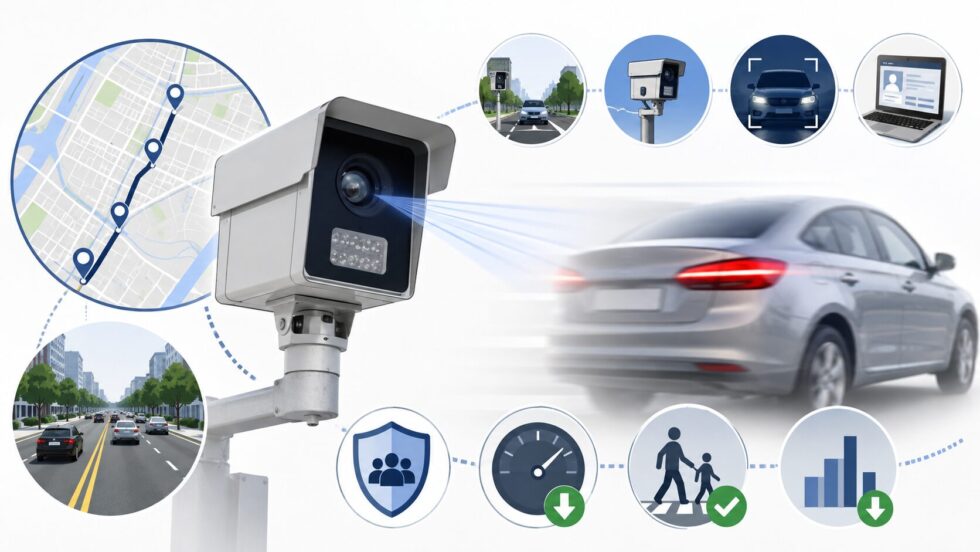
A traffic enforcement camera used for automated speed control does not operate in the same way as an ordinary security camera. Its purpose is to establish whether a specific vehicle has crossed an enforcement point above the permitted threshold and to create evidence that can be reviewed before a citation is issued.
A typical speed-enforcement record may include:
- the vehicle’s measured speed;
- the posted limit at the enforcement site;
- the date and exact time of the alleged violation;
- photographs of the vehicle;
- a visible registration plate;
- the direction of travel;
- the enforcement location;
- information identifying the authorised camera system.
The citation is normally sent to the registered owner because the equipment identifies the vehicle rather than stopping and interviewing the person driving it. That differs from a police traffic stop, where an officer establishes the driver’s identity at the roadside. The Philadelphia Parking Authority administers the city’s automated speed enforcement programme in partnership with local government. Although cameras perform the initial detection, automated evidence is generally subject to an administrative process before a notice is mailed.
A speed camera should also not be confused with a red-light camera. A red-light system detects vehicles entering an intersection after the signal has changed, while a speed camera measures whether a vehicle is travelling above the enforcement threshold. Some roads may contain both systems, but they address different violations.
What Drivers Should Do During the 60-Day Warning Period
Motorists do not need to wait for a warning letter before changing their behaviour. The safest response is to observe the posted speed limit immediately, particularly because the start date may vary from the tentative timetable. Drivers using Route 13 should:
- Check the posted limit after entering each new section of the road.
- Reduce speed before reaching residential crossings and junctions.
- Avoid relying on familiarity with an older speed limit.
- Leave enough distance to slow without sudden braking near a camera.
- Confirm that the vehicle registration address is current.
- Read any warning notice carefully rather than discarding it.
- Check official information before paying a later citation.
Maintaining an accurate registration address is particularly important. Automated notices are sent using vehicle records, meaning an owner who has moved but failed to update the address could miss a warning or citation. A missing letter does not necessarily cancel the underlying enforcement record.
Drivers should also be alert to fraudulent payment demands. A genuine citation should identify the vehicle, location, recorded speed, date, issuing authority, payment procedure and appeal rights. Requests to transfer money through an informal payment app, gift card or an unrelated account should be treated with suspicion.
Can a Route 13 Speed Camera Citation Be Challenged
An automated citation is not necessarily beyond review. Vehicle owners should examine the notice for instructions explaining how to contest it and the deadline for doing so. Possible questions may include:
- whether the registration plate has been correctly identified;
- whether the vehicle belongs to the person who received the notice;
- whether it had been sold, stolen or transferred before the incident;
- whether the listed time and location are accurate;
- whether the recorded speed and posted limit are shown clearly;
- whether the camera was operating within the authorised programme;
- whether the recipient qualifies for any statutory defence.
A challenge should be based on evidence rather than a general objection to camera enforcement. Useful documents may include a police report for a stolen vehicle, sale or transfer records, registration documents, photographs, repair invoices or other material directly relevant to the alleged violation.
The recipient should not ignore a citation while preparing a challenge. Missing the stated response deadline can restrict appeal options or lead to additional enforcement consequences.
How the New Route 13 Cameras Fit Into Philadelphia’s Wider Programme
Roosevelt Boulevard was Philadelphia’s first automated speed enforcement corridor. The system was originally introduced through a pilot programme permitted by Pennsylvania legislation and became the basis for later expansion.
Broad Street, part of State Route 611, followed with 15 published camera locations. The city said its selection reflected severe crash risks on a corridor running through a large number of residential and commercial districts. Route 13 was then authorised as another priority road, initially receiving cameras in the north-east before the latest installation extended enforcement through Strawberry Mansion, Brewerytown, West Philadelphia and University City.
The overall sequence can be summarised as follows:
| Corridor | Role in the programme |
|---|---|
| Roosevelt Boulevard | First major automated speed enforcement corridor |
| Broad Street/Route 611 | Large-scale expansion with 15 published locations |
| Route 13, Frankford Avenue | North-east section activated in 2026 |
| Route 13, Ridge Avenue to 60th and Baltimore | Latest reported installation of 10 cameras |
The new installation should therefore be understood as part of an expanding city enforcement network rather than an isolated set of cameras. Philadelphia is using several forms of automated traffic control, including speed cameras, red-light cameras and camera systems targeting vehicles that obstruct bus or trolley routes. Each programme has separate rules, fines and enforcement purposes.
What Remains Unconfirmed About the New Route 13 Cameras
Several essential facts have been reported, including the number of cameras, the broad corridor, the 11mph threshold, the anticipated $100 fine and the 60-day warning period. However, some operational details remain incomplete. Officials had not confirmed:
- the exact day the warning period would begin;
- the date on which the first financial citations would be issued;
- the precise street address of every camera;
- whether all 10 cameras would activate simultaneously;
- whether higher-speed violations would attract the city’s usual $125 and $150 penalty levels on this section;
- whether any individual sites would operate under different posted limits.
These points should become clearer in an official Philadelphia Parking Authority announcement. Until then, the installation itself is the practical warning: motorists using Route 13 should expect automated speed monitoring and observe every posted limit throughout the corridor.
The Bottom Line on the Route 13 Traffic Enforcement Camera Expansion
Philadelphia has installed 10 new traffic enforcement cameras along Route 13 from the 3400 block of Ridge Avenue to 60th Street and Baltimore Avenue. The expansion covers Strawberry Mansion, Brewerytown, West Philadelphia and University City and is intended to reduce speeding on a corridor combining heavy traffic with residential and pedestrian activity.
A 60-day warning period is tentatively due to begin in mid-to-late August 2026. After that period, drivers recorded at least 11mph above the posted limit are expected to face a minimum $100 citation. The final start date and complete list of camera positions still require official confirmation, but drivers should treat the cameras and roadside signs as an immediate reason to follow the legal limit.
Read about the life of Westminster and Pimlico district, London and the world. 24/7 news with fresh and useful updates on culture, business, technology and city life: Why was Heritage Live cancelled and what is known about the Sandringham concerts, line-ups and refunds
Materials used: Philadelphia Parking Authority, City of Philadelphia, WPVI-TV/6abc, Northeast Times, NBC10 Philadelphia.