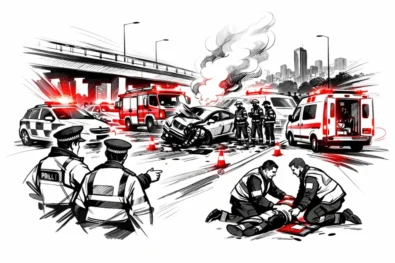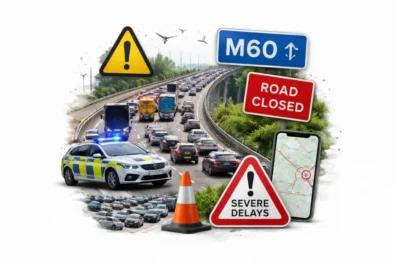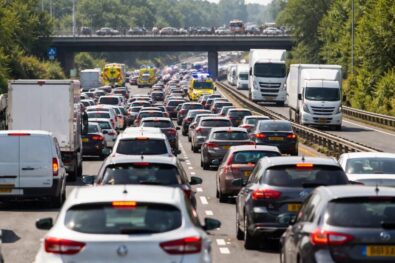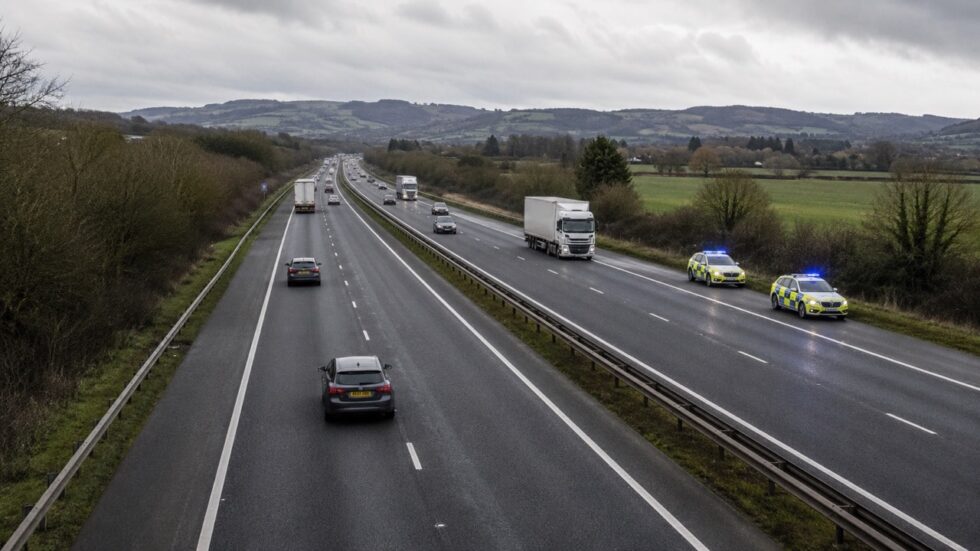
Avon and Somerset Police closed the M5 near Taunton in both directions shortly after 6:15am on Saturday 13 June 2026 after multiple drivers reported a person running across the active lanes between Junction 25 at Taunton and Junction 24 at Bridgwater South, before reopening the motorway later that morning when searches proved negative. The closure brought traffic to a complete standstill through the busiest part of the morning, with officers searching the carriageway on foot and from a police helicopter while queues built by the mile in both directions, The WP Times understands. By mid-morning the force confirmed that no person had been found and that National Highways had begun lifting the closure, drawing a several-hour disruption on one of the South West's principal routes to a close. El-balad
What happened on the M5 near Taunton, and when
The sequence of events was tightly compressed into the early hours of the morning. Police initially halted traffic and then put a full closure in place after receiving multiple distress calls from drivers reporting a solitary figure in the live lanes. Stopping all vehicles in both directions was the immediate priority, because a pedestrian on a carriageway carrying traffic at up to 70mph presents a hazard that cannot be managed while lanes remain open.
A clear timeline emerged from the official statements issued during the morning:
- Shortly after 6:15am — traffic stopped in both directions between J25 (Taunton) and J24 (Bridgwater South) after reports of a person in the live lanes.
- Through the early morning — officers searched the carriageway and surrounding area, supported by the National Police Air Service.
- By 8:26am — Avon and Somerset Police confirmed searches had proved negative and no person had been located.
- After 8:26am — National Highways began reopening the carriageways once the all-clear was given.
What the police said
The force set out the position in a statement issued during the operation. By 8:26am, Avon and Somerset Police said: "Traffic was initially halted and then a closure was put in place. Searches have been carried out, including with the assistance of the National Police Air Service; however, they proved negative." The wording confirmed two things at once: that a structured search of the carriageway and its surroundings had been conducted, and that it had not located the person who prompted the multiple calls from drivers. El-balad
After that statement, National Highways began reopening the carriageways, with the road reopening only once police had finished their searches and given the all-clear. The decision to reopen followed the standard order of events for a police-led closure: the road is not released back to traffic until the responding force is satisfied that no one remains on or near the live lanes.
How drivers were affected
The practical consequences for road users were immediate and substantial. Traffic monitoring agency Inrix recorded queues stretching for miles in both directions, with drivers facing long stationary tailbacks and delayed onward journeys while the motorway remained shut. Because the closure landed at the start of the morning, it caught a broad mix of long-distance travellers, commuters and early airport-bound drivers, all held stationary with no immediate prospect of movement.
One driver caught at the very front of the stopped traffic described the wait as it unfolded. The motorist said: "I'm at the front. Just been told we are waiting on a helicopter. Reports of a person running across the lanes and they can't find him now, so they need assistance locating him so it doesn't happen again." The account, given from the leading edge of the tailback, conveyed both the uncertainty of the hold and the reason behind it — a search that could not safely be wound down until officers were satisfied the carriageway was clear.
Why a full closure was the necessary response
For drivers held stationary for the best part of two hours, a complete closure of a motorway as busy as the M5 over reports of a single individual can feel disproportionate. In operational terms, however, it is the safest available option, and the morning's events illustrate why. A person on foot in live motorway lanes is exposed to traffic moving at high speed, and someone whose movements are unpredictable cannot be safely managed while any lane stays open. Halting all traffic removes the immediate collision risk and gives officers a controlled environment in which to search.
The layout and history of this particular stretch reinforce that caution. The section between Junction 24 and Junction 25 carries heavy long-distance flows, and it has been the scene of serious incidents in the past, including a fatal collision involving a pedestrian and a number of major crashes. The threshold for closing the road to any report of a person in the live lanes is set deliberately low because the consequences of getting it wrong are irreversible.
What we know — and what remains unconfirmed
Even after the reopening, several questions remained outstanding. The force did not identify the person reported to have been in the carriageway, and because the searches proved negative, it was not established who they were or where they went. No injuries were reported in connection with the incident, and the police statement focused on the search and its negative result rather than on any casualty.
The table below summarises the confirmed and unconfirmed elements:
| Detail | Status |
|---|---|
| Closure location (J24–J25) | Confirmed |
| Both directions closed | Confirmed |
| Closure time (shortly after 6:15am, 13 June 2026) | Confirmed |
| Cause (reports of person in live lanes) | Confirmed |
| Air support (National Police Air Service) | Confirmed |
| Searches negative / person not found | Confirmed |
| Road reopened (after 8:26am) | Confirmed |
| Identity of person reported | Not confirmed |
| Injuries | None reported |
With the carriageways reopening, the immediate advice was straightforward: expect residual delays to clear gradually rather than instantly, as the miles of stationary traffic that had built up worked their way through. Tailbacks of this length do not dissipate the moment a road reopens, and drivers approaching the area were advised to allow extra time and to check live traffic information before setting out.
The episode also served as a reminder of how a single safety incident can ripple across a region's road network within minutes. A closure beginning shortly after 6:15am on a Saturday displaced thousands of journeys, fed congestion onto surrounding A-roads, and affected travellers far beyond Somerset before the motorway was handed back to traffic. For those planning to use the M5 corridor in the hours that followed, the practical lesson was to build in a generous buffer and to treat the network as still recovering until queues had fully cleared.
Read about the life of Westminster and Pimlico district, London and the world. 24/7 news with fresh and useful updates on culture, business, technology and city life: UK Visa Changes 2026: What Foreign Workers Need To Know About New Salary Rules, English Tests And Settlement Delays