UK solar eclipse 2026 will reach Britain on Wednesday 12 August, when the Moon will cover roughly 90% of the Sun in London and as much as 95% in Cornwall. The eclipse begins across the country shortly after 6pm BST, reaches its maximum between 7.05pm and 7.16pm, then ends close to sunset. Britain will remain outside the path of totality, but this will be the largest solar eclipse visible from the UK since August 1999 and the closest the country has come to a total eclipse for almost 27 years. The decisive factor will not be travelling hundreds of miles but finding an unobstructed western horizon, because the Sun will sit low in the evening sky. Cornwall, the Isles of Scilly, Pembrokeshire, Devon, Somerset and western coastal viewpoints offer the strongest combination of greater coverage and open sightlines, The WP Times reports.
The event forms part of a total eclipse whose central shadow crosses northern Russia, Greenland, Iceland, northern Spain and a small part of Portugal. Across the UK, however, a bright crescent of the Sun will remain visible throughout, meaning daylight will weaken but the sky will not become fully dark. London’s eclipse is expected to start at 6.17pm, peak at about 7.12pm and finish at 8.06pm, while Cornwall reaches maximum several minutes later and with a larger proportion of the solar disc covered. The entire British viewing window lasts about one hour and 50 minutes, although buildings, hills, trees or cloud may cut it short locally. Proper solar filters will be required from the first moment to the last because even a narrow uncovered section of the Sun can permanently damage eyesight.
The best British view will come from a clear western horizon rather than from the country’s highest or darkest site.
Where to see the UK solar eclipse 2026 at its biggest
The south-west of Britain lies closest to the eclipse’s path of totality, so the proportion of the Sun hidden by the Moon increases towards Cornwall, the Isles of Scilly and south-west Wales. Royal Observatory Greenwich calculations put coverage at roughly 95% in Cornwall, about 94% in Pembrokeshire and around 90% in London. South-western Ireland fares even better, approaching 97.5% in some areas, although totality still remains beyond the British Isles.
Coverage percentages alone do not identify the best viewing site. At maximum eclipse, the Sun will be only about 10 degrees above the horizon in London and similarly low elsewhere, so a modest ridge, a line of trees or a row of buildings could hide the most dramatic stage. A west-facing beach, headland, open common or elevated urban viewpoint is more useful than a remote valley with restricted visibility. Coastal locations may offer long sightlines, but sea fog and low cloud remain possible. The strongest UK options include:
- Cornwall’s north and west coasts, including exposed headlands with open views towards the Atlantic;
- the Isles of Scilly, where coverage should be among the highest anywhere in the UK;
- west-facing parts of Pembrokeshire and the Gower Peninsula;
- elevated sites around Bristol, Somerset and Devon with clear views beyond local hills;
- open western viewpoints near Cardiff, Liverpool and Manchester;
- hilltops or parks in London where the skyline remains clear towards west-north-west.
Several well-known beauty spots may become congested before maximum eclipse. A less prominent beach, field-edge viewpoint or local hill with legal public access may provide a clearer experience than a landmark where parking fills early. Observers should check closing times, footpath restrictions and transport arrangements before travelling, particularly where the return journey begins shortly after sunset.
“Other than the weather, the only other criteria is a good view all the way to the horizon looking west” (Simon Holbeche, chair of Bath Astronomers, speaking about viewing conditions in western England).
The eclipse will also be visible from Scotland, northern England and Northern Ireland, but with slightly lower coverage. Edinburgh and Glasgow are expected to see first contact at about 6.08pm and maximum at approximately 7.05pm. Manchester and Liverpool begin near 6.13pm, with maximum close to 7.10pm. Norwich and Birmingham start at about 6.15pm and peak around 7.11pm, while London, Bristol and Cardiff begin near 6.17pm and peak around 7.12pm. Truro starts at approximately 6.18pm and reaches maximum near 7.16pm.
| UK location | Eclipse begins | Maximum eclipse | Approximate coverage |
|---|---|---|---|
| Edinburgh and Glasgow | 6.08pm | 7.05pm | Below south-west UK levels |
| Manchester and Liverpool | 6.13pm | 7.10pm | Around 90% |
| Norwich and Birmingham | 6.15pm | 7.11pm | Around 90% |
| London, Bristol and Cardiff | 6.17pm | 7.12pm | About 90% |
| Truro and western Cornwall | 6.18pm | 7.16pm | About 95% |
| Pembrokeshire | Around 6.16pm | Around 7.13pm | About 94% |
The times are local BST and should be treated as regional guides because contact times vary slightly by exact position. Royal Observatory Greenwich publishes localised information and will also run a free telescope livestream from 6.10pm for viewers affected by cloud or restricted horizons.
Travelling farther south-west improves the eclipse percentage, but a clear horizon can matter more than a difference of two or three percentage points.
What time the solar eclipse begins and what Britain will see
A solar eclipse occurs when the Moon passes between Earth and the Sun. The alignment on 12 August is precise enough to produce totality along a narrow international track, but Britain sits north of that central shadow. From the UK, the Moon will appear to move across most of the solar disc while leaving a curved section uncovered.
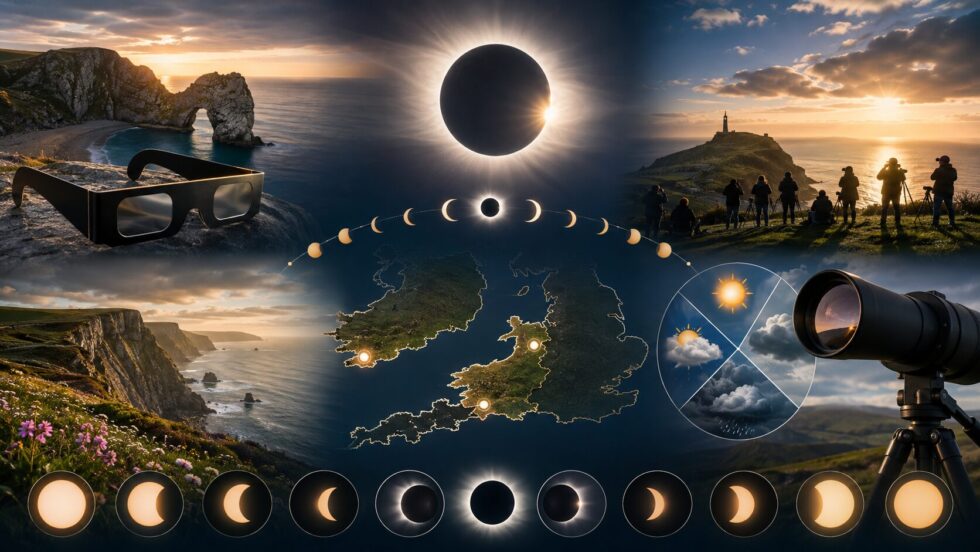
The sequence develops gradually:
- First contact occurs when the Moon’s edge first appears to touch the Sun.
- The covered area grows for almost an hour as the Moon moves across the solar disc.
- Maximum eclipse arrives shortly after 7pm, depending on location.
- The Moon begins to uncover the Sun while both objects continue descending.
- Final contact occurs shortly before or around sunset, ending the partial eclipse.
At maximum, daylight may take on a muted, metallic quality and temperatures may dip. Shadows can appear sharper because the remaining sunlight comes from a narrow crescent rather than the full solar disc. Gaps between leaves may project dozens of small crescent-shaped images on the ground, each acting as a basic pinhole projector. The sky will resemble late dusk or heavy cloud rather than night, because even a small visible fraction of the Sun produces substantial light. Royal Observatory Greenwich says the change should be noticeable, but Britain will not experience the darkness associated with totality.
The distinction matters for expectations. A 90% eclipse does not create 90% darkness, and the final uncovered portion of the Sun remains intensely bright. Totality allows observers inside the central path to see the solar corona without eclipse glasses for a brief, precisely timed interval. No such interval occurs anywhere in the UK on 12 August, so eye protection must stay in place throughout.
“The arc of totality misses us here in the UK, but we will still get to see over 90% of the Sun covered by the Moon” (National Space Centre, describing the eclipse path across Europe).
The international path begins in the Arctic region, crosses Greenland and Iceland, then reaches the Iberian Peninsula near sunset. Northern Spain will experience totality, with some locations receiving less than two minutes of complete solar coverage. The timing creates a narrow margin because the eclipsed Sun will be close to the western horizon, making cloud and terrain critical even within the totality zone. NASA’s published map places the central path across Iceland and Spain, while most of Europe experiences a partial eclipse.
The event also falls on the night of the Perseid meteor shower’s peak. The Moon will be new, leaving darker conditions after sunset than in years when moonlight washes out faint meteors. Eclipse viewers staying at rural sites after darkness may therefore see Perseids later in the evening, although the shower is usually stronger after midnight when its radiant climbs higher.
Why the 1999 comparison matters
The 11 August 1999 eclipse remains the benchmark for modern British observers because Cornwall lay inside the path of totality. Large crowds travelled to the county, but cloud disrupted views in many locations. The 2026 event will not reproduce totality in Britain, yet it will cover more of the Sun than any UK eclipse since then.
The partial eclipse of 29 March 2025 was much smaller, with roughly 30% to 40% of the Sun obscured from the UK at maximum. In London, NASA records coverage of about 30.7% in 2025 compared with approximately 91.4% in 2026. The difference will be clear both through certified viewers and in the surrounding light.
Britain’s next total solar eclipse is expected on 23 September 2090, with the path crossing parts of southern England. Partial eclipses will occur before then, including another event on 2 August 2027, but that eclipse will cover only about 45% of the Sun in London.
For most people in Britain, the 2026 eclipse is the strongest solar event they will have seen without travelling abroad.
How to watch the 2026 solar eclipse safely in the UK
Solar eclipse glasses UK suppliers should provide viewers compliant with the ISO 12312-2 international safety standard. The glasses must be intact, free from scratches or punctures and worn before looking towards the Sun. Ordinary sunglasses, smoked glass, exposed photographic film, sweet wrappers and improvised filters do not block the harmful radiation involved. NASA states that regular sunglasses remain unsafe regardless of how dark they appear.
Binoculars, cameras and telescopes require dedicated solar filters fitted securely over the front aperture, before sunlight enters the instrument. Eclipse glasses worn behind binoculars provide no protection because the concentrated beam can burn through the filter and injure the eye. A camera’s electronic screen does not make an unfiltered lens safe either; concentrated sunlight can damage the sensor and internal components. A safe viewing plan should include:
- certified eclipse glasses for every observer;
- spare viewers in case a pair is damaged;
- a west-facing location checked in advance;
- arrival early enough to avoid parking and access problems;
- weatherproof clothing, water and a torch for the return after sunset;
- a pinhole projector for children or anyone unable to use glasses correctly;
- solar filters designed specifically for any camera, telescope or binoculars.
Pinhole projection offers a simple alternative to direct viewing. A small hole in a piece of card can project an image of the Sun on to a second white surface held behind it. The observer watches the projected image, not the Sun through the hole. Kitchen colanders can produce multiple crescent projections, while leafy trees may create the same effect naturally on walls and pavements.
“During a partial solar eclipse, it is never safe to look directly at the Sun without proper eye protection” (NASA, safety guidance for the 12 August 2026 eclipse). Cloud forecasts will become more reliable in the final days before 12 August. A broad regional forecast is less useful than hourly cloud-cover information because a narrow clear interval around 7.10pm could determine whether maximum eclipse is visible. High cloud may still permit a filtered view, while low western cloud can block the Sun completely. Drivers should avoid stopping on verges or roads when moving between clearer areas.
The best places to watch the solar eclipse will therefore depend on three conditions: cloud breaks, a low western horizon and safe public access. A location with 92% coverage under clear skies will outperform a 95% site under solid cloud. Viewers should identify at least two nearby alternatives rather than relying on a single famous destination.
Those unable to reach an open site can follow the Royal Observatory Greenwich eclipse livestream, scheduled to begin at 6.10pm. NASA is also providing information and coverage through its official August 2026 eclipse guide. The Royal Observatory’s UK viewing guide includes regional timings and coverage estimates.
The practical timetable is simple: reach the site before 6pm, put eye protection on before first contact, expect the strongest phase shortly after 7pm and keep the western horizon clear until the Sun is almost setting. Cornwall offers the largest eclipse in Britain, but observers across the country can see a major partial eclipse without long-distance travel. The essential equipment is certified eye protection; the essential geographical feature is an uninterrupted view towards the west.
Materials used: Royal Museums Greenwich, NASA Science, NASA Goddard Space Flight Center, National Space Centre, BBC News.
Read about the life of Westminster and Pimlico district, London and the world. 24/7 news with fresh and useful updates on culture, business, technology and city life: Which omega-3 is best in the UK and is it safe with medicines