
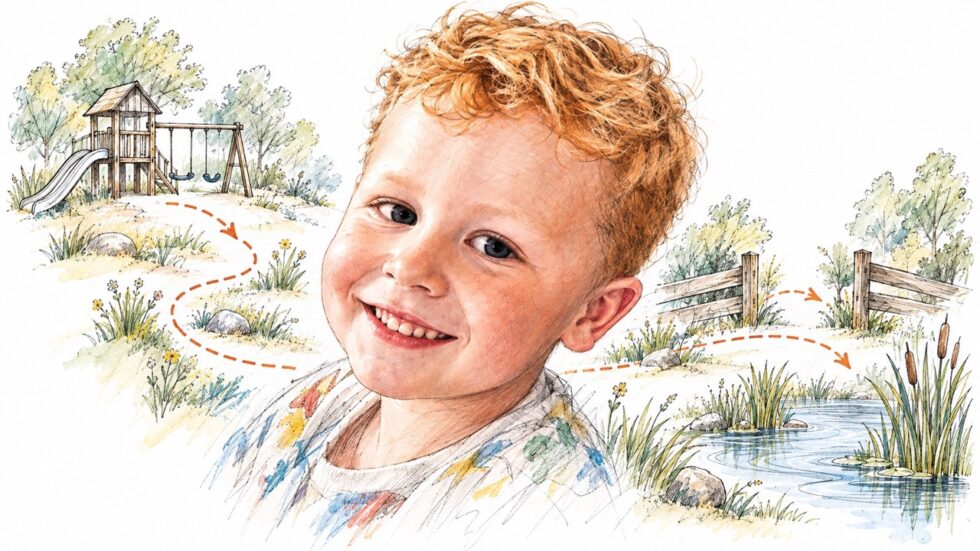
What happened to Noah Woods was set out in greater detail at an inquest in Suffolk on 25 September, when a coroner's court heard that the three-year-old left a playground through a gap in a fence before running towards a pond where his body was found the following day. Noah disappeared in Brantham on 15 September after visiting the under-fives play area at Merriam Close with a relative, an outing described to the court as part of his normal routine. CCTV showed him playing there before he passed through a gap into a memorial garden, left through an open gate and continued towards Decoy Pond, Detective Chief Inspector Matthew Connick told the hearing. His relative followed, tried to catch up and called after him but lost sight of the boy after about 200 metres. Metropolitan Police divers found Noah the following afternoon about five metres from the bank of the pond, among submerged tree roots and in water estimated to be 1.8 metres deep, reports The WP Times .
The disappearance prompted a large search involving specialist police teams, emergency services and about 1,300 members of the public. Noah's death was confirmed by paramedics at 4.31pm on 16 September, and his mother formally identified him at Ipswich Hospital that evening. Suffolk Police said his death was not being treated as suspicious. The inquest heard that a post-mortem examination had been carried out at Addenbrooke's Hospital mortuary in Cambridge, but the medical cause of death remained subject to further investigation when proceedings were opened. Assistant coroner Jyoti Gill adjourned the inquest to a date yet to be fixed.
How Noah Woods left the playground in Brantham
Noah had gone to the Merriam Close playground with a relative on Tuesday, 15 September. DCI Connick told the inquest that the relative was looking after him as part of an established routine and CCTV showed the pair in the play area. The first footage referred to at the hearing was recorded at 2.13pm, while Noah was last seen playing there on CCTV at 2.37pm. The camera was motion-activated rather than continuous, meaning those recordings did not provide an uninterrupted account of every minute Noah spent at the site.
The court heard that Noah subsequently left the playground through a gap in the fence separating it from the neighbouring memorial garden. Connick said: “Noah left through a gap in the fence leading to the memorial garden where he left through an open gate” (DCI Matthew Connick, Suffolk Coroner's Court, 25 September 2026). From there, Noah went along a route through the nearby new-build housing development in the direction of Decoy Pond.
His relative followed closely behind and tried to catch up, the hearing was told. The relative shouted after Noah, but after approximately 200 metres the child could no longer be seen. Another man then joined the attempt to find him before police were contacted and a large-scale search began.
The evidence presented at the opening hearing established an initial chronology of Noah's movements; the coroner did not make a final determination about the circumstances of his death.
The sequence presented to the court began with Noah playing at Merriam Close, continued through the gap in the internal fence and the memorial garden, and then through an open gate towards the housing development and Decoy Pond. This provided more detail than was available during the initial missing-person operation, when Suffolk Constabulary said Noah had been seen running down an alleyway beside the playground towards a new-build housing estate.
What is known about the fence at Merriam Close
Brantham Parish Council, which maintains the play area, said it understood there had been a break in internal fencing being constructed to separate the children's playground from the memorial garden. The council distinguished that barrier from the perimeter of the wider site, saying the whole Merriam Close area, including the play area and memorial garden, was enclosed by perimeter fencing. The route described at the inquest therefore involved two separate points: Noah first passed through a gap in the internal fence from the playground into the memorial garden, then left the garden through an open gate. The hearing did not establish why the gap was present, why the gate was open or whether either circumstance carried legal responsibility for what followed. Brantham Parish Council said it was “deeply saddened” by Noah's death and that its thoughts remained with his family and everyone affected. It said it would co-operate fully with any investigation and would not comment further while inquiries remained under way.
| Part of Noah's route | Evidence presented |
|---|---|
| Merriam Close playground | Noah was there with a relative |
| CCTV | Footage at 2.13pm and 2.37pm; recording was motion-activated |
| Internal fence | Noah passed through a gap into the memorial garden |
| Memorial garden | He crossed the garden |
| Gate | He left through an open gate |
| Route afterwards | Towards the new-build housing development |
| Direction | Towards Decoy Pond |
| Relative | Followed Noah, called after him and tried to catch up |
| Loss of sight | After approximately 200 metres |
No finding of responsibility was announced at the opening of the inquest. The condition of the fencing, the circumstances surrounding the open gate and any relevance those matters may have to the wider investigation remain separate from the factual account of Noah's route given at the hearing.
How the search for Noah Woods unfolded
Police launched a major operation after Noah was reported missing. Specialist search officers and dog units were deployed, while helicopters from the National Police Air Service and HM Coastguard searched from the air. Suffolk Fire and Rescue Service, Suffolk Lowland Search and Rescue, East of England Ambulance Service personnel and other agencies assisted the operation, while Metropolitan Police provided specialist divers. Officers carried out house-to-house inquiries and examined CCTV, video-doorbell and other footage that might establish Noah's movements. Residents were asked to search gardens, sheds and outbuildings, while motorists were asked to check dashcam recordings. Police also asked members of the public not to fly drones because they could interfere with aircraft and specialist equipment being used during the operation.
During the search, police described Noah as non-verbal and partially deaf and said he was undergoing an assessment for autism. His family later clarified that he had mild hearing loss and delayed speech and was being assessed for autism but had not received a diagnosis. The response from the public was substantial. Suffolk Police said about 1,300 people helped search for Noah during the following 24 hours. Members of the community searched the village and surrounding areas, while others helped organise volunteers, manage traffic and provide food, drinks and facilities for those taking part.
The search developed from a local missing-child operation into a multi-agency response involving specialist police resources, emergency services and more than a thousand members of the public.
Police continued the operation through the night and into 16 September. Attention included areas around the River Stour and Decoy Pond, which lay in the direction Noah was reported to have travelled after leaving Merriam Close.
Where Noah Woods was found in Decoy Pond
Metropolitan Police divers entered Decoy Pond on 16 September. The inquest later heard that one of the divers found Noah approximately five metres from the bank, among submerged tree roots, at a point where the water was estimated to be 1.8 metres deep. The discovery was made during the second day of the search. Paramedics confirmed Noah's death at 4.31pm. His mother, Charlie Peck, formally identified him at Ipswich Hospital later that evening.
Suffolk Police initially announced that a child's body had been found but said formal identification had yet to take place. Noah's family had already been informed. Once identification was completed, the force confirmed publicly that the child was Noah and said his death was not being treated as suspicious.
The official police account of the search and identification said officers still had inquiries to complete before submitting a file to the coroner. The agencies involved included Suffolk Constabulary, Metropolitan Police's Dive Team, Norfolk Constabulary, British Transport Police, the National Police Air Service, HM Coastguard, Suffolk Fire and Rescue Service, Suffolk Lowland Search and Rescue, East of England Ambulance Service and the Environment Agency.
DCI Connick gave the court the more precise details of where Noah had been located. He said the child was found “approximately five metres from the bank and within submerged tree roots”, with the depth estimated at 1.8 metres at that location (DCI Matthew Connick, Suffolk Coroner's Court, 25 September 2026).
What the Noah Woods inquest has heard about his death
The Noah Woods inquest opened at Suffolk Coroner's Court in Ipswich on 25 September. Assistant coroner Jyoti Gill heard evidence from DCI Connick about Noah's disappearance, the CCTV recordings, his route from the playground, the search operation and the recovery of his body.
The hearing was brief and did not constitute the full inquest. Its purpose included formally opening proceedings and recording the information available at that stage. The substantive investigation into the circumstances and medical cause of Noah's death remains separate from the initial hearing.
A post-mortem examination was carried out at Addenbrooke's Hospital mortuary in Cambridge. Connick told the court that Noah's medical cause of death was pending further investigation. The fact that his body was recovered from Decoy Pond is established, but the opening hearing did not announce a final medical cause of death.
Police have consistently said the death is not being treated as suspicious. That description concerns the police investigation and does not replace the coroner's determination of how the child died. The information placed before the court included Noah's age, the date and location of his disappearance, the last CCTV footage, his route through the fence and memorial garden, the actions of his relative, the direction in which he travelled and the precise location where divers subsequently found him. Gill expressed condolences to Noah's family, friends and all those affected before adjourning proceedings.
“The inquest is adjourned to a date to be fixed in due course” (Assistant coroner Jyoti Gill, Suffolk Coroner's Court, 25 September 2026).
No date for the full inquest was announced at the hearing.
Noah Woods' family remember a ‘happy, cheeky, playful’ boy
Noah's family described him as a “happy, cheeky, playful three-year-old boy” who loved to laugh and giggle. He lived with his mother, father and baby brother and was, they said, at the centre of their family. The statement provided further details about the developmental conditions mentioned during the search. Noah was being assessed for autism but had not received a diagnosis. He had mild hearing loss and delayed speech, but his family said he had been learning every day and saying new words.
“He was saying new words all the time and had only just started finding and using his little voice,” the family said in a statement released through Suffolk Constabulary. They said the sound of his voice was among the things they missed most.
The family also described Noah's relationship with his baby brother as particularly close. They said he was affectionate, liked making his brother laugh and would regularly go to him when he cried. The family's account also provided context for the visit to Merriam Close on the day Noah disappeared. Every Tuesday since he was born, they said, Noah had gone to the park with the relative who was with him on 15 September. The two had a close relationship and would play chase, run around and explore the playground equipment together.
“Noah was a happy, cheeky, playful three-year-old boy who loved to laugh, loved to giggle and who brought joy wherever he went” (Noah Woods' family, statement released through Suffolk Constabulary, September 2026).
His mother, Charlie, included a separate message in the family statement, asking parents to “hold their children a little tighter, cherish every moment, and never take those precious memories for granted”.
The family thanked the police and other emergency services, specialist teams, relatives, friends and members of the public who joined the search. They also acknowledged support received from the local community and football organisations after Noah's death.
Background to the Noah Woods case in Suffolk
What happened to Noah Woods first became the subject of a public police appeal on 15 September, when Suffolk Constabulary asked for urgent help to locate the three-year-old after he became separated from a relative in Brantham. Initial information placed his disappearance at about 3pm, but officers later established from CCTV that the last confirmed footage of him in the playground was recorded at 2.37pm. Police said during the search that Noah had run down an alleyway beside the Merriam Close play area towards a new-build housing development. Specialist teams searched through the night while officers collected CCTV, video-doorbell and dashcam footage and carried out inquiries with residents.
Approximately 1,300 members of the public joined the effort, according to Suffolk Police. The search involved police dogs, aircraft, search-and-rescue teams and emergency-service personnel, with specialist Metropolitan Police divers subsequently deployed to Decoy Pond.
On 16 September a police diver found Noah's body about five metres from the edge of the pond among submerged tree roots. His death was confirmed at 4.31pm and his identity was formally confirmed by his mother that evening.
Suffolk Police publicly confirmed Noah's identity after the formal identification process and said his death was not being treated as suspicious. Officers continued their inquiries before preparing material for the coroner. The opening of the inquest on 25 September provided the first detailed public account of the route Noah was said to have taken after leaving the play area. The court heard that he went through a gap in an internal fence into a memorial garden, left through an open gate and continued towards Decoy Pond while his relative followed and attempted to catch him.
The hearing also recorded the last CCTV time, the approximate distance after which Noah disappeared from the relative's sight, the location and depth at which his body was found, and the time his death was confirmed. The post-mortem medical cause of death remained subject to further investigation when the inquest was opened, and proceedings were adjourned to a date yet to be fixed.
Sources used: Suffolk Constabulary, Suffolk Coroner's Court, Brantham Parish Council, family statement released through Suffolk Constabulary.
Read about the life of Westminster and Pimlico district, London and the world. 24/7 news with fresh and useful updates on culture, business, technology and city life: What will Ruthin School closure mean after 742 years of
teaching in North Wales
